Story code: ST-000014
Part 3: The Note on the Handoff Pad
I came in early for my next shift with a pen in my apron pocket and a sentence already worked out in my head. Not a speech. Not a complaint. Just something narrow enough that it could not be turned into me attacking Linda’s character.
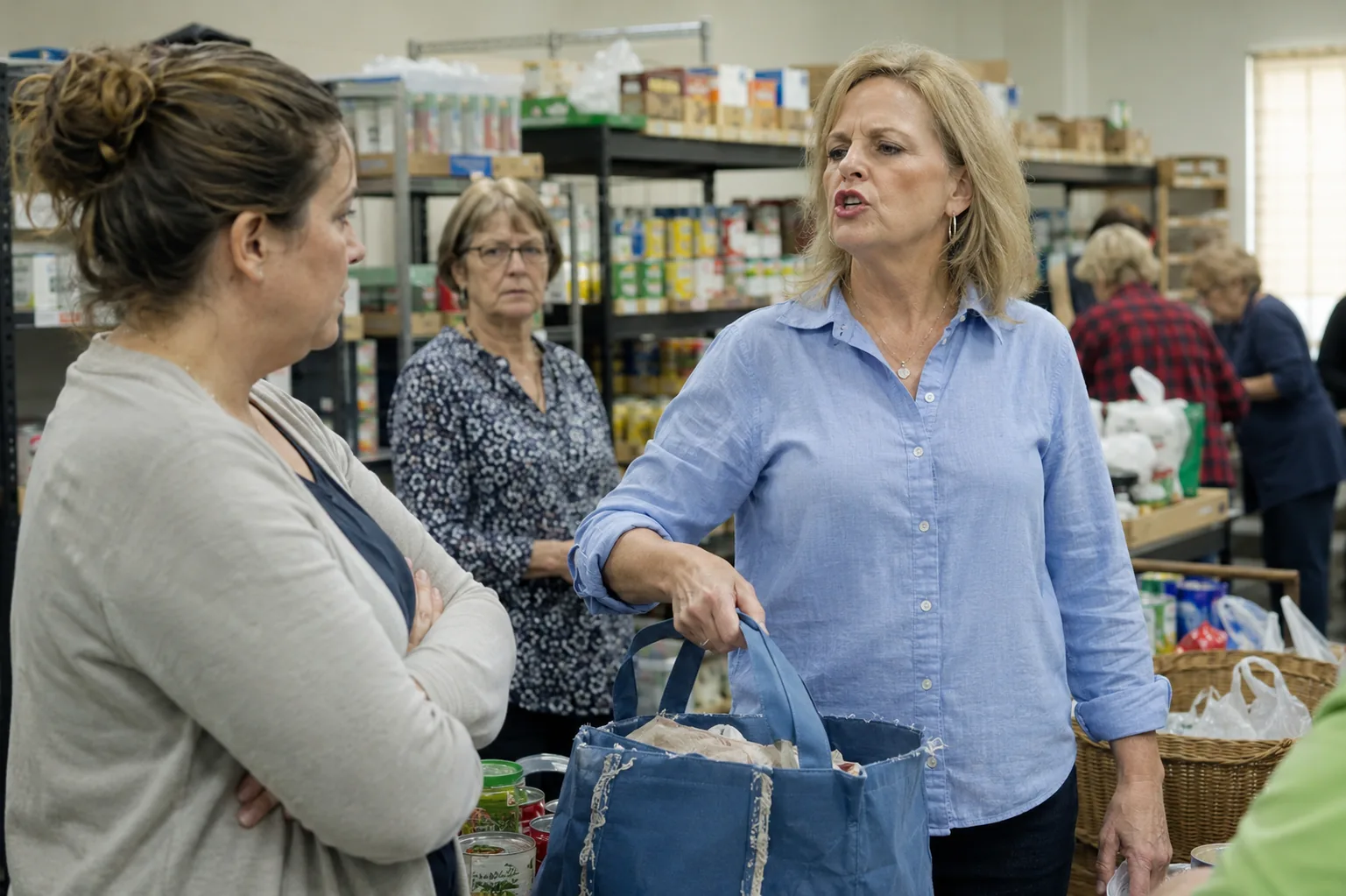
Harvest Table Pantry looked the same as always when I walked in: boxed dry goods waiting by the rear sorting table, a roll of labels drifting near the edge, the volunteer clipboard already half covered in Linda’s handwriting. The blue donation tote sat on the side table by the intake shelves. One frayed handle was folded over itself like even that worn strip of nylon had been made part of the story.
Linda saw me and started before I had set my bag down.
“Glad you made it,” she said. “I need you on intake, and please don’t create confusion over tote handling today.”
There was no hello in it. Just the reminder.
I said, “I’m not handling the tote.”
She gave me a quick look, like she was checking whether that was agreement or resistance. “Good. Then we should be fine.”
That would have been the easy version for her. She keeps the burden, keeps the speech, keeps me inside the frame anyway. I tied my apron, took the clipboard to the rear sorting table, and copied the task list onto the handoff pad by the small office doorway the way volunteers sometimes do when a shift change gets busy.
Under my own name, I added one line: Mara Jensen will not accept instructions or corrections related to Linda Carver’s donation tote; any tote transfer needs to go through the posted task list or Deacon Paul.
That was it. No accusation. No theory. Just the boundary and where the task should go instead.
My hand shook a little while I wrote it, mostly because I knew how small it looked compared to the pressure it was meant to stop. Then I clipped the pad back in place where anyone doing volunteer handoff would naturally see it.
Renee came in carrying two flats of canned beans and read the line while setting them down.
She looked at me. “That’s smart.”
“It’s specific,” I said.
“That too.”
We got to work. For the first half hour, things almost felt normal. I sorted rice, checked dates, and restocked labels. Linda moved around the room with her usual running commentary about how much there was to manage, but she didn’t pull me into it. Every time she passed the blue tote, though, she touched it. Sometimes it was a hand on the zipper. Sometimes a tug on the handle. Always enough to keep it visible.
Then she reached the office doorway and saw the handoff note.
She stopped reading the pad and called my name from across the room. Not loud enough for a scene at the front, but loud enough that everybody in the work area heard it.
“Mara. Come here.”
I walked over. Renee stayed at the sorting table, stacking cans in straight columns. Paul was near the side table with receipts and intake sheets.
Linda tapped the note with one finger. “What is this supposed to mean?”
“It means if the tote needs to be moved or reassigned, it goes through the task list or Paul,” I said.
“You don’t get to write special rules for yourself.”
“I wrote a handoff boundary for one task.”
She pulled the pad off the hook. “This is dramatic.”
“It’s practical.”
Her mouth tightened. She held the pad in one hand and reached back with the other until her fingers found the tote handle behind her. “So now I have to get permission to do the work I’ve always done?”
“No. I said I won’t take directions about the tote from you anymore. If it’s a pantry task, put it on the list or ask Paul to assign it.”
That was when Paul finally stepped closer. He did not rush. He just came to the doorway, looked at the pad, and read the line again.
“This seems clear enough,” he said. “If we’re having confusion over that item, we can route it through the task list.”
Linda turned toward him. “Confusion is being created by this note, not by me handling donations the way I always have.”
Paul kept his voice soft. “Then a written route should reduce confusion, not increase it.”
For a second nobody moved. I could hear a cart rattling near the front shelves and the soft slap of labels being set on cardboard behind me.
Linda said, “Fine. If everyone wants everything written down, let’s write it down.”
She grabbed the clipboard from the wall, flipped to the current task page, and wrote hard enough that I could hear the pen scratch. Then she held it out toward Paul instead of me.
“There,” she said. “Donation tote remains with chair unless chair requests transfer.”
Paul read it. So did I.
She had just put in writing what she had spent two shifts disguising as sacrifice. The burden she said was crushing her was now the one duty she formally refused to release.
Paul didn’t hand the clipboard back right away. He looked from the line she wrote to the tote at her feet, then to the note still in his other hand.
I said, carefully, “Then please add that I am not to be directed on tote handling at all.”
He nodded once. “I can do that.”
Linda’s fingers tightened on the tote handle. She did not let go.
And for the first time, the sequence was not just in my memory. It was sitting in writing on the pantry forms, in her own words, waiting for the next shift to see it.