Story code: ST-000665
Part 2: The Burden of Proof
The monitor went completely black, followed instantly by the blaring, cheerful chime of the operating system rebooting. The man sleeping two computers down jerked awake, muttering a string of curses before burying his face back into his ragged backpack. Mateo stood up, his chair scraping loudly against the linoleum floor. The reference librarian shot him a warning glare over the top of her reading glasses.
He grabbed his phone, the cracked screen biting into his thumb, and walked away from the computer banks. He retreated to a secluded corner of the library smelling intensely of dust and decaying paper, wedging himself into a plastic chair between the humming microfiche machine and a rack of outdated foreign language dictionaries.
His phone battery sat at eighteen percent. The library’s public wifi was a notoriously fragile thread, dropping connection whenever someone in the building opened a high-resolution image. Mateo turned off the wifi, opting to burn through the last megabytes of his throttled cellular data plan.
He opened his social media app. The search bar auto-populated with trending topics. Right at the top, bolded and unignorable, was #JulianGrind.
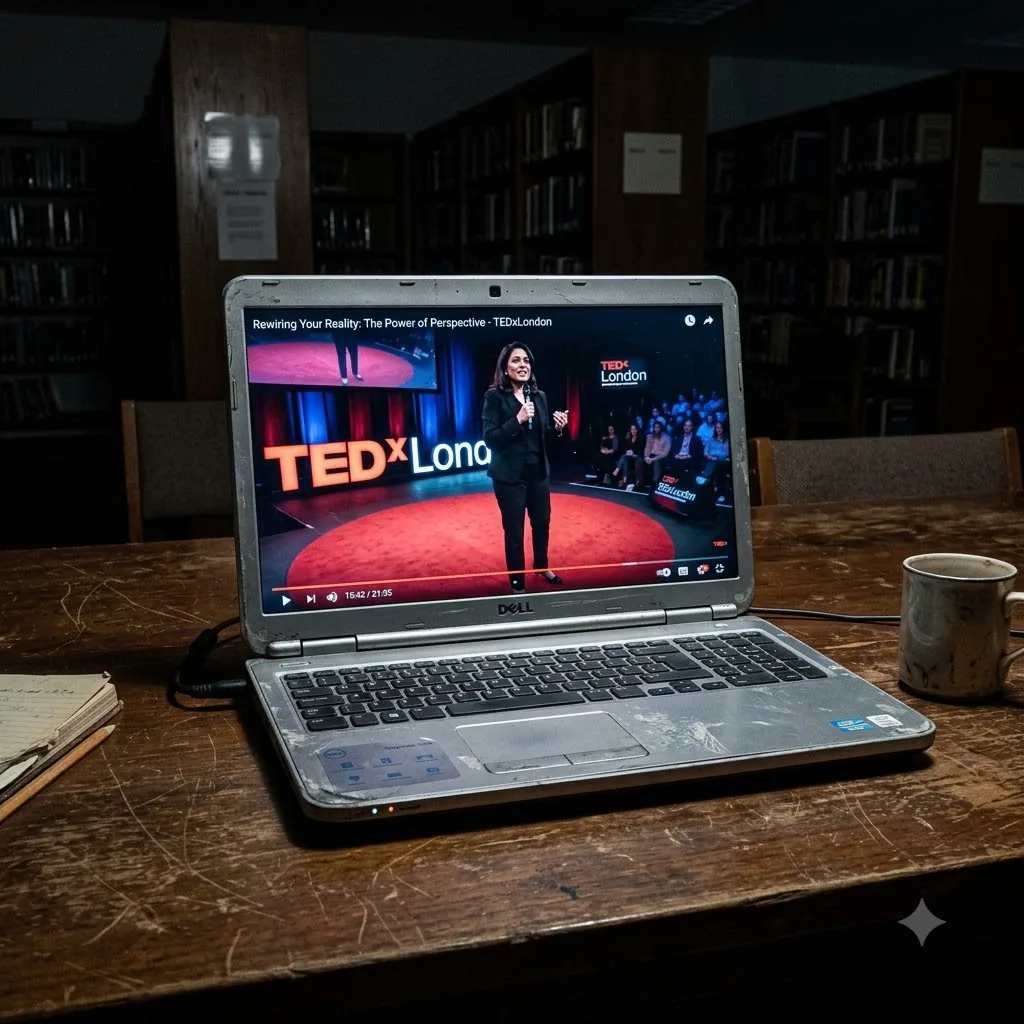
Mateo tapped the hashtag. The feed was a waterfall of praise. Dozens of accounts were sharing screenshots of the TEDx stream, specifically focusing on the doctored photo of his desk. They praised Julian’s grit. They talked about the beauty of the bootstrapping struggle. Venture capitalists and tech influencers were quoting Julian’s platitudes about resilience and ‘earning your keep.’
Mateo’s thumbs hovered over his shattered screen. His chest felt tight, the same familiar panic that used to grip him when the server bills came due and the corporate account was empty. He tapped the compose button.
He uploaded the original, uncropped photo from his archive. The image loaded slowly, the progress bar stuttering. When it finally appeared, the aggressive pink of the electric company’s Final Notice envelopes and the sickly yellow of the foam sleeping pad stood out in harsh contrast to the slick, color-corrected version currently circulating the globe.
Mateo typed his caption carefully, his hands shaking. *Julian didn’t sleep under this desk. I did. Notice the eviction notices and the sleeping pad his PR team photoshopped out. Don’t buy the lie.*
He added the #JulianGrind hashtag. He tagged Julian’s official account. He tagged the TEDx organizers.
He stared at the blue ‘Post’ button. If he pressed it, he was crossing a line. He thought about the three-inch thick severance agreement he had signed in a windowless conference room, surrounded by Julian’s aggressive legal team. He had traded his equity for a payout that barely covered his accumulated debts, gagged by a non-disparagement clause he could not afford to fight.
But they were using his literal poverty as a costume.
Mateo pressed the button.
The app froze for a terrifying three seconds before the post appeared in the feed. Mateo sat in the quiet corner of the library, the microfiche machine vibrating against his shoulder. He watched the screen.
Nothing happened. One minute passed. Then three. The post sat there, buried beneath a relentless avalanche of sycophantic praise for Julian’s keynote. Mateo’s follower count was practically non-existent. He was screaming into a hurricane.
He let his head fall back against the brick wall, closing his eyes. It was useless. He was a ghost trying to haunt a fortress. He was about to lock his phone and walk out into the glaring San Jose afternoon when his device vibrated.
It was a notification. A quote-repost.
Mateo sat up, a sudden spike of adrenaline making his vision swim. He tapped the notification.
A prominent angel investor-a man with three million followers who had just praised Julian’s talk-had shared Mateo’s post.
For one brief, soaring second, Mateo thought he had won. He thought the truth had found its amplifier. Then he read the investor’s comment attached to the share.
*Look at the absolute state of tech entitlement. Disgruntled ex-contractor trying to ruin Julian’s moment with a hilariously bad Photoshop job. Pink envelopes? A yellow foam pad? Did you use MS Paint for this? Next time you try to extort a successful founder, make it look convincing.*
Mateo blinked, the words blurring. He refreshed the app.
The notification icon turned into a red blur, the numbers spinning up so fast the counter glitched. Ten. Fifty. Three hundred.
He tapped into the replies. They were a unified wall of mockery.
*Bro really photoshopped fake bills into the picture.*
*Imagine being this jealous of your former boss.*
*The lighting on that yellow pad is completely off. Fake.*
*Reported for defamation.*
Mateo could not breathe. The internet’s collective reality-distortion field had instantly rejected his truth because it didn’t look as cinematic as Julian’s lie. Julian’s highly edited, color-graded version of the desk looked like a movie set; Mateo’s real, ugly, desperate photo looked like a clumsy manipulation to people raised on aesthetic filters. They were choosing the beautiful fake over the ugly truth.
His phone grew hot in his palm. He tried to reply to a few of the top comments, frantically typing that he had the original file metadata, that they could check the timestamps. His replies were instantly buried under a barrage of clown emojis and accusations of deepfaking.
Then, a new notification cut through the noise. It wasn’t from a random tech influencer.
It was an email. The sender name was Legal@AscendancyPartners.com. Julian’s corporate law firm.
Mateo opened the email, the white background of the message stark against his dark screen.
*Mr. Silva,*
*We are aware of the fraudulent, doctored imagery you have published today in a malicious attempt to damage our client’s reputation. This constitutes a direct and egregious violation of Section 4 (Non-Disparagement) of your severance agreement.*
Mateo’s eyes skipped down the legalese, landing on the bolded text at the bottom.
*You have twenty-four hours to delete the fabricated image and publish the attached retraction and apology. Failure to do so will result in immediate litigation to enforce the $250,000 penalty clause, as well as an injunction against your current web-hosting accounts.*
Mateo swiped down to view the attachment. It was a pre-written apology admitting he had digitally altered the photo out of spite. They wanted him to publicly brand himself a liar.
He minimized the email app and looked at his home screen. The notification bubble on his banking app still read: -$14.50.
His phone battery dropped to fourteen percent. The screen dimmed automatically to save power, casting Mateo’s reflection over the cracked glass. He was entirely alone, boxed into a corner, and Julian had not even had to leave the stage to destroy him.