Story code: ST-000666
Part 2: The Anatomy of Obsolescence
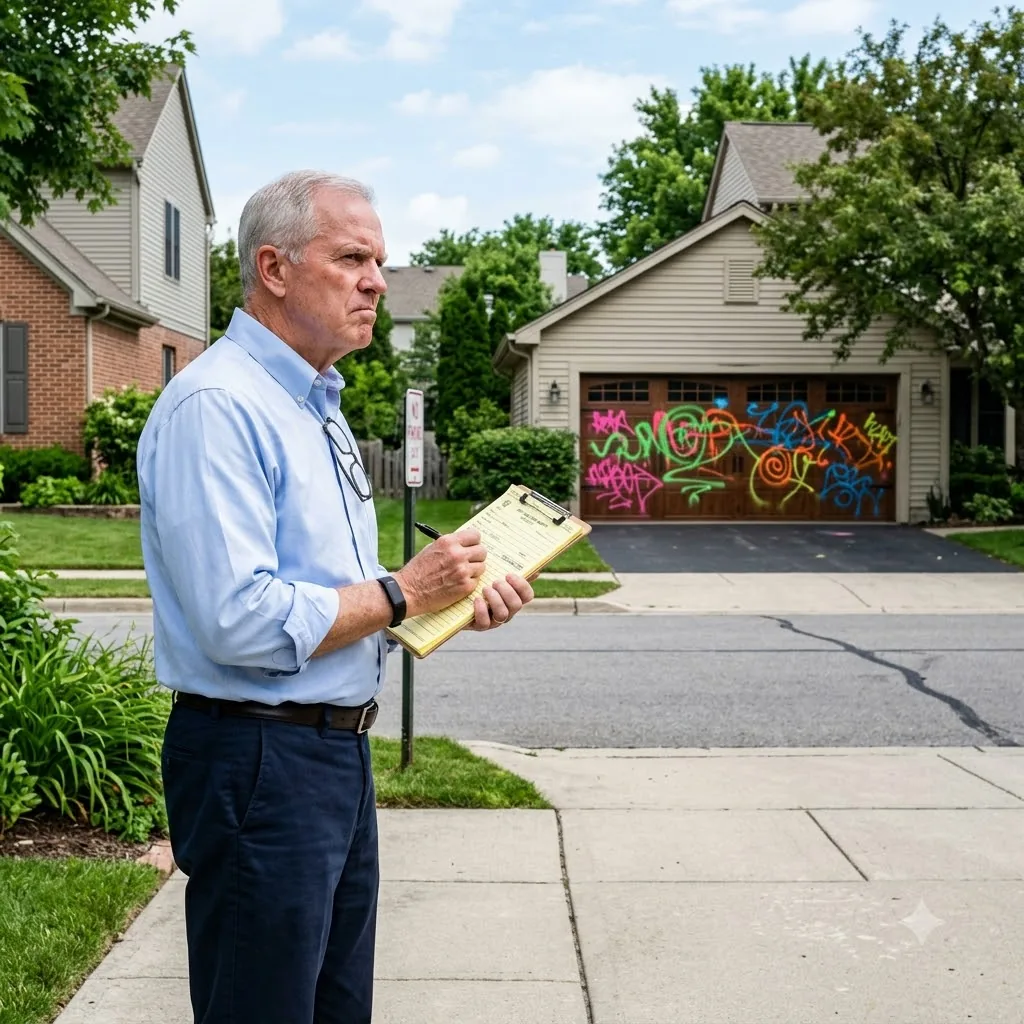
The neon lines were not a random explosion of careless vandalism. As Richard’s eyes tracked the sprawling magenta arcs and the sharp, electric blue angles, the chaotic geometry suddenly snapped into a terrifyingly coherent grid. It was a schematic. Specifically, it was the structural wireframe of the Primary Routing Matrix.
He knew the cascading logic gates by heart. He knew the hexagonal data-node clusters, represented here by towering, dripping blocks of electric blue. It was the digital nervous system he had engineered from scratch twenty-two years ago. It was the intensely private, proprietary architecture that had processed every transaction for the firm, an incredibly dense web of dependencies he had sacrificed his youth, his weekends, and his marriage to balance. He had lived a gray, perfectly regimented life so that those blue nodes could process millions of data points flawlessly in the dark. Now, it was stripped of its dignity, magnified and smeared across a suburban garage door like a grotesque carnival banner.
But it wasn’t just a copy of his life’s work. Violently slashed across the center of his elegant, meticulously balanced matrix was a thick, jagged bypass of toxic yellow paint. The neon line severed his main processing loops, aggressively routing around the blue nodes and leaving them isolated in dead space. It was a flawless, undeniable visual representation of the “redundant synergies” the HR representative had monotone-read to him exactly ninety-four minutes ago.
His raised fist began to tremble. The heavy leather cover of the Master Covenant slipped a fraction of an inch against his sweaty ribs.
Before Richard could command his arm to lower, the heavy oak door unlatched with a sharp click and swung inward.
Miller stood in the doorway. The neighbor was entirely the wrong shape for the man Richard had imagined. He wasn’t a reckless teenager or a disheveled rebel. Miller wore a crisp, expensive cashmere sweater pushed up to his elbows. A heavy, industrial-grade respirator mask hung loosely around his neck. His hands were stained with fresh, electric blue acrylic, but his demeanor was horrifyingly calm. He looked incredibly young, and entirely unbothered by the screaming HOA president frozen on his porch.
Richard’s throat tightened, constricting his vocal cords. He forced his fist down, uncurling his stiff fingers, and instinctively tapped the gold-edged pages of the binder. “Section Four,” Richard rasped. His voice sounded thin, stripped of its usual baritone authority. He swallowed hard, desperately trying to build a firewall between his professional termination and this neighborhood violation. He projected from his diaphragm. “Section Four, Paragraph B, Sub-section Three.”
Miller leaned against the doorjamb, crossing his arms over his chest. He didn’t look at the rulebook. He looked directly at the deep, rigid lines around Richard’s mouth. “Good morning, Richard.”
“You are in direct violation of the mandatory Earth Tone Palette,” Richard stated, gripping the binder with both hands now, holding it like a physical shield against the reality of the toxic yellow line. “This is an unauthorized exterior modification. You have twenty-four hours to prime and paint over this… this defacement, or you will be subject to a two-hundred-dollar initial fine, compounding daily.”
Miller slowly wiped a streak of blue paint from his thumb using a rag pulled from his pocket. “It’s not defacement. It’s a post-mortem.”
Richard’s eyes darted involuntarily back to the massive yellow bypass line. The wet paint caught the morning sun, gleaming with a slick, poisonous vitality. “I don’t care what you call it. It violates the covenant.”
“They published your matrix internally at midnight,” Miller said quietly. The words hit Richard like a physical blow to the sternum, stealing the air from his lungs. “A company-wide memo. A case study in legacy bottlenecks. They called it ‘The Anatomy of Obsolescence.’ I’m the senior deployment lead for Apex Optimization. We’re the vendor they hired to automate your division. We ran the final migration protocol at eight-thirty this morning.”
The crisp morning air suddenly felt devoid of oxygen. The manicured lawns, the perfectly plumb mailboxes, the precisely measured grass-it all faded into a meaningless, out-of-focus blur. The strict boundaries of the neighborhood, the very rules Richard used to define his reality, were disintegrating beneath his polished shoes. The man standing in front of him wasn’t just a neighbor with bad taste in paint. This was the architect of his destruction. Miller was the toxic yellow line.
“When I saw your name on the legacy architecture, and realized you were the same guy who lives quietly across the street, marching to his car at exactly six-fifteen every morning…” Miller paused, turning his head to look back at the sprawling mural. “I couldn’t sleep. I had to see it at scale. I had to see the exact shape of a machine right as it gets thrown away.”
“The covenant,” Richard stammered, pointing a rigid, shaking finger at the leather binder. His voice was rising to a frantic, reedy pitch, desperately clinging to the only system where he still had a title. “The covenant requires pre-approval! You cannot simply bypass-you cannot paint over-”
“The covenant doesn’t matter anymore, Richard,” Miller interrupted, his voice laced with a heavy, suffocating pity that made Richard’s stomach violently churn. “Just like the matrix. The data doesn’t flow through it. The system just routes around it. You can stand there and cite paragraphs at me all day, but the yellow line is already painted.”
A low hum broke the neighborhood’s manufactured silence. A white panel van belonging to the contracted landscaping crew slowly turned the corner. It crept along the curb, slowing to a crawl as it approached Number Forty-Two. The driver’s window was rolled down, and two men in neon safety vests leaned forward, their eyes wide as they stared at the blinding, chaotic schematic on the garage. Then, inevitably, their gaze shifted to Richard.
They didn’t see a Senior Compliance Director. They didn’t see an HOA enforcer. They saw a stiff, graying man in a redundant suit, standing helplessly on a porch, clutching a useless binder as if it could shield him from the neon sign screaming his failure to the entire world.
Richard felt the blood drain completely from his face. The rigid control he had maintained for decades was shattering, turning to dust in his hands.
“I’ll pay your fines,” Miller said softly, stepping backward into the foyer of his house. “Send the invoices to my email. But the paint is a bonded industrial epoxy resin. It cures in four hours. It’s permanent, Richard. It’s not going anywhere unless you tear the whole door down.”
Miller gently shut the heavy oak door. The latch clicked into place with absolute, echoing finality.
Richard stood perfectly still on the woven welcome mat. The chemical rot of the aerosol fumes was nauseating, eating away at the pristine suburban air. The landscaping van idled loudly at the curb, the crew still watching him. The heavy leather binder in his arms felt completely empty, a dead weight. He turned his head slowly, his eyes drawn against his will back to the garage door. The toxic yellow paint of the bypass line was beginning to run in the morning sun, forming thick, slow drips that bled down over the blue nodes of his life’s work, crying bright neon tears onto the immaculate concrete driveway.