Story code: ST-000702
Part 3: Public Record
The fluorescent lights of the municipal council chambers emitted a low, electronic whine that seemed tuned to the exact frequency of Arthur’s pulsing headache. He sat rigidly in the polished wooden pew of the front gallery, his hands folded in his lap. Beside him, Davis exuded the relaxed, practiced confidence of a man billing four hundred dollars an hour. The lawyer’s custom-tailored suit and expensive cologne felt like a protective barrier against the sterile, bureaucratic machinery of the city hall hearing room.
This was the final battleground. The city council’s emergency zoning review would determine whether the developer’s economic hardship claim bypassed the neighborhood association’s injunction. If the council voted yes, the bulldozers would demolish the Oak Street duplexes by Monday. If they voted no, Arthur’s pristine, tree-lined enclave remained untouched.
Arthur pressed his thumb against his index finger, feeling the cold metal of his wedding band. He had forty-five thousand dollars left. His wife was gone. His house was a silent museum. He had sacrificed everything to preserve the exclusive character of his neighborhood, to protect it from the encroaching blight of high-density housing. Today was merely the formality of victory. Davis had assured him that the developer’s track record of “blight management”-the very evictions and car impounds Davis had engineered-would be their silver bullet.
“We just need to maintain the narrative,” Davis whispered, leaning in without taking his eyes off the five council members seated at the raised dais. “You are the concerned citizen protecting historic heritage. The developer is a negligent slumlord bringing chaos to the district. We stick to the script, and we go home.”
Arthur nodded tightly, ignoring the sour taste in his mouth. He hadn’t slept since he saw Maya’s name on the eviction list. He had spent the weekend trying to rationalize it, mentally retreating to the safety of his principles. It was unfortunate, yes. But it was economics. It was the law. You couldn’t halt progress-or in this case, preservation-for one barista’s bad luck.
“The chair recognizes the legal counsel for Oak Street Development,” the council president announced, his voice booming through the PA system.
The developer’s lawyer, a sharp-featured woman in a navy suit, stood up. “Thank you, Mr. President. To address the neighborhood association’s claims regarding community character and local standards, we would like to call a community impact witness. We call Maya Lin.”
Arthur’s stomach plummeted into a terrifying free-fall.
The heavy oak doors at the back of the chamber swung open. Arthur turned, his breath catching in his throat. Maya walked down the center aisle. She was stripped of the crisp green apron and the deferential, polished smile she wore at Café Lumière. She looked exhausted, dressed in a faded gray sweater, her shoulders carrying a heavy, defensive posture. Her eyes were dark, scanning the room before locking onto Arthur.
There was no warmth in her gaze. No recognition of their supposed camaraderie. She looked at him with the cold, assessing stare of a survivor.
Arthur gripped the edge of the wooden pew. His heart hammered violently against his ribs. *How did the developer find her?* he thought in a sudden panic. *What is she doing here?*
Maya took her seat at the witness table, adjusting the microphone. It shrieked with a brief spike of feedback.
“Please state your name and address for the record,” the council clerk droned.
“Maya Lin,” she said. Her voice was slightly raspy, lacking its usual cheerful customer-service cadence. “My address was 42 Oak Street, Apartment 4B. But as of Thursday evening, my address is a blue Honda Civic, license plate JKL-882.”
A murmur rippled through the gallery. Davis shifted in his seat, his pen pausing over his legal pad. Arthur felt a cold sweat prickle the back of his neck.
“Ms. Lin,” the developer’s lawyer said gently. “Where exactly is this vehicle parked?”
“Currently, it is parked on Elmwood Drive,” Maya answered, her eyes drifting away from the lawyer and fixing directly on Arthur’s pale face. “Right beneath the historic gas lamp in front of number 14.”
Arthur stopped breathing. Number 14 Elmwood Drive. His house. His sprawling, empty, multi-million-dollar house. The “unauthorized vehicle” that had been parked on his street for the last three nights-the one he had angrily reported to the non-emergency police line just yesterday morning-was Maya’s bedroom.
“Objection,” Davis barked, standing up. “This is a zoning hearing, not a forum for vehicular vagrancy complaints. The witness’s living situation is irrelevant to the structural impact of the proposed development.”
“It is entirely relevant to the association’s claims regarding ‘neighborhood character’,” the developer’s lawyer shot back.
“I’ll allow it,” the council president said, looking down at Maya with furrowed brows. “Proceed, Ms. Lin. You claim to understand the character of this historic district?”
“I know it intimately,” Maya said into the microphone. She didn’t blink. She held Arthur’s gaze, trapping him in the crosshairs of her humiliation. “I know the street-sweeping schedule for Elmwood Drive better than the residents do. Tuesdays and Thursdays on the north side between two and four a.m. Mondays and Wednesdays on the south side. I know this because if I don’t wake up at 1:45 a.m. to move my home, Mr. Davis’s private security patrols will call the city to impound my life.”
The silence in the council chambers was absolute, heavy and suffocating. Arthur wanted to shrink into the floorboards. He could feel the eyes of the council members shifting toward him, weighing the pristine elegance of his tailored suit against the stark reality of the woman sitting at the table.
“The neighborhood association claims that building affordable housing on Oak Street will bring in people who don’t respect the community’s premium standards,” Maya continued, her voice rising in volume, echoing off the wood-paneled walls. “People who are a nuisance. People who ruin the atmosphere. But I’ve been serving the head of the neighborhood association his morning coffee for three years. I know his standards.”
Davis grabbed Arthur’s forearm, squeezing hard. “Don’t react,” Davis hissed barely above a whisper. “Look straight ahead.”
Arthur couldn’t move. He was paralyzed, watching the very foundation of his pristine life being dismantled on public record.
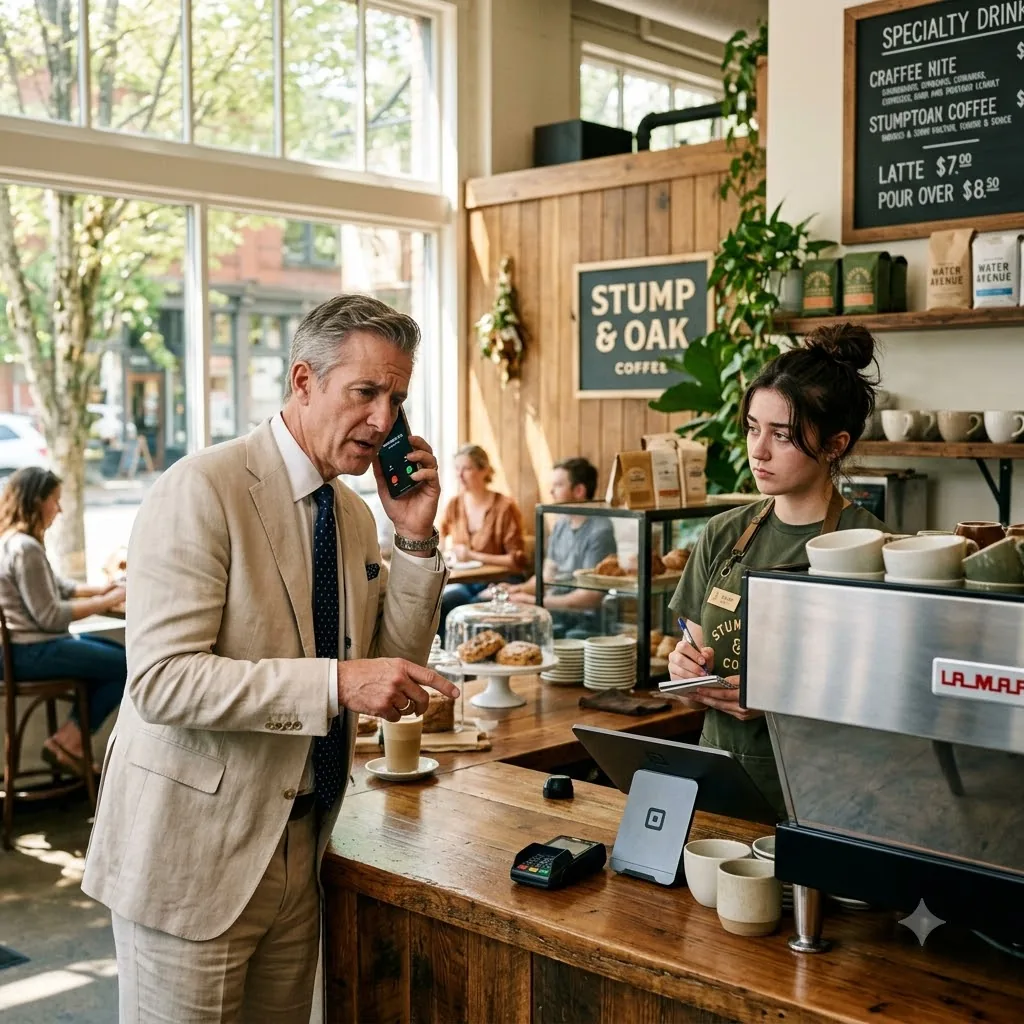
“A flat white,” Maya recited methodically, her voice dripping with venom. “Extra hot. Served in a warmed ceramic mug, never paper. He tips exactly fifteen percent, rounded to the nearest quarter. He likes to joke about the local politicians and talk about meritocracy while I wipe down the steam wand.”
She leaned forward, her knuckles white where she gripped the edges of the witness table.
“He stood in front of me on Thursday morning, drinking the coffee I made him, and told me that we all have our battles,” Maya said, the raw emotion finally cracking her composure, though it only made her words sharper. “Then he turned his back, walked out the door, and paid the lawyer sitting next to him to make sure I lost my apartment.”
The council president stared. The developer’s lawyer stepped back, letting the silence ring. Every camera in the local press row was pointed squarely at Arthur.
Arthur sat frozen under the fluorescent lights, the air completely trapped in his lungs, utterly unable to formulate a single word in defense of the sanctuary he had burned his life to the ground to protect.