Story code: ST-000730
Part 2: Algorithmic Restructuring
The plain white dialogue box contained a single line of unformatted black text: *ACCESS DENIED. CREDENTIALS INACTIVE. ERROR CODE 89-A: AUTOMATED ROLE ELIMINATION.*
David blinked. He moved his mouse, clicking the small ‘X’ in the corner of the box. The window vanished, but the corporate intranet login screen remained grayed out. He retyped his password, striking the mechanical keys with a heavier, sharper rhythm. He hit enter.
The same white box flared onto the screen.
He pulled his company-issued smartphone from his pajama pocket. The screen lit up with a cascade of silent push notifications. *Email account disconnected. Calendar access revoked. Internal messaging client logged out.* At the top of the stack sat a single automated text message from an unassigned shortcode: *Your position has been identified for algorithmic restructuring. Severance details have been dispatched to your personal email address. Please return all hardware within three business days. Thank you for your service.*
David stared at the glowing rectangle. The ergonomic mesh chair suddenly felt stiff and confining. Twelve years. He had spent twelve years feeding data into the company’s predictive models, pruning inefficiencies from the global supply chain, and celebrating when the quarterly metrics showed a fraction of a percent increase in automated throughput. He had built the very logic loops that just evaluated him. There was no meeting with a regional manager. No awkward, apologetic conversation with Human Resources. The algorithm ran its overnight diagnostic, identified his salary as a statistical inefficiency, and cleanly excised him from the network.
He was a fixed cost. He had been optimized.
A cold sweat broke out across his collarbones. He thought of Elena, asleep in the dark bedroom down the hall, her legs bruised from physically keeping human beings alive. Her job was messy, biological, and desperately real. His job was numbers. And the numbers had just decided he was obsolete.
Panic, tight and hot, coiled in his chest. The walls of his perfectly organized office seemed to inch inward. The silence of the house was deafening. He needed to exert control. He needed to complete a tangible task, to fix a variable, to prove he still fit into a functional system.
His hand dropped to his pocket, his fingers brushing the crisp paper of the yellow HOA citation. The four point two inches. He could fix that immediately. He could move the Honda Civic perfectly within the lateral boundary line. It was a rule he could actually follow.
David stood up so fast his chair rolled backward and bounced off the baseboard. He marched down the hallway, grabbed Elena’s spare key fob from the ceramic bowl by the door, and stepped back out into the damp morning air.
The quiet of the neighborhood was already shattered by the grinding, rhythmic beep of a heavy vehicle in reverse.
A massive white flatbed tow truck was backing slowly into the cul-de-sac, angling its rear tires toward David’s driveway.
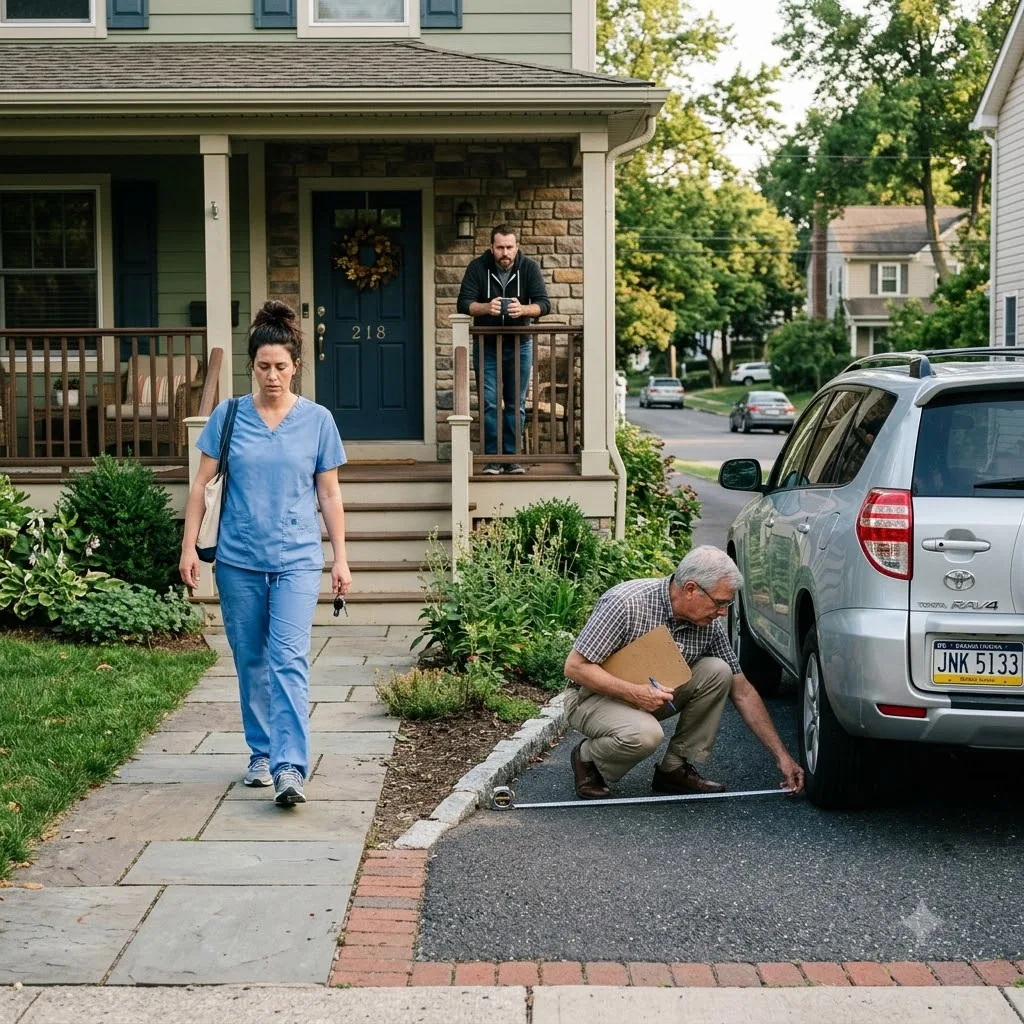
Gary stood on the damp grass near the property line, his aluminum clipboard pressed against his neon yellow safety vest. He was using a bright orange plastic wand to guide the tow truck driver closer to Elena’s bumper.
“Whoa!” David yelled, sprinting down the concrete front steps. “Hey! Stop!”
The tow truck’s air brakes hissed, the heavy diesel engine idling with a bone-rattling rumble. Gary lowered the orange wand and adjusted his wire-rimmed glasses, looking at David with a mask of mild, bureaucratic disappointment.
“Gary, what are you doing?” David demanded, his voice cracking over the sound of the engine. He stepped directly between the flatbed’s heavy steel ramp and the hood of the Civic.
“I am following up on a documented infraction, David,” Gary said smoothly. He tapped a manicured fingernail against his clipboard. “Section Four, Paragraph B. Subsection Three clearly states that any vehicle obstructing the communal sightlines or violating property demarcations must be rectified to maintain standards.”
“You just gave me the ticket twenty minutes ago!” David shouted, gesturing wildly at his own pajama pocket. “You gave me fourteen days to pay it!”
“Fourteen days to remit the financial penalty, yes,” Gary corrected, his tone adopting the patient, condescending cadence of a teacher explaining basic division. “However, the physical violation remains active. You did not move the vehicle. Therefore, it constitutes a rolling hazard. I am obligated to escalate.”
David felt a dangerous, unfamiliar pressure building behind his eyes. The panic over his termination collided violently with the absurdity of the metal ruler. “My wife just got off a fourteen-hour shift in the ICU, Gary. She is exhausted. I came out here to move the car right now.”
“The timeline has already lapsed,” Gary said, checking his heavy stainless-steel wristwatch. “Once a citation is logged in the HOA digital portal, the system automatically dispatches the contracted towing service if the vehicle hasn’t been re-registered as compliant within fifteen minutes. It’s a new protocol we voted in last month to increase neighborhood efficiency.”
The word *efficiency* struck David like a physical blow.
“Cancel it,” David said, his voice dropping to a low, trembling register.
“I can’t,” Gary sighed, looking genuinely helpless, though a smug shadow played at the corner of his mouth. “The system is fully automated now, David. It takes the human error out of neighborhood management. Once the truck is dispatched, the fee is locked in. Two hundred and fifty dollars for the hook-up, plus impound. If I override it, the HOA absorbs the cost. The algorithm won’t allow me to justify that to the board.”
The tow truck driver, a broad-shouldered man in a grease-stained hoodie, leaned out of his cab window. “Hey! Am I taking this Honda or what? I got three more calls in this subdivision.”
David looked at the heavy steel chains dangling from the flatbed. He pictured Elena waking up, physically broken from saving lives, only to find her car stolen by a spreadsheet. He pictured his own automated termination notice sitting on his frozen computer screen.
His lifelong belief in the perfection of systems, in the absolute righteousness of metrics, fractured irreparably.
“No,” David said. He crossed his arms and planted his feet firmly on the asphalt, his slippers digging into the exact four point two inches of driveway that supposedly threatened the entire order of the world.
Gary frowned, clicking his red pen with a sharp, warning snap. “David, step aside. You are interfering with an authorized vendor. That’s a Class A violation.”
“I’m not moving,” David said, his heart hammering a frantic, erratic rhythm against his ribs. “And neither is this car.”