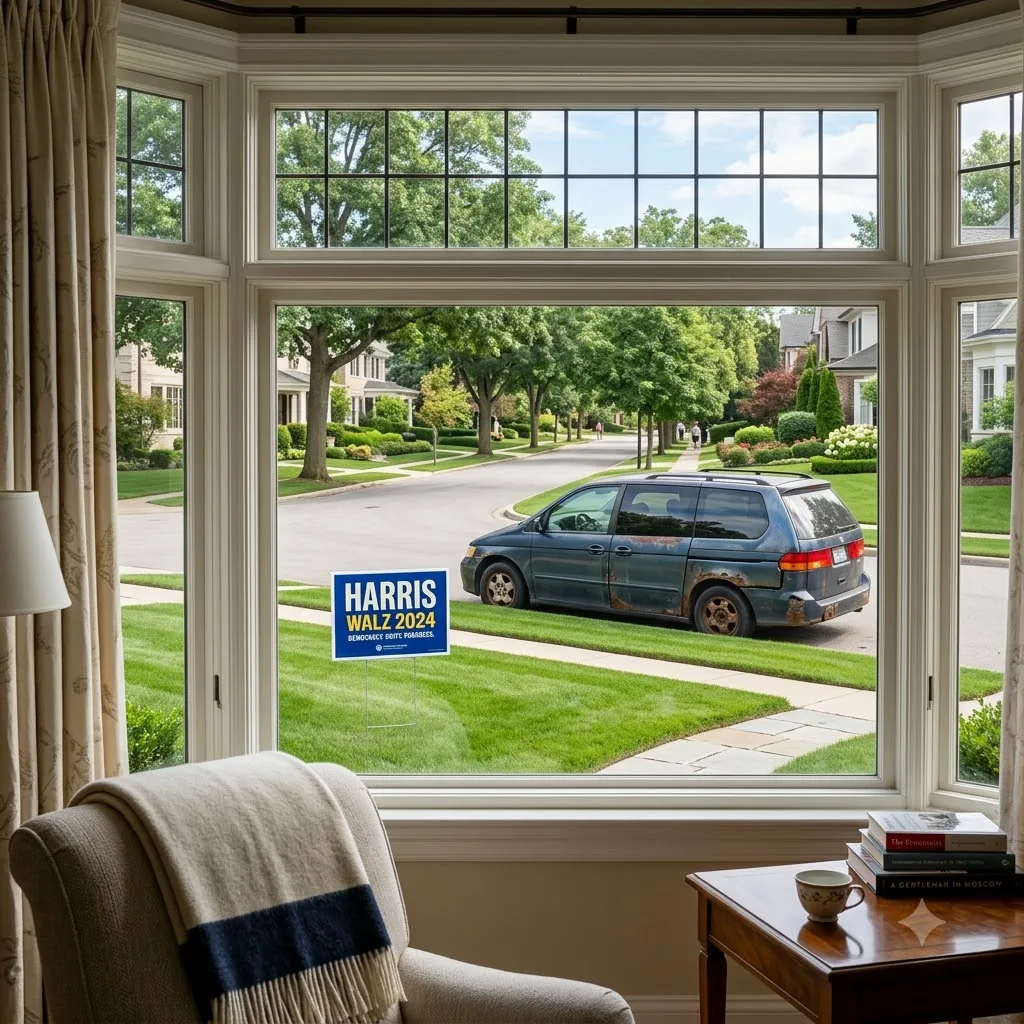
Story code: ST-000741
Part 2: The Proper Channels
The metal door slid violently open on its track, hitting the rear stopper with a deafening bang that echoed down the quiet suburban street. Elaine flinched, instinctively taking a half-step back from her living room window. From the dark, gaping maw of the Odyssey’s interior, an avalanche of sheer desperation spilled out onto the immaculate asphalt of Elmwood Avenue. Black plastic trash bags, a cracked blue Coleman cooler, and a tangled heap of cheap silver thermal blankets tumbled out in a chaotic cascade.
The two officers reacted instantly. The taller one shoved himself backward, creating distance, while his hand snapped down to his hip. The sharp, heavy metallic snick of a firearm being unholstered cut through the crisp autumn air.
Elaine’s breath hitched in her throat. She hurried into her grand foyer, her fingers trembling slightly as she grasped the heavy brass handle of her front door. She pulled it open just a crack, letting the freezing, biting wind sweep into her warm, perfectly climate-controlled home. She needed to hear. She needed to know that the authorities were managing the situation cleanly.
“Show me your hands! Step out of the vehicle right now!” the taller officer roared. His voice was stripped of the calm, professional detachment Elaine had observed moments ago. It was raw, aggressive, and thrumming with adrenaline.
A figure slowly emerged from the shadowy interior of the van. It was a young woman, perhaps in her early twenties, drowning in three layers of oversized, frayed wool sweaters. Her hair was matted, her face pale and streaked with dirt. She was hyperventilating, her narrow chest heaving, and she was clutching a large, dark, tightly bound bundle fiercely against her collarbone.
“I wasn’t doing anything!” the young woman screamed, her voice cracking with sheer panic. “I’m just resting! Please!”
“Drop whatever is in your hands and get on the ground!” the second officer barked, moving laterally to flank her, his own weapon drawn and leveled at her chest.
Elaine gripped the edge of her oak door, her manicured nails digging into the wood. This was not supposed to happen. She had called a non-emergency number to arrange a quiet, bureaucratic towing of an abandoned eyesore. She had expected a ticket, a polite tap on the window, and a sheepish driver moving along. She had not ordered a violent armed standoff in front of her prize-winning hydrangeas.
The young woman froze, paralyzed by the shouting and the guns, entirely unable to process the conflicting commands to drop her belongings and get on the ground simultaneously. The second officer didn’t wait for her to figure it out. He lunged forward, grabbing her violently by the shoulder of her thick sweater. With a brutal, twisting motion, he yanked her away from the open door and slammed her face-first into the exterior of the Odyssey.
The rusted metal panel groaned sickeningly under the impact. The bundle the woman had been holding was dislodged by the force, dropping to the pavement with a heavy thud. It wasn’t a weapon. It wasn’t contraband. The oversized canvas duffel bag burst open upon hitting the ground, vomiting a tragic array of mundane survival items into the gutter: cheap packets of dried ramen, a plastic first-aid kit, rolls of toilet paper, and a stack of heavily dog-eared paperback books.
“Stop! What the hell are you doing?!” a new voice bellowed down the street.
Elaine’s head snapped to the right. Marcus, the endlessly irritating housing advocate, had abandoned his route. He dropped his massive stack of neon-green flyers. The crisp wind caught them immediately, sending dozens of bright, aggressive papers fluttering like fluorescent autumn leaves across the pristine, manicured lawns of Elmwood Avenue, blanketing Elaine’s ‘In This House We Believe’ sign.
Marcus sprinted across the grass, waving his arms frantically. “She’s not doing anything! I told her she could park here! She’s with me!”
Elaine’s mind raced, a cold shock washing over her. Marcus had told her to park there? This wasn’t a random transient. This was a deliberate, calculated stunt by the housing advocate to bring his miserable poverty crusade directly into their sanctuary, using this wretched girl as a prop.
“Get back on the sidewalk!” the taller officer screamed, pivoting his stance and aiming his sidearm directly at Marcus’s chest. “Stand down!”
Marcus didn’t stop fast enough. He was too angry, too entirely convinced of his own moral righteousness. He took one step off the curb and onto the street. The taller officer didn’t hesitate. He holstered his firearm in a flash, drew his heavy baton, and charged. He struck Marcus behind the knee, collapsing the advocate instantly. As Marcus hit the pavement, the officer drove a knee viciously into his back, pinning him to the asphalt and wrenching his arms behind him with terrifying speed.
The neighborhood’s quiet sanctity was entirely obliterated. The air was suddenly filled with the wailing sirens of arriving backup. Two more police cruisers tore around the corner of Elmwood, their tires squealing in protest. One of the cars misjudged the narrow street, its heavy tires jumping the curb and tearing deep, muddy trenches through the Millers’ perfectly edged sod before slamming to a halt.
The state response was overwhelmingly, horrifically disproportionate. Four more officers poured out of the new cruisers, swarming the scene. They yanked the young woman up from the side of the van, aggressively slapping heavy steel handcuffs onto her wrists while she sobbed hysterically. Marcus was similarly bound, his cheek pressed flat against the cold, hard street.
Elaine felt a sickening twist of nausea in her stomach. She watched as two of the new officers climbed into the back of the Odyssey and began viciously tearing it apart. They threw sleeping bags, a small propane stove, and clothing out into the street, treating the young woman’s entire life like hazardous waste. The sheer scale of the violence, the absolute destruction of her neighborhood’s peace, was dizzying.
Through the flashing strobe of red and blue lights bouncing off the facades of the million-dollar homes, Elaine saw the taller officer standing over Marcus. The officer reached down, ripped one of the neon-green flyers from Marcus’s jacket pocket, and read it. He then grabbed his radio, speaking rapidly into the microphone.
A moment later, the officer looked up. He scanned the houses, his eyes tracking past the Millers’ ruined lawn. He locked eyes with Elaine, standing in the narrow crack of her doorway.
He pointed a thick, leather-gloved finger directly at her house, said something to the heavily armed sergeant beside him, and began marching purposefully across the street, right toward Elaine’s front porch.