Story code: ST-000743
Part 2: The Silent Trap
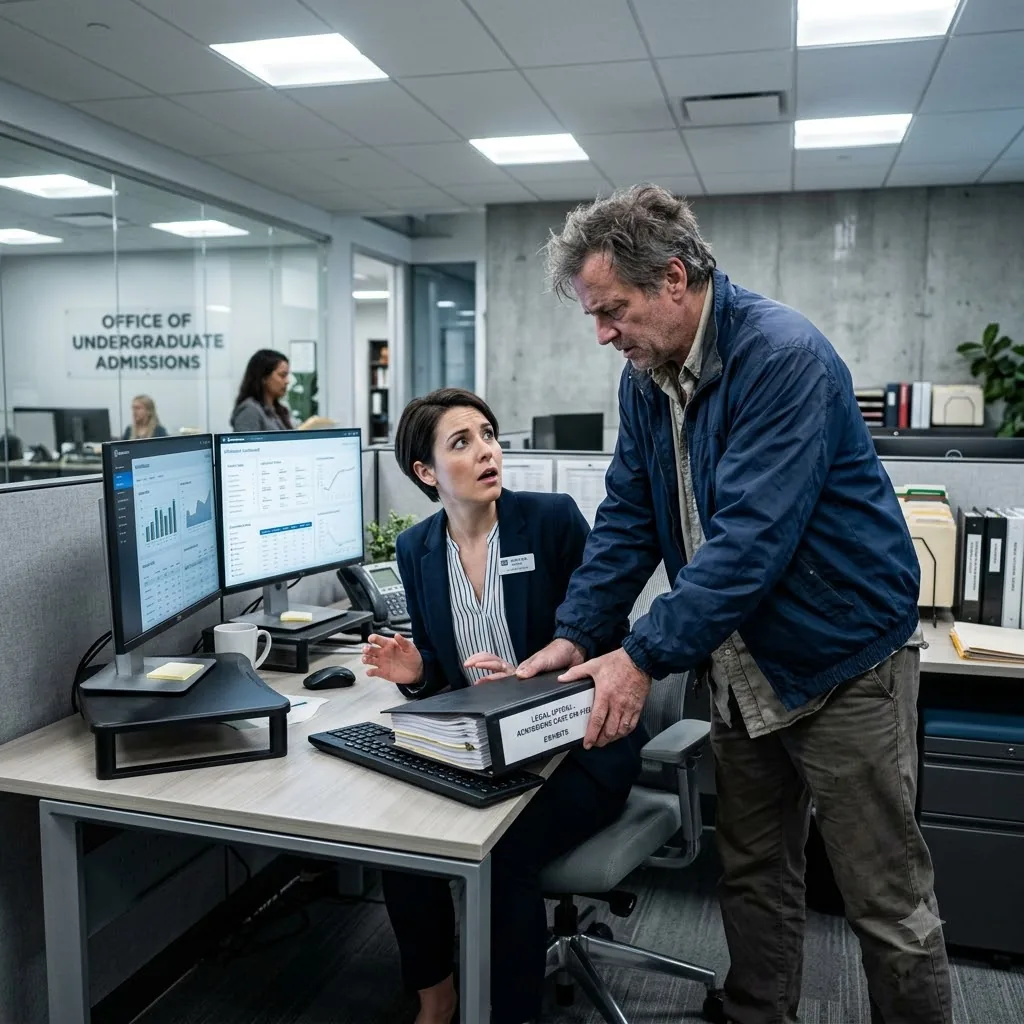
His grip was like an industrial vice. Rough calluses scraped against the soft skin of Elena’s inner wrist. He didn’t twist or pull her arm; he merely held it in place, an immovable physical barrier between her fingers and the silent alarm recessed beneath the desktop. Elena’s breath hitched in her throat, her heart hammering against her ribs so violently she felt the pulse in her teeth. In five years at the admissions department, her greatest physical hazard had been eye strain from the harsh blue light of dual monitors. Now, the scent of damp wool and stale panic filled her lungs.
He told her, in that same terrifyingly even rasp, not to press the button. He stated he had spent the last three months mapping the administrative wing, pulling public blueprints and vendor installation logs for the building’s security system. He knew the button would lock down the corridor and immediately summon the campus police. He said he would gladly let them come, but only after she looked at the proof. Slowly, deliberately, he uncurled his fingers and released her wrist. A faint red imprint remained on her pale skin. Elena pulled her arm back, pressing it tightly against her chest, her hands shaking uncontrollably.
He turned back to the massive binder. The metal rings gleamed under the fluorescent overhead lights as he flipped past the first thick block of tabs. He stopped at a section marked with a bright yellow divider and flattened the pages with his heavy palm. He ordered her to look at page forty-seven. Elena kept her eyes locked on his chest, terrified that breaking eye contact or acknowledging the paper would somehow validate his violent intrusion.
He tapped the page sharply, the sound like a gunshot in the small, sterile room. He read the header aloud: Proprietary Risk Matrix, Sub-Routine Delta. He asked her if she recognized the terminology.
Against her institutional training, Elena let her gaze drop to the page. It was a printed spreadsheet, dense with thousands of rows of data. But the column headers were not the sanitized, grayed-out sub-metrics she saw on her screen every day. They were raw, unfiltered categories. Zip Code Median Income. Parental Debt-to-Asset Ratio. Uninsured Medical Liability Flag. And there, in the final column, was the exact red confidence badge she clicked on three hundred times a shift.
He pointed a thick, trembling finger at a highlighted row. He told her that was David. He stated his son had a perfect grade point average, but the algorithm had flagged him because the family had taken out a second mortgage to pay for his mother’s chemotherapy. The software didn’t see a dedicated student overcoming adversity; it calculated a statistical probability of tuition default. The black box had categorized his wife’s illness as an unacceptable financial liability, and Elena had blindly rubber-stamped the denial.
A cold sweat broke out across the back of Elena’s neck. The university had repeatedly sworn in departmental meetings that the software was strictly socio-economically blind. The legal department had distributed memos to that effect. But the spreadsheet laid bare a deeply cynical proxy system. It was filtering out desperation under the guise of academic risk.
Before Elena could formulate a response, a crisp, subtle chime broke the heavy silence.
It came from her secondary monitor, positioned just to the right of the crushed laptop. The screen woke from its idle state, displaying the university’s internal emergency messaging system. A priority broadcast window had popped open, overriding her email client. The message was from Marcus Vance, the Vice President of Administration.
*Elena. Do not react to this message. Campus security camera feeds show an unauthorized male in your office. We have initiated a silent perimeter lockdown. Do not hit your panic button; it will trigger the audible alarms and may provoke him. Keep him talking. Keep him agitated. The microphone on your desktop webcam has been activated remotely. We are recording everything.*
Elena stared at the crisp black text on the white background. A second message materialized just below the first.
*Legal is monitoring the audio. Let him make threats. The more he incriminates himself on tape, the easier it will be to secure a permanent restraining order and seal his fabricated documents under a workplace violence injunction. Do not validate his paperwork. Police are staging in the stairwell. Keep him going.*
The air in the room suddenly felt impossibly thin. Elena looked from the glowing monitor back to the father. He hadn’t noticed the screen; his bloodshot eyes were still locked on the open binder, his chest heaving as he prepared to turn to the next tab.
He was falling into a trap. The university didn’t care about Elena’s immediate safety. Marcus was intentionally delaying the police intervention to gather enough audio evidence to destroy the man’s credibility. They were deliberately letting a grieving, desperate father rant and rave, capturing every raised voice and aggressive physical gesture. They were going to frame his lawsuit not as legitimate legal discovery, but as the paranoid manifesto of a violent stalker. The algorithmic shield wouldn’t need to hold up in a civil courtroom if the plaintiff was sitting in a jail cell for terrorizing a female employee.
The man leaned closer across the desk, his voice rising in volume, echoing sharply off the frosted glass of her office door. He declared that he was going to tear the entire admissions department down to the foundation. He shouted that the administration was going to pay for what they did to David, that he would not rest until every single person responsible for the software was ruined.
On the bezel of her secondary monitor, a small red dot blinked steadily next to the webcam lens, dutifully capturing every damning, out-of-context word.
Elena rubbed her bruised wrist. She looked at the spreadsheet on her desk, the undeniable proof of the university’s mechanical cruelty. The man was committing financial suicide to expose the truth, completely unaware that his raw, unfiltered grief was currently being packaged into the perfect weapon to silence him. If she sat quietly and played the victim, as Marcus ordered, she would keep her job, her pension, and her sanitized life. The police would burst in, the man would be arrested, and the black box would continue its silent massacre.
The man slammed his hand on the desk again, demanding to know if she was even listening to him. He demanded she read the next page, his voice cracking with a dangerous, unpredictable edge. The red dot on the camera blinked, waiting for her to push him over the edge.