Story code: ST-000793
Part 2: The Contagion Protocol
The heavy knock echoed a second time, louder and more desperate. Arthur tightened his grip on the cold iron poker, keeping it carefully concealed behind his right leg as he reached for the brass deadbolt with his free hand. He threw the latch and pulled the door inward, his muscles coiled, fully bracing for a rush of violence.
Instead, only the wind howled through the gap, driving a sheet of freezing rain across the wooden threshold. The young woman from the driveway stood on his porch, shivering so violently her teeth audibly clicked together. Her thin denim jacket was entirely soaked through, clinging to her narrow shoulders, and her dark hair was plastered flat against her pale cheeks.
“Arthur?” she asked. Her voice was thin and raw, barely audible over the relentless drumming of the rain on the tin roof.
He didn’t move. He didn’t invite her out of the storm. “Who are you?”
She wrapped her arms tightly around her ribs. “My name is Maya. I… I work at the regional data compliance hub in the city. I’m the one who processed the order.”
Arthur frowned, his grip on the heavy iron poker slipping slightly as a cold sweat formed on his palm. “What order?”
“The order to erase you,” Maya whispered, her eyes darting nervously over her shoulder, scanning the empty, rain-slicked driveway. “Please. Let me in. I think they tracked my car’s navigation before I could rip the battery out.”
Arthur hesitated, studying her terrified, wide-eyed expression. He took a deliberate step backward, pulling the door open just enough for her to pass. Maya hurried inside, leaving a trail of muddy water across the braided rug. Arthur shoved the heavy oak door shut, engaged the deadbolt, and finally leaned the poker against the stone hearth.
Maya stood in the center of the small living room, staring at the thousands of books lining the walls, the crackling fire, and the heavy manual typewriter sitting on his cluttered desk. “You really live like this,” she murmured, a strange mix of profound relief and creeping horror in her voice. “No local network. No smart devices. No digital footprint.”
“I prefer the quiet,” Arthur said, his voice hard and uncompromising. “You said you erased me. I want to know why my card was declined at the diner this morning, and why my publisher’s phone line threatened me with a lawsuit.”
Maya reached into her soaking wet pocket and pulled out a sleek, rectangular phone. The screen was cracked and entirely dead. “This morning, a Tier One containment protocol came across my terminal. It’s an automated system routine usually reserved for neutralizing massive corporate data leaks or international financial fraud. It systematically scrubs a target’s financial access, invalidates their legal identification, and severs all known network ties. It forces third-party systems-like your publisher’s automated switchboard and your bank’s routing servers-to firewall you instantly, or risk crippling institutional fines.”
Arthur stared at her. The technical jargon felt like a foreign language, but the terrifying reality of his morning suddenly snapped into a cold, mechanical focus. “Why would a computer do that to me? I don’t even own a computer. I write mystery novels. On paper.”
“That’s exactly why I drove all the way out here,” Maya said, stepping closer to the warmth of the fireplace. “A Tier One protocol doesn’t target human beings. It targets digital contagion. But the algorithm flagged your name, Arthur. It flagged a specific string of text from a document digitized by your publisher’s mailroom yesterday afternoon.”
Arthur felt the bottom drop out of his stomach. His new manuscript. He had mailed the final four hundred pages to Martin, his editor, just five days ago. It was a fictional thriller about a rural land dispute. He had made up every single town, every single character.
“What words did it flag?” Arthur demanded, stepping toward her.
“I don’t know!” Maya said, shrinking back slightly. “The file was automatically encrypted and permanently deleted before I could even authorize the read-receipt. But the system didn’t just delete the file. It designated your physical address as Ground Zero. It categorized you as a biological threat vector.”
“A what?”
“It thinks you’re a virus, Arthur,” Maya said, her eyes welling with genuine panic. “It categorized your manuscript as a literal infection that needs to be quarantined. And because I hesitated at my terminal for three minutes before confirming the purge… it flagged me as compromised, too.”
Arthur paced toward the kitchen, running a rough hand through his graying hair. This was utter madness. A technical glitch of catastrophic proportions. He turned and looked at his desk. Sitting neatly next to his typewriter was a thick, bound stack of paper. The carbon copy of his manuscript.
Maya followed his gaze. She saw the stack of paper and stumbled backward, bumping into the couch as if the desk were highly radioactive. “Is that the source text? Is that the copy?”
“It’s just a story,” Arthur snapped, moving toward his rotary phone. He snatched the heavy black receiver off the cradle, praying for the familiar hum of the operator. The same dead, shrill dial tone mocked him.
“We need to drive to the sheriff’s station,” Arthur said, slamming the phone down. “We’ll take my truck. It has a carburetor and a spark plug. No computers.”
“You aren’t listening to me,” Maya pleaded, her voice dropping to a trembling whisper. “My debit card stopped working at a gas station twenty miles away. My phone lost all service ten miles ago. The quarantine zone is actively expanding. And when a Tier One protocol fails to contain a threat digitally… it issues a physical remediation ticket to private contractors.”
Arthur froze, his hand still resting on the plastic shell of the phone. “What does that mean?”
Before Maya could answer, a sharp, metallic *crack* echoed from the driveway, cutting cleanly through the sound of the rain.
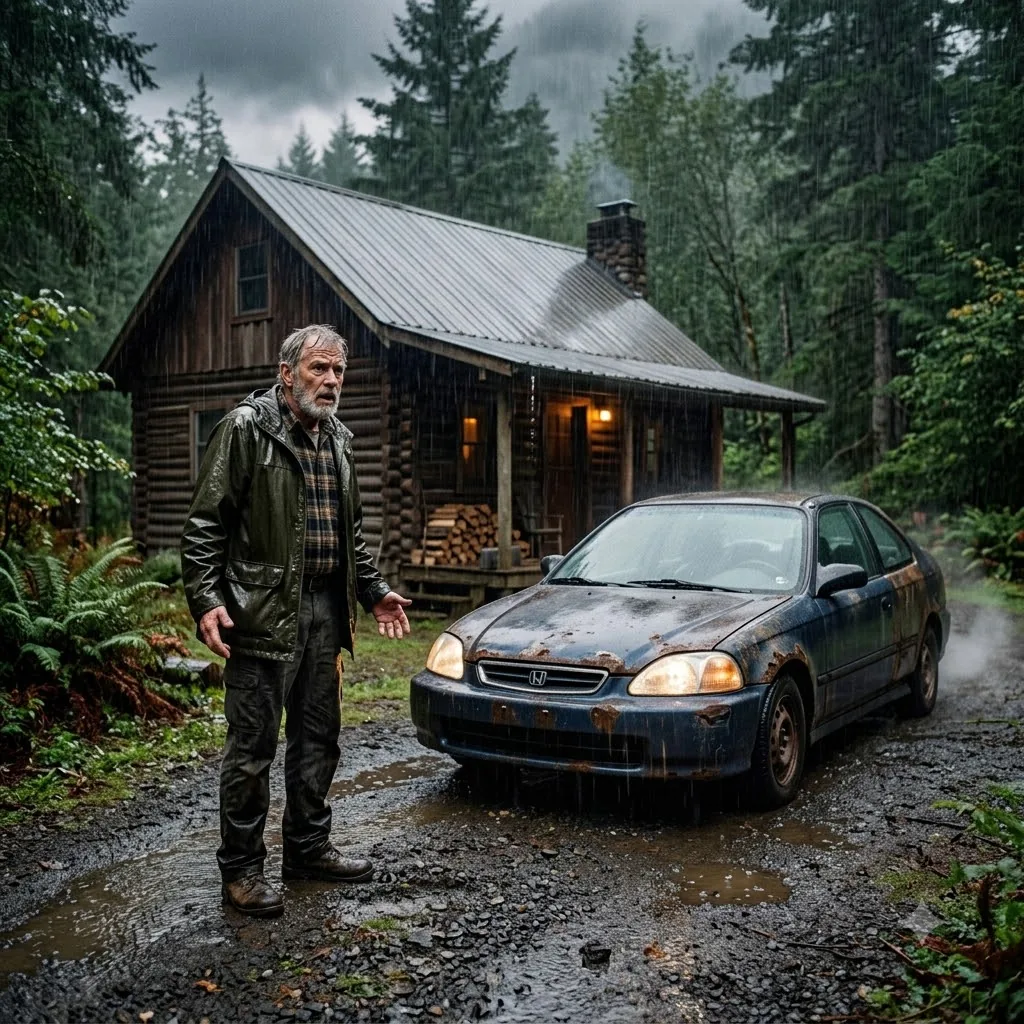
Arthur lunged toward the window, dragging the heavy wool curtain back an inch. Through the distorted, rain-streaked glass, he watched Maya’s rusted Honda Civic slump violently to the left. The front driver’s side tire had been completely blown out.
A second *crack* whipped through the air. The rear tire hissed and flattened, dropping the chassis onto the wet gravel.
Arthur’s breath caught in his throat. He looked past the disabled car, staring into the dense tree line at the edge of his property. The woods were usually a wall of impenetrable blackness in this weather. But now, three distinct beams of harsh, tactical white light were cutting through the pines, sweeping silently and deliberately toward the front porch of his cabin.