Story code: ST-000806
Part 2: The High-Risk Premium
The guard’s palm rested firmly against the varnished oak doorframe. His name tag read *Marcus*, and his heavy duty belt creaked as he shifted his weight. He looked more tired than intimidating, a working-class guy just trying to make it to the end of his shift.
“Sir, you need an appointment to go in there,” Marcus said, his voice a low rumble. “You know I can’t let you through.”
Leo stopped exactly one foot away from the guard. He did not raise his hands. He did not step forward. He knew that the slightest aggressive movement would give the zoning office exactly what they wanted: a police report, a legitimate safety incident, and a completely legal reason to permanently ban him from the municipal building. They would love nothing more than to point to an altercation as proof that his event was a public danger.
“I don’t want any trouble, Marcus,” Leo said, keeping his voice level but projecting it loudly enough to carry through the heavy wood. “I just need to speak with Director Sterling about an immediate, life-threatening crisis regarding Code 4B. The parking strain in Centennial Park is apparently catastrophic.”
The silence that followed was broken by the quiet *click* of the brass handle turning from the inside.
The door swung inward, revealing Director Sterling. He wore a perfectly tailored charcoal suit, his silver hair immaculate under the warm recess lighting of his office. Sterling smiled, a practiced, genial expression that was utterly devoid of warmth.
“It’s alright, Marcus,” Sterling said smoothly, adjusting his silk tie. “Mr. Vance is understandably passionate about his paperwork. Come in, Leo. Let’s not cause a scene in the hallway.”
Leo walked past Marcus, stepping onto the plush, sound-dampening carpet of the director’s office. The room smelled of expensive cologne and lemon polish. A wall of framed civic awards and polished mahogany shelving stood behind an expansive desk. Sterling walked around to the back of the desk and gestured toward a leather guest chair. Leo remained standing.
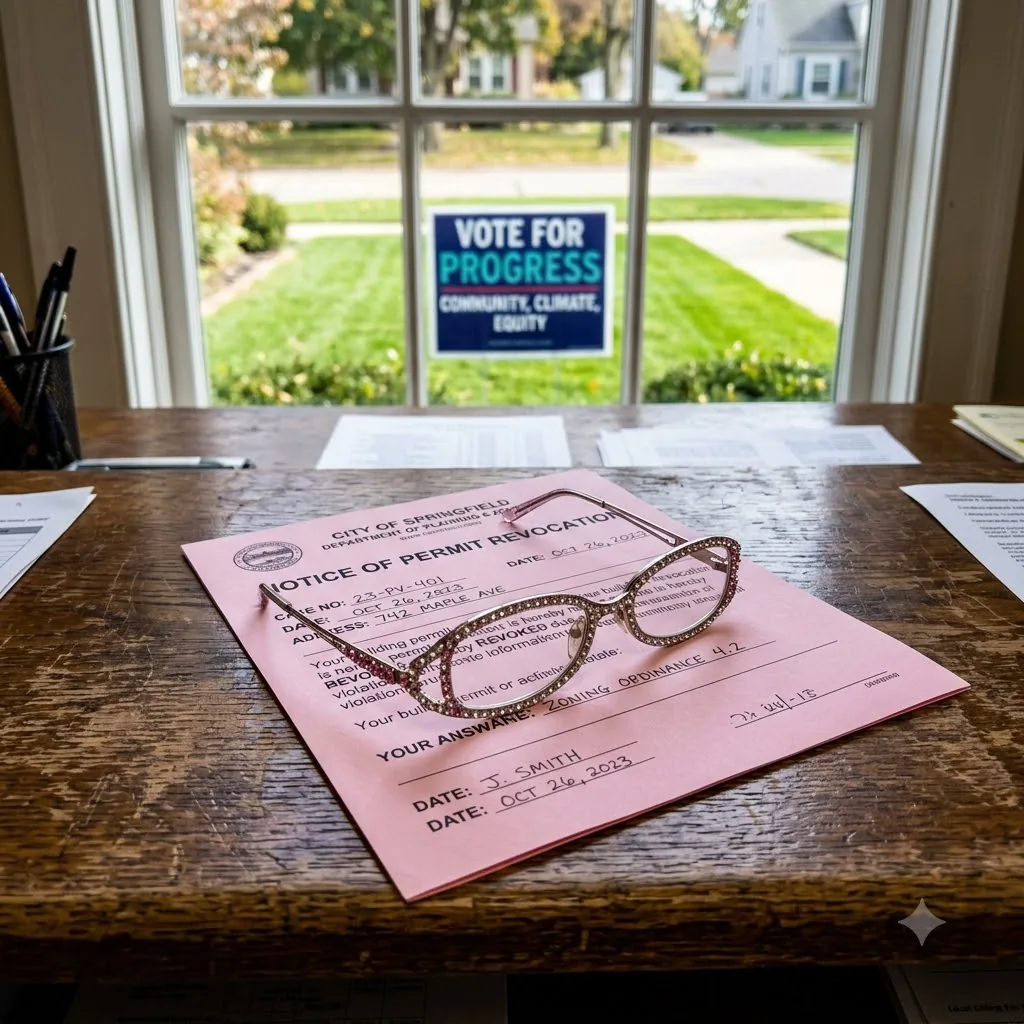
Leo reached into his breast pocket, pulled out the folded pink carbon-copy paper, and placed it precisely in the center of Sterling’s spotless desk blotter.
“The chili cook-off had three thousand people, Sterling,” Leo said. “The church bazaar last month had two thousand. Neither of those triggered a pedestrian density limit. Explain to me how a youth pride festival with five hundred registered attendees is a sudden, critical threat to public infrastructure.”
Sterling sighed, sliding into his high-backed leather chair. He folded his hands together, resting them on the desk like a disappointed headmaster dealing with a slow student.
“Leo, I understand you’re frustrated,” Sterling began, his tone dripping with practiced empathy. “But you are comparing apples to oranges. The chili cook-off was a standard community gathering. Your event has triggered the Youth Proximity and High-Friction Gathering clauses under section nine. It changes the entire algorithmic stress model.”
“High-friction gathering,” Leo repeated, the words tasting like ash. “That is not a zoning term.”
“It is a public safety classification,” Sterling corrected gently, opening a thick, leather-bound folio on his desk. “When an event draws a… particular demographic that may attract organized protests, aggressive counter-demonstrations, or general civic unrest, the city must account for the secondary footprint. We have to consider the risk to the surrounding family-friendly traffic corridors.”
Leo stared at the man, the sheer audacity of the bureaucratic language washing over him. The mask was so thin, yet legally impenetrable. Sterling was not banning a youth pride event because the zoning board hated it; he was restricting it because *other* people might hate it, and therefore, the event itself was classified as a municipal hazard. It was a perfectly sanitized, administrative way to blame the marginalized for the threat of violence against them. They were charging him a tax for the bigotry of others.
“There are no protests scheduled,” Leo said, his voice dropping an octave. “You are inventing a threat to invoke a safety clause that doesn’t apply to a poured-concrete plaza.”
“The city cannot operate on assumptions, Leo,” Sterling said, tapping a polished fingernail against the pink slip. “We have an obligation to protect the vulnerable residents of this city. Unaccompanied minors in a high-density, high-friction environment? The liability is simply too great for a standard permit.”
Sterling opened a desk drawer and pulled out a fresh, crisp sheet of white paper. He slid it across the mahogany surface to rest beside the pink revocation notice.
“However, we are not unreasonable,” Sterling continued, offering that same chilling smile. “We pride ourselves on our inclusivity. The zoning board met this morning and drafted a provisional compromise. We can reinstate your gathering immediately, provided you comply with the Tier 3 Security and Sanitation requirements.”
Leo picked up the white sheet. It was an itemized municipal invoice.
The list was staggering in its absurdity. Because of the “high-friction” classification, the city was requiring the festival to hire four private ambulances to remain on standby for ten hours. They were mandating the installation of forty concrete anti-terrorism barricades around the plaza perimeter-a measure never requested for the massive chili cook-off. They had even added fees for specialized biohazard waste disposal units. Finally, they required the prepayment of triple-time wages for twelve off-duty police officers to manage the imaginary pedestrian flow.
Leo’s eyes dropped to the bolded total at the bottom of the page.
*Total Estimated Cost: $34,850.00.*
“This is extortion,” Leo breathed, staring at the number. The festival’s entire budget, raised through six agonizing months of bake sales, car washes, and small community donations, was barely four thousand dollars.
“It is civic responsibility,” Sterling countered softly. “You want to host a high-risk event, you pay the high-risk premium. We are treating you exactly as the code dictates. Fairly, and without prejudice.”
Sterling checked a silver watch on his wrist, then looked back at Leo with total complacency.
“The invoice must be paid in full by cashier’s check at Window 4 no later than 5:00 PM tomorrow,” Sterling said. “If the funds are not cleared by then, the pink slip stands, and the plaza remains closed to your group. I’m sorry, Leo. It’s out of my hands. It’s just the code.”
Leo stood in the quiet, climate-controlled office, holding a piece of paper that effectively killed the festival as thoroughly as any direct ban. Sterling had legally, politely priced them out of existence. He had twenty-four hours to find thirty-four thousand dollars, or figure out how to dismantle a zoning code that was explicitly designed to be unbreakable.