Story code: ST-000844
Part 3: Clearwater
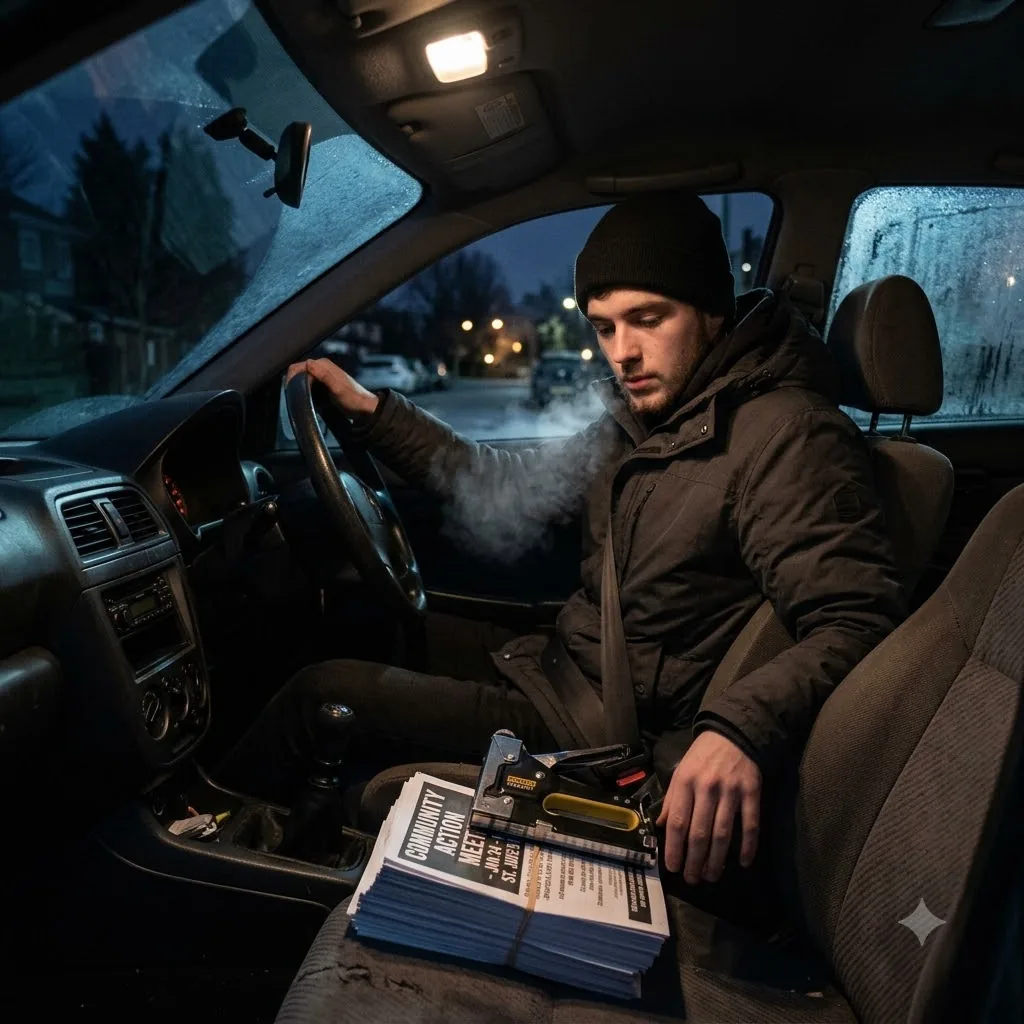
The camera flash strobed violently, a harsh burst of white light that burned an afterimage into Silas’s retinas. He flinched, turning his face away just as his phone buzzed again against the dashboard of his Honda. The caller ID-*Mom*-pulsed like a warning beacon in the dark cabin.
Before the guard could lower his phone to inspect the photo, a heavy, metallic groan echoed across the asphalt.
The plywood covering the storefront didn’t move, but the reinforced steel security door set into the cinderblock wall beside it suddenly swung open. Warm, stale air spilled out into the freezing morning, carrying the sharp, chemical scent of Hoppe’s No. 9 gun solvent and freshly cut pine.
Silas’s breath caught in his throat. Standing in the doorway, framed by the dim amber light of the shop’s interior, was his Uncle Marcus. He was fully dressed in heavy Carhartt canvas and insulated boots, a steaming mug of coffee in one hand. He hadn’t just arrived to answer an alarm; he had been sleeping in the back office, standing guard over his inventory.
The private security guard immediately lowered his flashlight, his aggressive posture evaporating into deferential respect. “Morning, Mr. Vance. Caught this one trying to red-tag the wood. He dropped the stapler when I rolled up.” The guard paused, holding out Silas’s license. “Turns out, it’s a family matter.”
Marcus didn’t look shocked. He didn’t even look angry. He took a long, slow sip of his coffee, his eyes locking onto Silas. The familiar, jovial warmth that usually defined his uncle-the loud, booming laugh that dominated Thanksgiving dinners and summer barbecues-was entirely absent. His face was a flat, unreadable mask.
“Appreciate it, Terry,” Marcus said, his voice quiet and even. “I’ll take it from here. Grab his keys and phone from the car, would you? We don’t need the battery dying.”
Silas couldn’t speak. His throat felt swollen shut. He watched, paralyzed, as the guard reached into the idling Honda, killed the engine, and scooped up the keys and the buzzing phone. Terry walked over and deposited them into Marcus’s large, calloused hand.
“Have a good morning, Terry,” Marcus said, dismissing the man.
“You too, sir.” The guard turned back toward his running diesel truck.
Marcus stepped out into the cold. He closed the distance to Silas in two long strides, his heavy boots crunching on the frost. He didn’t raise his voice or lift a hand in anger. Instead, he placed a firm, heavy palm on the back of Silas’s neck. The grip was paternal, yet unyielding-a clamp disguised as a caress.
“Freezing out here, Silas,” Marcus said softly. “Let’s get you inside.”
Before Silas could protest or pull away, his uncle guided him forward with undeniable physical force, marching him through the steel doorway. The moment they crossed the threshold, Marcus let go, shoved the heavy metal door shut, and threw the deadbolts. *Clack. Clack. Clack.*
The sound of the locks sliding into their iron housings felt sickeningly final.
The shop was a graveyard of retail. The glass display cases that once held rows of polished handguns were completely empty, the inventory secured in the massive steel vault in the back room. The only light came from a single fluorescent tube flickering above the register.
“Uncle Marcus, I’m sorry,” Silas blurted out, the words tumbling over each other in a desperate rush. “I didn’t staple them. I swear to God. I was angry about what happened downtown, but I couldn’t bring myself to do it. The wood is clean.”
Marcus didn’t look at the plywood outside. He didn’t look at the staple gun still lying on the frozen asphalt. He walked behind the empty display counter, set his coffee mug down, and placed Silas’s keys and phone on the glass. The screen lit up again. *Missed Call: Mom.*
“You think this is about flyers, Silas?” Marcus asked, sighing as he leaned against the counter. The pastoral, disappointed-uncle routine vanished, replaced by a cold, clinical efficiency that Silas had never seen before. “You think your mother and I care about an arts-and-crafts temper tantrum?”
“She left a voicemail,” Silas said, his voice trembling as he backed up slightly, putting distance between himself and the counter. “She said she’s cutting my tuition on Thursday. I get it. I crossed a line. I’ll drop my classes today. I’ll pack up my apartment and figure something out on my own.”
Marcus tilted his head, offering a slow, pitying smile. “You can’t pack an empty apartment, Silas.”
The words hung in the dim, chemical-smelling air. Silas froze. “What?”
“Your mother told you Thursday and Friday to keep you calm, to keep you predictable while we handled the logistics,” Marcus said, his tone as casual as if he were explaining a delayed shipping order. “The guarantor signature wasn’t pulled on Friday. She pulled it yesterday morning. The property manager let her in at noon. Your clothes, your books, your laptop-everything you own is already in contractor bags in the bed of my truck out back.”
Silas’s chest seized. The air in the room suddenly felt too thick to breathe. “You… you went into my room? You can’t do that. I’m on the lease.”
“You’re a dependent with no income,” Marcus corrected effortlessly. “And after your mother tearfully explained to the dean of students that you were suffering a severe mental health crisis-evidenced by your sudden, radicalized obsession with shutting down your own family’s livelihood-the university was incredibly accommodating. They processed your medical withdrawal by three o’clock yesterday.”
“No,” Silas gasped, taking another step back until his shoulder blades hit the reinforced steel of the front door. He reached blindly behind him for the deadbolts, but they required a key from the inside. “No, you’re lying. Let me out. Give me my phone.”
Marcus didn’t move toward him. He simply reached into the breast pocket of his heavy canvas jacket, pulled out a tri-fold glossy brochure, and tossed it onto the glass counter. It slid with a soft hiss, stopping right next to Silas’s captive car keys.
Silas stared at it. The cover featured a stock photo of pristine, snow-capped mountains and a tall chain-link fence bordering a dense pine forest. Bold, soothing letters stretched across the top: *Clearwater Restorative Horizons, Idaho.*
“Your mother and father love you very much, Silas,” Marcus said, his voice dropping into a chilling, absolute calm. “But you are sick. You’ve been poisoned by the people you’re spending time with. So, we’re taking you somewhere safe. Somewhere isolated. A healing camp, where hard work and discipline can clear your head. No cell towers. No protests. No toxic influences.”
Silas looked from the brochure to his uncle’s impassive face. The suffocating mathematics of his mother’s voicemail hadn’t been a threat of future ruin. It had been a distraction. His life hadn’t just disintegrated-it had been meticulously dismantled, boxed up, and erased while he was sitting in his car agonizing over a staple gun.
“My truck is fueled up,” Marcus said, picking up his coffee mug. “We have a fourteen-hour drive ahead of us. Are you going to walk out to the alley quietly, Silas, or do I need to call Terry back inside to help me carry you?”