Story code: ST-000856
Part 2: Accelerated Degradation
“No,” Mateo lied, his voice sounding entirely too loud over the rattling hum of the ancient beverage cooler. “Just utility bills today. Standard mail.”
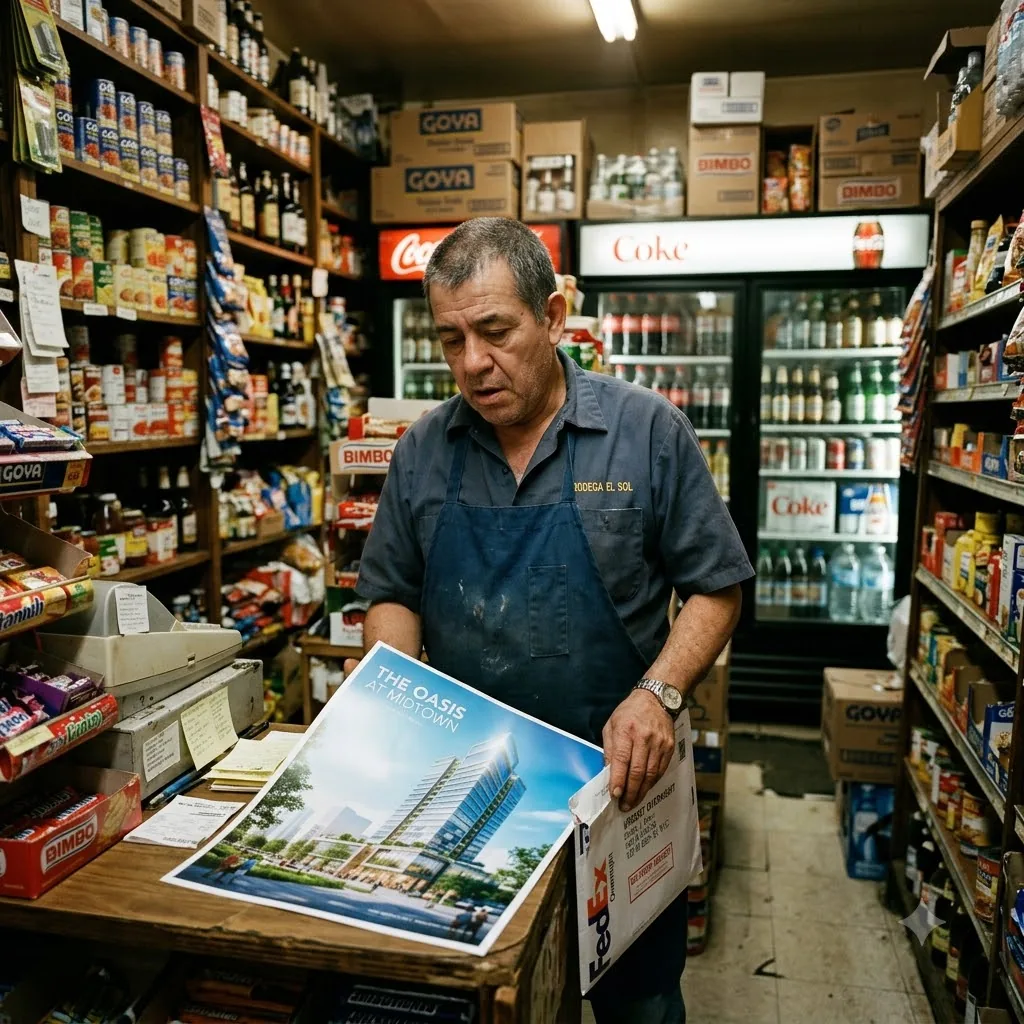
He pressed his calloused palms firmly onto the stack of tabloids, feeling the glossy edge of the architectural rendering hidden just beneath the cheap newsprint.
Julian’s empathetic smile remained frozen in place, but his eyes dropped to Mateo’s white-knuckled grip on the newspapers. A suffocating silence stretched between them, filled only by the aggressive ticking of the plastic cat clock on the wall behind the register.
“That is a shame,” Julian said softly. He did not move away from the counter. Instead, he reached out and casually adjusted a display of dusty keychains, his perfectly manicured fingers lingering merely inches from the tabloids. “It is in a heavy grey envelope. Thick cardstock. Very distinctive.”
“I will keep an eye out,” Mateo said, willing his breathing to remain steady.
Julian sighed, his shoulders drooping in an exaggerated show of exhaustion. “You know, Mateo, with this horrific rent increase hanging over your head, you shouldn’t have to worry about the daily grind. Have you given any thought to what happens next? If the new management company doesn’t back down?”
“My grandfather fought to keep this place open during the blackouts, through the recessions,” Mateo said, keeping his tone carefully neutral. “We don’t just pack up and leave.”
“Of course,” Julian murmured, his voice dripping with synthetic soothing tones. “But times are changing. The neighborhood is changing. I was actually speaking to a colleague who deals with these predatory LLCs. He mentioned that sometimes, they offer early buyout packages. Generous ones. Enough to, say, retire to Florida. Or start a smaller, easier venture somewhere else. Somewhere less… physically demanding.”
Mateo stared at the man standing across his counter. Just minutes ago, Julian had seemed like a rare ally. Now, viewing him through the lens of the hidden clearance blueprint, every word sounded calculated. Julian was not offering support; he was probing for weakness. He was trying to gauge exactly how much fight Mateo had left in him.
“I appreciate the concern, Julian. Really. But we are staying.”
Julian’s bright eyes hardened for a fraction of a second. The warm, inviting neighbor vanished entirely, replaced by something cold and acutely observant. Then, as quickly as it appeared, the pleasant mask slipped back into place.
“Well, I am always in your corner,” Julian said cheerfully. He finally stepped back from the counter. “Oh, before I forget, let me grab a bottle of sparkling water. The dust out there is making my throat a bit dry.”
Mateo’s stomach dropped. The beverage coolers were at the very back of the store. To ring Julian up, Mateo would have to lift his hands off the tabloids. He would have to operate the register, which meant shifting the piles on the cramped counter.
Julian walked slowly down the narrow aisle, his pristine sneakers silent on the sticky linoleum. He took his time, inspecting a row of canned condensed milk before finally pulling a green glass bottle from the cooler. He strolled back, placing the cold, condensation-covered bottle directly next to the stack of newspapers.
“That will be two-fifty,” Mateo said. His throat felt like sandpaper.
Julian pulled a sleek leather wallet from his linen trousers and handed over a crisp twenty-dollar bill. Mateo had no choice. He moved his left hand off the tabloids, keeping his right arm firmly anchored over the pile, and awkwardly punched the stiff keys of the register. The drawer shot open with a loud, metallic clang, violently vibrating the counter.
The stack of tabloids shifted.
Just half an inch. But it was enough to reveal a sliver of the thick, slate-grey envelope protruding from the bottom. The embossed silver lettering of ‘Vance’ caught the harsh glare of the fluorescent overhead lights.
Mateo froze, his hand hovering over the cash drawer.
Julian looked down. He stared directly at the silver lettering. For three agonizing seconds, neither man breathed. Mateo’s heart slammed against his ribs like a trapped bird. He calculated the distance to the heavy wooden bat his grandfather kept under the register, an absurd, desperate thought driven by pure panic.
“Keep the change, Mateo,” Julian said. His voice was suddenly devoid of all warmth. It was flat, perfectly modulated, and chillingly precise. “Put it toward the new rent.”
Julian picked up his water and turned around. He walked out of the bodega, the brass bell jingling cheerfully in his wake.
Mateo collapsed back against the cigarette display, his legs trembling violently. He waited until Julian’s white-shirted figure disappeared past the front windows before locking the heavy glass door and flipping the open sign to CLOSED.
With shaking hands, he shoved the tabloids onto the floor and pulled the grey envelope entirely out of its hiding place. The glossy blueprint was damning, but it was not enough to save him. He reached into the torn opening of the envelope and pulled out a secondary stack of papers bound by a thick metal clip.
The header on the first page read: *Apex Ascendancy LLC – Expansion Strategy & Risk Mitigation.*
Apex Ascendancy. The faceless management company that had just tripled his rent.
Mateo’s eyes frantically scanned the dense, legal text. It was a step-by-step corporate playbook. Julian was not just a friendly neighbor renting the unit next door; Julian was the primary shareholder of Apex Ascendancy. He had formed the LLC specifically to purchase the building anonymously.
But it was the ‘Risk Mitigation’ section that made Mateo’s blood run entirely cold.
*Phase 3: In the event that Unit A (Bodega) refuses voluntary buyout or cannot be evicted via standard rent escalation, implement accelerated structural degradation protocols to force municipal condemnation.*
Mateo read the sentence three times, his brain struggling to process the clinical language. Accelerated structural degradation. They were planning to intentionally damage the building to get it condemned, which would legally void Mateo’s grandfathered lease overnight.
A small, handwritten note was scrawled in the margin next to Phase 3, written in an elegant, sweeping script that perfectly matched the silver foil on the envelope.
*Water damage initiated in shared wall. Scheduled city inspector for Friday morning. – J.V.*
Friday morning.
Mateo looked up at the plastic cat clock. It was Thursday afternoon.
A sudden, heavy dripping sound echoed from the dark hallway leading to the bodega’s back storeroom. It was a slow, steady, and utterly relentless plop-plop-plop hitting the concrete floor. Mateo realized the faint, persistent dampness he had been smelling all morning was not the old air conditioner at all.
He ran past the aisles of dry goods, throwing open the swinging door to the storeroom.
The back wall-the one shared directly with the pristine matcha bar next door-was completely saturated. The peeling yellow paint was bulging outward in massive, water-logged blisters. A steady stream of murky water was pouring from a fresh, jagged crack near the ceiling, raining down directly onto Mateo’s pallets of uninsured bulk inventory.