Story code: ST-000868
Part 4: The Rot
The wail of the sirens began as a distant, metallic whine before swelling into a deafening scream that finally drowned out the muffled cries coming from the second-story nursery. When the ambulance turned onto the cul-de-sac, its strobing red and white lights swept violently across the manicured lawns, illuminating the scene in harsh, unforgiving flashes.
David remained kneeling in the wet grass, his arms heavy and completely numb. He watched as two paramedics piled out of the rig. They didn’t run. They moved with a calm, clinical efficiency that instantly made the frantic, bloody chaos of the last ten minutes feel entirely pathetic.
One paramedic knelt beside the shivering teenager, wrapping a thick thermal blanket around the boy’s shoulders while gently inspecting the jagged laceration on his scalp. The other began taking vitals, speaking to the kid in a low, soothing voice. The teenager was still weeping, his knees pulled tightly to his chest, flinching whenever a shadow moved too quickly.
Arthur Miller tried to step forward, his bloody hands held out in a gesture of defensive explanation. “He was trespassing,” Miller stammered, though his voice lacked any of the booming, authoritative resonance it had carried in the dark. It sounded thin, reedy, and incredibly old. “He was in the side yard. I thought he was armed.”
The paramedic taking the boy’s blood pressure didn’t even look up. “Step back, sir. Let us work.”
Miller opened his mouth to argue, to reassert the dominance he had wielded like a club just moments before, but the words died in his throat. In the harsh, strobing lights of the ambulance, the tactical silver-striped vest didn’t look like a uniform of authority anymore. It looked like a cheap Halloween costume stretched tight over the belly of a terrified, aging man who had nearly beaten a lost teenager to death in a blind panic. Miller slowly lowered his hands and backed away, retreating until his heavy boots hit the concrete of the driveway. He looked small. He looked entirely broken.
David slowly pushed himself up from the ruined grass. His bare feet were freezing, numb to the bone, coated in wet soil and drying blood. He watched as the paramedics lifted the teenager onto a collapsible stretcher. The wheels clicked securely into place, a sharp mechanical sound that echoed through the quiet street. They rolled the boy toward the open doors of the ambulance, leaving behind a dark, trampled depression in David’s expensive Kentucky bluegrass.
Greg Henderson had already vanished, having slipped away into the shadows of the hydrangeas the moment the sirens had grown close.
Only Elias remained. The large man stood near the edge of the property line, his chest rising and falling in a slow, steady rhythm. He didn’t look at Miller. He didn’t look at the ambulance. Elias stepped onto the custom-cut slate pavers bordering the lawn and bent down.
He picked up the matte-black AR-15 he had dropped to save the boy’s life. The heavy impact had gouged a deep, white scratch into the expensive stone, and the rifle’s receiver was visibly scuffed. Elias didn’t check the weapon for function. He simply slung the nylon strap over his shoulder.
“Elias,” Miller said, his voice trembling as he reached out a pleading hand. “We need to get our story straight before the police get here. We need to explain the protocol.”
Elias stopped. He turned his head just enough to look at Miller out of the corner of his eye. The disgust on Elias’s face was absolute. He didn’t say a single word. He just adjusted the strap on his shoulder, turned his back on the retired real estate broker, and walked away into the heavy shadows of the subdivision, leaving the neighborhood watch dead in the street.
The ambulance doors slammed shut. The engine roared, and the heavy vehicle pulled away from the curb, taking the flashing lights with it. The cul-de-sac was plunged back into darkness, lit only by the ambient, sterile glow of the streetlamps.
David stood alone in the center of his lawn. He looked down at his hands. The teenager’s blood had dried in the creases of his knuckles and beneath his fingernails, forming dark, rust-colored crusts. He looked at the thick pool of black liquid soaking into the deep aeration holes he had paid hundreds of dollars to have punched into the soil just a few weeks ago.
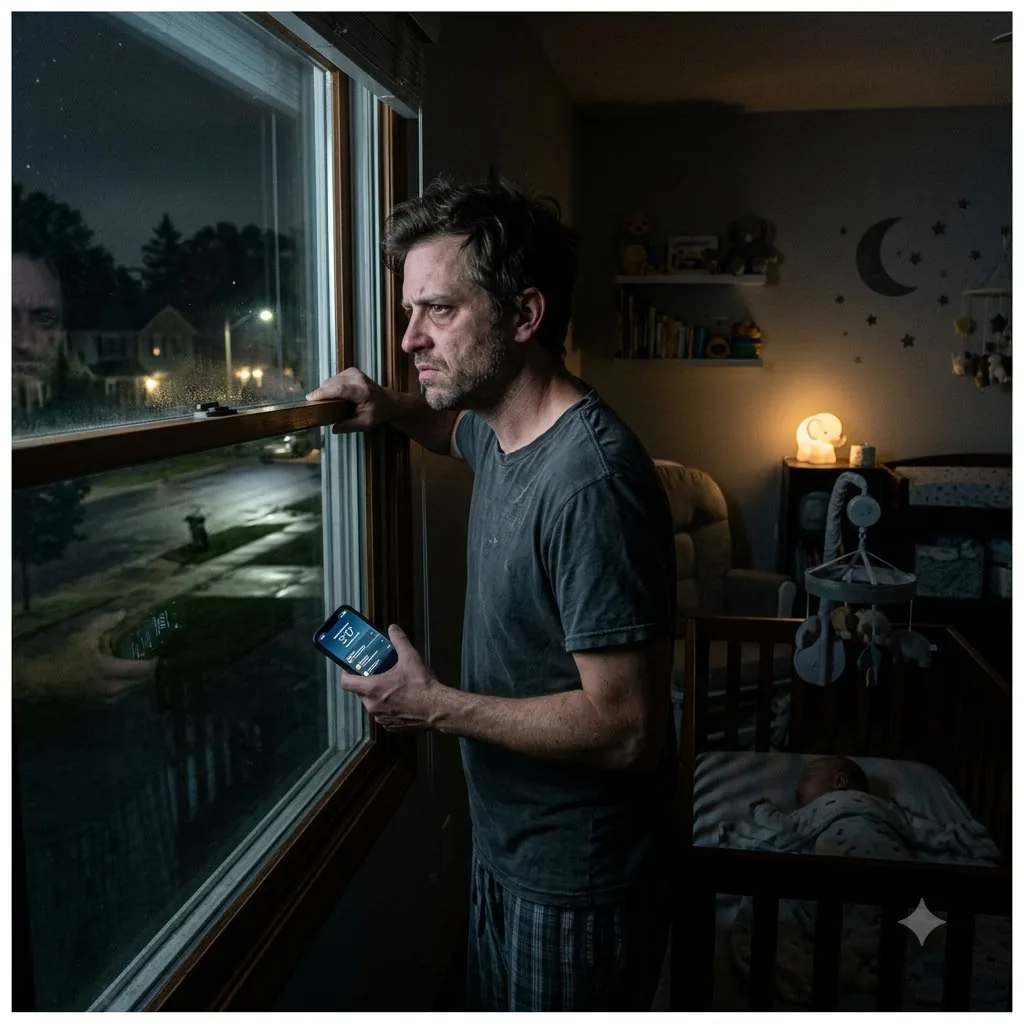
Slowly, David turned around and looked up at his house. The motion-sensor floodlights were still off. The gas-filled, double-glazed windows reflected the pale moonlight like the walls of an impenetrable fortress. Inside that house was an acoustic-paneled nursery that had cost him three thousand dollars. He had retrofitted the doorframes with high-density weatherstripping. He had bought the most expensive white noise machine on the market.
He had done everything in his power, spent every dollar he could spare, to seal his family away from the outside world. He had convinced himself that the danger, the noise, and the rot of the world were things that existed strictly beyond the brick walls and the wrought-iron security gates.
But as David stood shivering in the dark, staring at the blood permanently staining his perfect grass, he realized the horrific truth. His sterile, soundproofed worldview hadn’t kept the monsters out. It had only blinded him to the fact that they were already inside the gates, wearing reflective vests and patrolling his own front yard.
The silence he had fought so desperately to protect finally returned to the cul-de-sac, heavy and suffocating, wrapping around him like a shroud.