Story code: ST-000874
Part 2: The Nuisance
Mateo stared through the cold glass of his storefront, his breath fogging the pane around the glossy paper taped to the outside. The 300-percent rent hike notice trembled in his calloused grip. The bold, black numbers on the property management’s stationery burned into his retinas. The sum was so impossibly high it felt like a physical blow to his sternum, knocking the wind from his lungs. He lowered the letter and squinted at the back of the petition taped over his faded store logo. The morning sunlight illuminated the heavy black text, bleeding through the glossy paper in reverse.
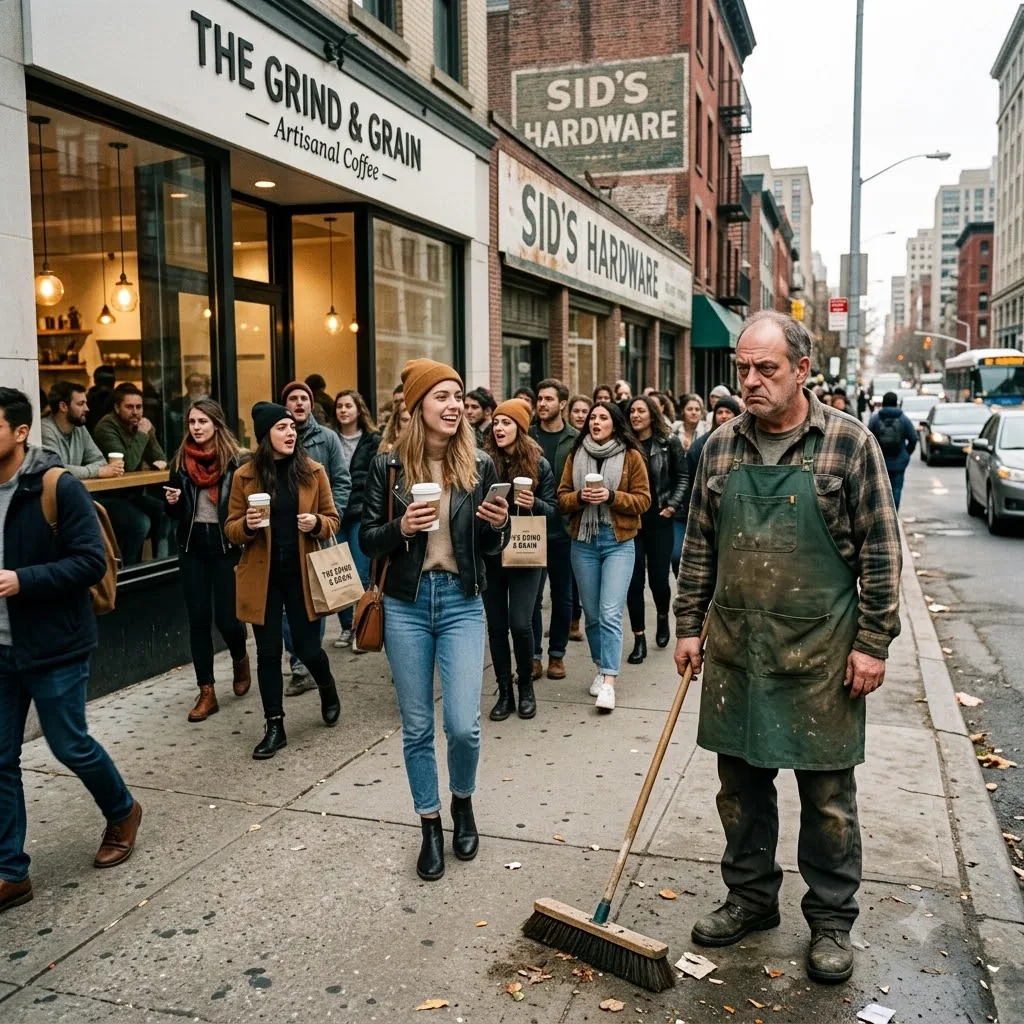
He folded the devastating letter, shoved it deep into the pocket of his apron, and pushed his heavy front door open. The old brass bell chimed weakly, instantly swallowed by the deafening chant of the crowd. Mateo stepped onto his own sidewalk. The protesters instinctively shifted away from him, pulling their tailored coats tighter with looks of mild disgust, creating a narrow path.
Mateo turned around to face his own window to read the petition the café owner had just taped up.
*PETITION TO REMOVE NUISANCE STRUCTURE AND REVOKE PERMITS.*
Beneath the capitalized headline was a bulleted list of grievances detailing a “public health hazard,” a “magnet for loitering,” and an “unregulated waste zone.” But it was the second paragraph that made the blood run cold in Mateo’s veins. The petition specifically named the “unlicensed mutual aid pantry operated by minor resident Elena Santos.”
Elena. His seventeen-year-old daughter.
Mateo looked to the far corner of his storefront, right at the edge of his property line. There it stood: a brightly painted wooden cabinet Elena had built herself out of reclaimed pallets over the summer. It was stocked with canned black beans, baby formula, winter coats, and surplus produce. Elena had spent a week painting vibrant yellow sunflowers on its heavy doors. To Mateo, it was a point of immense fatherly pride, a symbol of everything good he had tried to raise her to be. To the café owner standing on her milk crate, it was a disease.
“We will not let our neighborhood be degraded!” the café owner shouted into her megaphone, turning her piercing gaze directly toward Mateo. “We demand clean streets! We demand safety for our patrons!”
The protesters cheered, rattling their signs.
Mateo’s heart hammered against his ribs. His hand rested over his apron pocket, feeling the crinkle of the rent hike notice. The property management company hadn’t just sent this out of nowhere. The timing was entirely too perfect. The café owner wasn’t just protesting; she was coordinating with the landlord to squeeze him out. If he couldn’t pay the new rent-which he absolutely couldn’t-the café would likely expand right through his brick walls.
“Hey! Leave that alone!”
The bright, sharp voice cut through the dull roar of the chants. Mateo spun around. Elena was marching up the sidewalk, her heavy school backpack slung over one shoulder, her plaid uniform skirt swishing furiously. She was carrying a heavy cardboard box of bruised apples she had picked up from the wholesale market before classes.
Two protesters in expensive activewear had separated from the main group and were currently trying to drape a heavy gray canvas tarp over Elena’s painted pantry.
“I said back off!” Elena shouted, dropping her heavy box. Bruised apples spilled across the concrete, rolling under the expensive boots of the crowd. She shoved her way through the adults, her small frame vibrating with indignation. She grabbed the edge of the tarp and yanked it violently out of a tall man’s hands.
“It’s an unauthorized health hazard, sweetie,” the man said with a condescending smile, reaching back for the canvas. “We’re just cleaning up the blight.”
Mateo didn’t think; he simply moved. He crossed the pavement in three long strides and inserted his broad shoulders between the tall man and his daughter. He didn’t say a single word. He just planted his feet and fixed the protester with a dark, unyielding stare built on fifty years of defending his corner. The man blinked, held his hands up in mock surrender, and slowly backed away.
“Papa,” Elena breathed, her voice trembling slightly. She knelt to gather the rolling apples, her hands shaking as she placed them back in the cardboard box. “They’re trying to board up the pantry. They’ve been harassing people who come to take food all morning.”
“I know, mija,” Mateo murmured, keeping his eyes locked on the hostile crowd pressing in around them.
The café owner stepped down from her wooden crate and marched over, her megaphone lowered but her voice projecting just as loudly. “Mr. Santos,” she said, her tone dripping with manufactured patience. “Your daughter’s little charity project is violating three different city ordinances. It attracts pests. It attracts vagrants. It is actively ruining the property value and the safety of this entire block.”
“This is our property,” Mateo said, his voice a low, steady rumble. “She is helping our neighbors. The people who actually live here.”
“This is a commercial zone,” the woman corrected sharply, her eyes flashing. She gestured to the glossy petition taped to Mateo’s window. “And frankly, the property management agrees with my assessment. They have been incredibly receptive to my concerns about your specific liability.”
Mateo’s grip tightened around the crumpled rent notice in his pocket. *Receptive to my concerns.* The words clicked into place, locking his lungs in a cold vice. The 300-percent increase wasn’t an arbitrary market adjustment. It was a targeted eviction disguised as a rent hike, triggered directly by this woman’s aggressive complaints about Elena’s pantry.
“If that illegal structure isn’t entirely dismantled by tomorrow morning,” the café owner continued, crossing her arms over her linen jumpsuit, “the city inspectors will be here. And I have been personally assured by your landlord that any municipal fines issued to this address will be grounds for immediate lease termination. Think about your family’s future, Mr. Santos. Be reasonable.”
She offered a thin, victorious smile, turned on her heel, and marched back to her milk crate.
The crowd immediately resumed its rhythmic chanting, stepping closer to the glass. *Clean streets! Safe streets!*
Elena stood up, clutching a few bruised apples to her chest. Her dark eyes were blazing with defiant, angry tears. “We’re not taking it down, Papa. We can’t. Mrs. Torres relies on this for her diabetes test strips. The Rodriguez family needs the formula. We can’t let her bully us out of helping our own people.”
Mateo looked at his daughter’s fierce, beautiful, idealistic face. She had his stubborn chin and her late mother’s massive, bleeding heart. She had absolutely no idea how deep the trap was. She didn’t know about the devastating piece of paper burning a hole in his pocket. She didn’t realize that the document promised to strip away the store that paid for her school uniform, the roof over their heads, and the very food on their own table.
He looked back at his bodega, the faded awning that had shielded his family through decades of hardship. Then he looked at the brightly painted pantry, the physical manifestation of his daughter’s pride and joy. To fight for one meant sacrificing the other.
“Papa?” Elena asked, her voice dropping to a frightened whisper as she searched his conflicted expression. “We’re not taking it down, right?”
Mateo swallowed hard, the bitter taste of ash coating his tongue. The crowd pressed in closer, their designer signs boxing his family in against the cold glass. He felt the crushing weight of the paper in his pocket, a ticking bomb that demanded he crush his daughter’s spirit in order to save her shelter.
He placed a heavy, calloused hand on her trembling shoulder, entirely unable to find the words, as another unified chant rattled the very foundation of his life’s work.