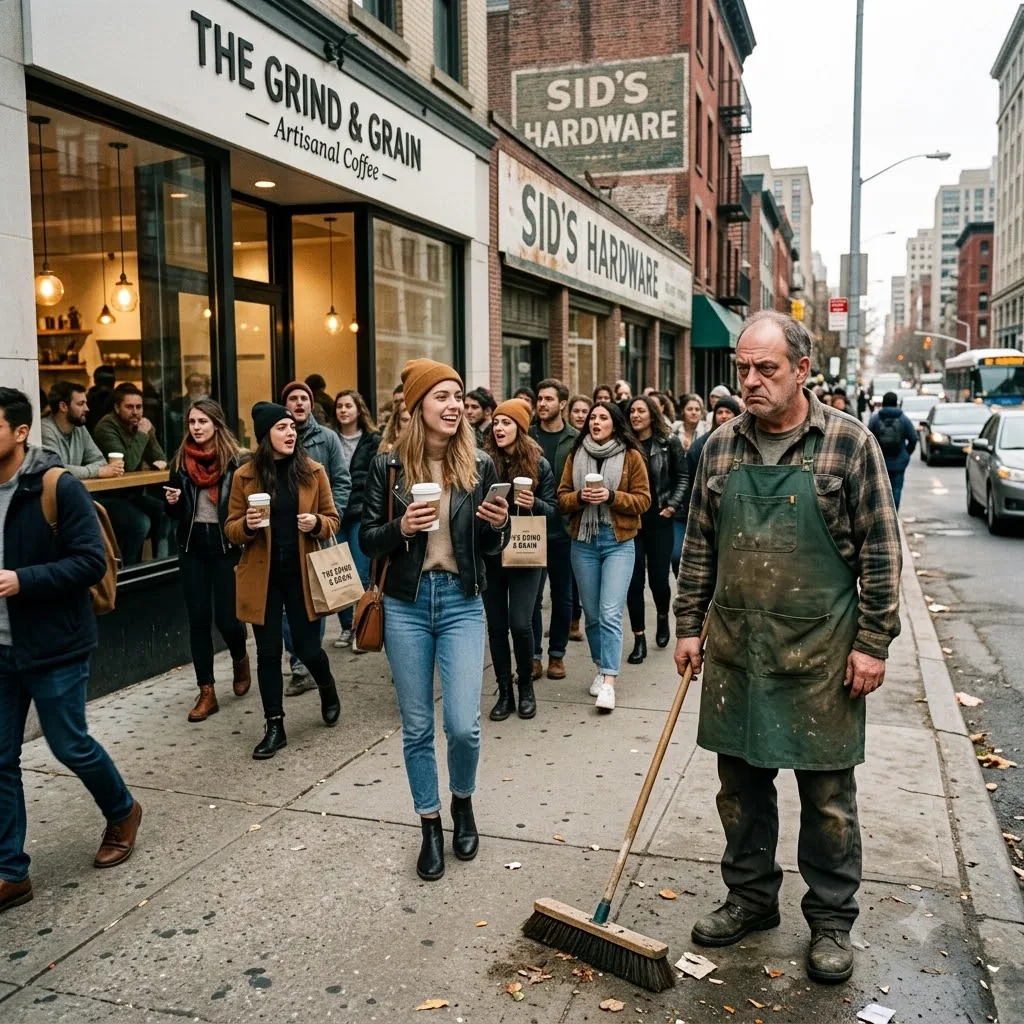
Story code: ST-000874
Part 3: The Paper Trail
The tall man in the expensive activewear didn’t stay backed away for long. Emboldened by a surge in the crowd’s rhythmic chanting, he stepped forward again, pulling a smartphone from his pocket. He shoved the camera directly toward Elena’s face, the triple lenses hovering inches from her frightened eyes.
“Say hi to the neighborhood watch, delinquent,” the man sneered, tapping the screen to record. “Tell everyone why you like bringing rats to our street.”
Elena flinched, dropping the few bruised apples she still held against her chest. She shrank back against the cold glass of the storefront, pulling her heavy backpack up like a shield. A sharp, terrified sob broke in her throat.
Mateo didn’t issue a warning. He dropped a heavy, calloused hand flat against the man’s chest and shoved hard. The protester stumbled backward into the crowd, his phone slipping from his grip and clattering onto the concrete.
“Inside,” Mateo ordered, his voice a low, terrifying rumble that brooked absolutely no argument.
He grabbed Elena by the shoulder of her uniform jacket, shielding her from the sudden angry shouts of the mob, and pushed her through the bodega’s door. He followed her in, twisting the heavy deadbolt with a loud, metallic clack. The thick glass muffled the protesters instantly, reducing their aggressive chants to a dull, aquatic roar.
Elena didn’t stop in the aisles. She kept her head down, her shoulders shaking violently, and fled straight past the register, pushing through the swinging wooden doors that led to the back stockroom.
Mateo stood alone in the quiet hum of the ancient refrigeration units. The smell of fresh pine cleaner and baking bread surrounded him, a stark, comforting contrast to the hostility vibrating against his front windows. He reached into his apron pocket and pulled out the crumpled notice from the property management company.
Three hundred percent.
He smoothed the heavy stationery out against the scratched Formica of his checkout counter. He looked at the date typed at the top. It had been mailed exactly three days ago. He looked through the front glass at the glossy petition the café owner had just taped over his store’s faded logo.
The pieces locked together in his mind with the heavy, undeniable weight of a closing vault.
If he tore down Elena’s mutual aid pantry, it wouldn’t matter. If he swept the sidewalk twice an hour and banned teenagers from his store entirely, it wouldn’t matter. Chloe didn’t actually care about municipal health codes or the curated aesthetic of the neighborhood. She wanted the square footage. She had complained to the corporate landlord, framing his family’s bodega as a structural liability to manufacture a breach of lease. The impossible rent hike was simply the landlord doing the dirty work for her. The loud, righteous protest outside was a smokescreen, a moral crusade designed to break Mateo’s spirit so he would pack up his fifty years of history and leave quietly.
He looked at the swinging doors of the stockroom. He could hear Elena weeping, mourning the vulnerable community she thought she had failed.
Mateo slowly untied his canvas apron. He folded it neatly and laid it on the counter. He picked up the rent hike notice. He unlocked his front door, stepped back out into the chilly morning air, and marched straight to his storefront window. He ripped Chloe’s glossy petition off the glass, taking a long strip of heavy-duty packing tape with it.
The protesters stopped chanting as Mateo turned and walked directly toward the invisible property line. He didn’t look at them. He didn’t acknowledge their clever cardboard signs. He walked with the heavy, unyielding momentum of a man who had absolute clarity.
He pulled open the heavy, matte-black door of the artisanal café.
The air inside was aggressively warm, smelling heavily of steamed oat milk, roasted espresso, and lavender syrup. Soft, lo-fi jazz drifted from hidden ceiling speakers. A dozen patrons sat at reclaimed-wood tables, tapping quietly on silver laptops. It was a curated sanctuary of progressive urban wealth.
Chloe stood behind the gleaming marble counter, her linen jumpsuit pristine. She was warmly handing a stamped compostable cup to a woman in a thick cashmere sweater.
Chloe looked up. The warm, customer-service smile froze on her face, hardening instantly into a mask of pure, panicked contempt. “Mr. Santos,” she said, her voice dropping to a harsh, venomous whisper. “You need to leave immediately. This is private property. I will call the police.”
Mateo didn’t whisper. He didn’t shout, either. He simply spoke with the booming, chest-deep resonance of a man used to calling out across a busy bodega.
“I brought back your petition,” Mateo announced, his voice slicing cleanly through the quiet jazz. Every laptop in the room suddenly stopped clicking.
He slapped the glossy paper face-up onto the pristine marble counter, right next to a glass display of vegan croissants. Then, he slammed the property management’s heavy white stationery down directly beside it.
“And I brought the invoice,” Mateo added.
Chloe lunged forward to cover the papers with her hands, but Mateo’s thick, calloused fingers pinned them flat to the marble. The woman in the cashmere sweater took a slow step back, her eyes darting between Mateo’s unblinking stare and the documents.
“You told my daughter her charity was a health hazard,” Mateo said, projecting his steady voice to the furthest corners of the silent café. “You told your crowd outside you wanted safe streets. But you didn’t write this petition to clean up the block. You wrote it to create a paper trail.”
“I have no idea what you’re talking about,” Chloe hissed, her face flushing a deep, ugly red. “Keep your voice down, or I am calling the authorities.”
“Call them,” Mateo said, lifting his hand so everyone in the room could see the bold financial numbers on the landlord’s stationery. “Tell them how you coordinated with a corporate property manager to hit a fifty-year-old, minority-owned family business with a three-hundred-percent rent increase.”
A low murmur rippled through the café. A man in a knitted beanie near the window slowly closed his laptop. These were patrons who explicitly prided themselves on supporting local, ethical businesses.
“That is a lie,” Chloe stammered, her eyes darting frantically to the cashmere-clad woman at the register. “I don’t control your rent! I just filed a noise and sanitation complaint!”
“You filed a targeted complaint against a teenage girl giving free food to poor people,” Mateo corrected, his voice echoing off the minimalist subway tile. He tapped the heavy white paper. “And three days later, my landlord cites your exact words-‘unregulated liability’-to break my lease. You don’t want a clean sidewalk. You want my building so you can knock down the shared brick wall and expand your dining room.”
Chloe opened her mouth, but her curated, polite script completely failed her. She stared helplessly at the two documents lying side-by-side on her marble counter. The dates matched perfectly. The legal phrasing overlapped flawlessly. The predatory, coordinated intent was written in stark black and white for her entire morning rush to see.
The woman in the cashmere sweater looked at the undeniable evidence, then looked back at Chloe’s panicked, flushed face. Slowly, the customer set her artisanal coffee cup back down on the marble counter, picked up her leather handbag, and took a deliberate step toward the exit.
Chloe stood frozen behind her expensive espresso machine, her mouth slightly open, entirely unable to find a single word to rebuild the shattered illusion of her moral crusade.