Story code: ST-000874
Part 4: The Empty Shell
The woman in the cashmere sweater didn’t look back as she pushed through the heavy matte-black door and stepped out into the chilly morning air. The soft chime of the café’s bell felt like a final, ringing verdict. At the corner table, two more silver laptops snapped shut in unison. A young man in a tailored peacoat gathered his things, avoiding eye contact with the counter. The quiet, lo-fi jazz continued to play from the hidden ceiling speakers, but the curated sanctuary of the artisanal café had completely collapsed.
Mateo turned his back on Chloe’s silent, flushed face. He left the glossy petition and the landlord’s heavy white stationery sitting flat on the pristine marble counter. He didn’t need the physical papers anymore. The truth was out, ugly and undeniable, poisoning the air of her pristine dining room. He walked out of the café with his head held high, moving with the steady, unhurried pace of a man who had reclaimed his dignity.
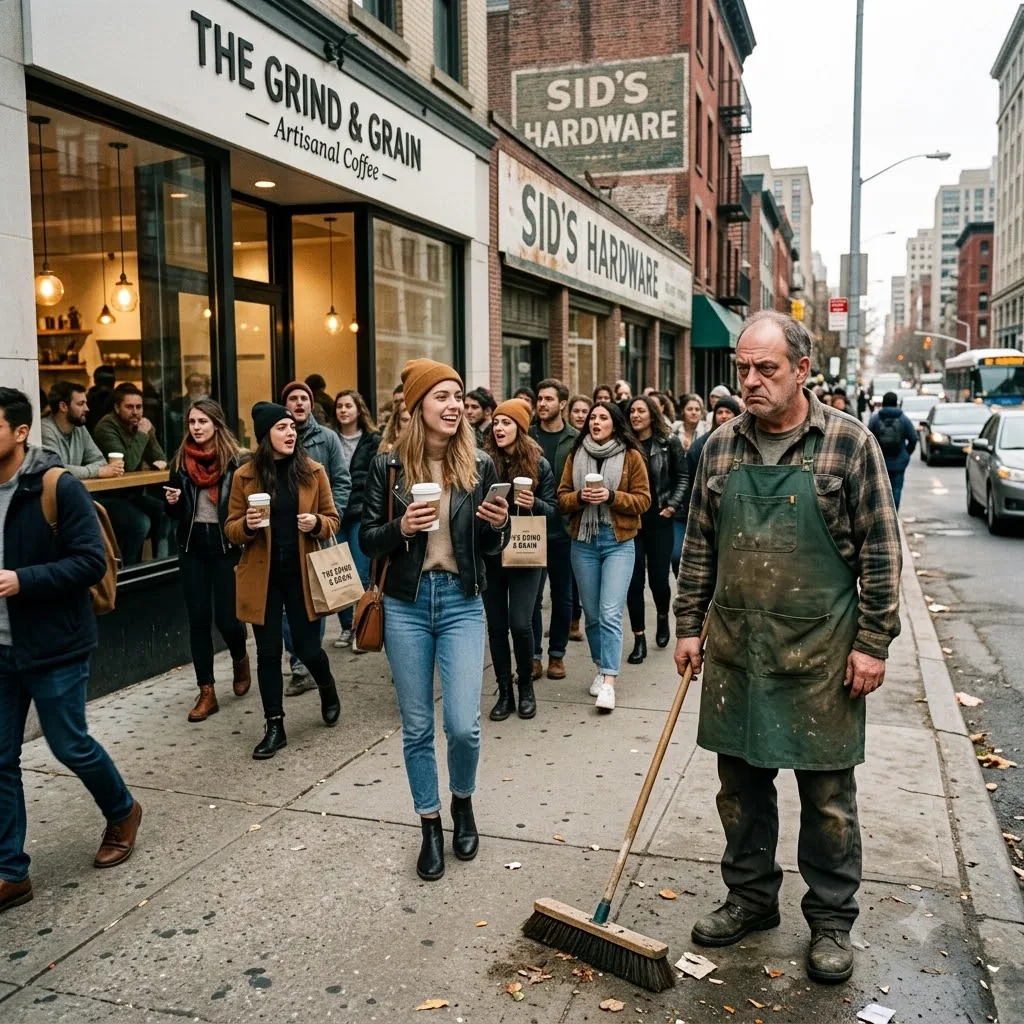
Outside on the pavement, the moral crusade was already fracturing. The woman in the cashmere sweater was whispering sharply to the young woman in the knitted beanie. Cardboard signs were being lowered, one by one, until the heavy canvas tarp was dropped completely onto the concrete. The battery-powered megaphone sat abandoned on the reclaimed wood milk crate. The manufactured outrage dissolved into uncomfortable, guilty murmurs as the protesters realized they were acting as the private eviction squad for a corporate landlord.
Mateo didn’t pick up his wooden push broom. He didn’t sweep the invisible property line. He just walked straight through the dispersing crowd, parting them like smoke, and stepped back into the dim, familiar sanctuary of his bodega.
He pushed the heavy front door shut, twisted the deadbolt with a loud, metallic clack, and reached up to the front window. With a heavy hand, Mateo flipped the faded plastic sign from “OPEN” to “CLOSED.” It was eleven in the morning. He had not locked his doors during daylight hours in fifty years.
The silence inside the store was absolute, save for the steady, comforting hum of the ancient refrigeration units. Mateo walked down the narrow aisle, the scent of fresh pine cleaner and baking bread wrapping around him like a heavy blanket. He pushed through the swinging wooden doors into the back stockroom.
Elena sat on a stack of fifty-pound flour sacks, her knees pulled to her chest, her face buried in the sleeves of her plaid school uniform.
“It’s over out there,” Mateo said gently, his deep voice softening.
Elena looked up, her dark eyes red and swollen. “They left?”
“They left,” Mateo confirmed. He reached out, resting his large, calloused hand on top of her head. “Come with me, mija. We need to sit down.”
He guided her out of the back room and into the main store. They didn’t go to the register. Mateo stopped in aisle two, right between the towering shelves of black beans and the baby formula. He lowered himself onto an overturned milk crate. He patted the scuffed linoleum beside him, and Elena sat down on the floor, crossing her legs.
“I stopped her,” Mateo said, his voice a low rumble. “I showed her customers what she was really doing. She won’t have a mob anymore.” He paused, the bitter taste of ash returning to his tongue. “But it doesn’t change the paper, Elena. The landlord sent the notice. The rent is going up three hundred percent.”
Elena’s breath hitched. She looked up at the ceiling, then around at the heavily stocked shelves. “Because of my pantry,” she whispered, her voice cracking with fresh devastation. “I lost the store. I lost our home for a wooden box.”
“No,” Mateo commanded, his tone fierce and absolute. “Do not ever think that. If it wasn’t the pantry, she would have complained about the awning, or the smell of the bread, or the dust on the sidewalk. She wanted the square footage. She wanted the brick wall knocked down. Your pantry was just the excuse she gave the men in suits. You did a good thing, Elena. You helped our people.”
Elena reached into her heavy school backpack, which she had dragged out from the back room. Her hands shook as she pulled out a worn, paperback novel. It was a history of neighborhood civil rights movements-a banned book from her school’s curriculum that she had specifically bought to stock in the small library wing of her mutual aid pantry. She held it by the spine, staring at the cover as if it were a fragile artifact.
Mateo slid off the milk crate and sat on the cold linoleum right beside her. He leaned his broad shoulder against his daughter’s.
“We have thirty days,” Mateo said quietly. “Thirty days until the lease formally expires and the sheriff comes with a padlock.”
“What do we do?” Elena asked, opening the banned book across their laps.
Mateo looked at the rows of fresh plantains, the deep freezers full of meat, the shelves stacked high with the rice and beans that had sustained their neighborhood for half a century. The rent hike was a death sentence for the business, but the inventory belonged to him.
“We expand the pantry,” Mateo said, a hard, defiant spark igniting in his chest. “We take the doors off the hinges. We move every single can, every coat, every piece of fruit out to the sidewalk. We give it all away. Every last ounce of it.”
Elena looked at him, her tear-streaked face slowly breaking into a fierce, understanding smile.
“If they want to take our corner,” Mateo said, tracing a calloused finger over the title of the book in her lap, “we are going to leave them a completely empty shell. And we are going to feed the entire block on our way out.”
They sat together in the quiet aisle, reading the first chapter aloud, drawing up their battle lines in the dust of fifty years of history.