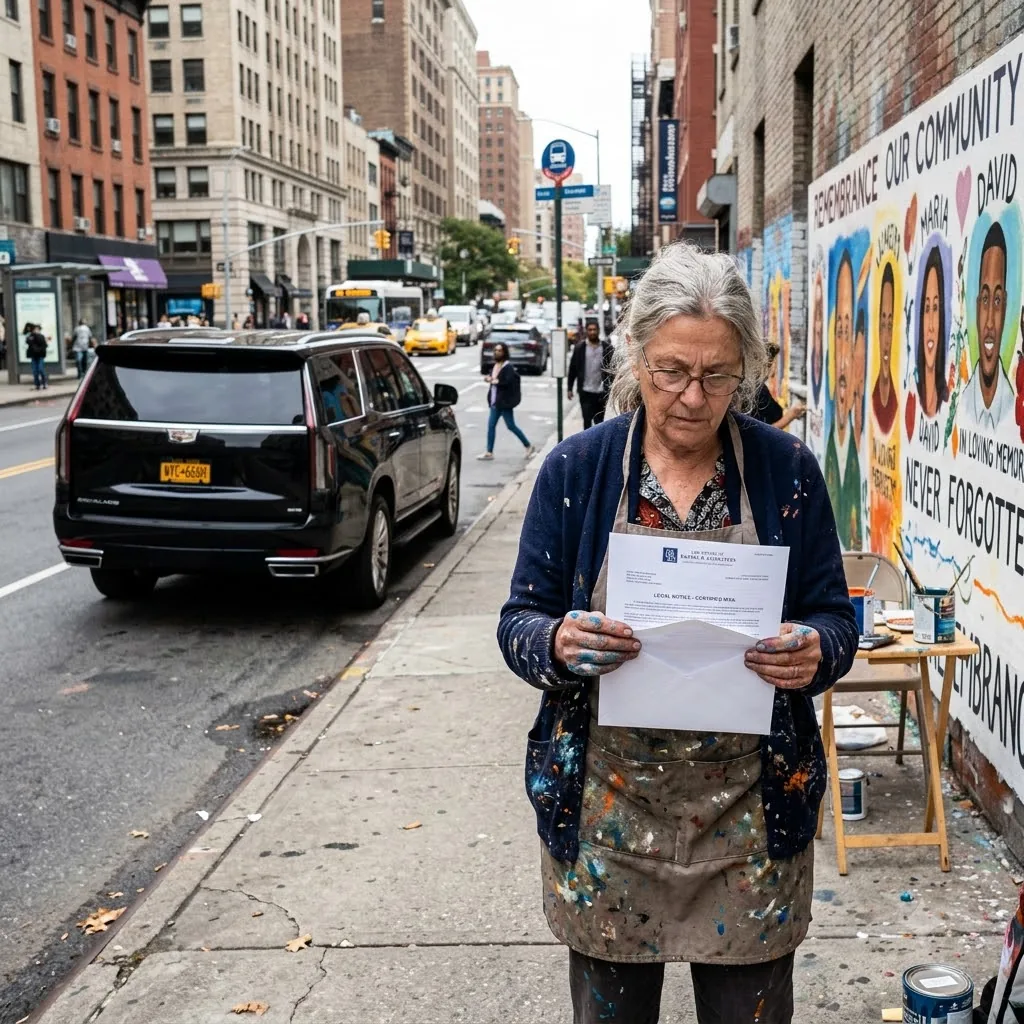
Story code: ST-000882
Part 3: The Authentic Soul
The Foundry Lofts occupied a renovated textile mill three blocks from Gloria’s house, sitting on a street that had been entirely scrubbed of its history. Valets in crisp black vests sprinted between idling luxury sedans, while a line of well-dressed guests flowed through the towering glass doors. Gloria stood on the opposite corner, the evening air biting at her thin sweater. She had scrubbed her hands until her skin was raw, but faint blue halos still clung to her cuticles. She wore her Sunday church clothes-a modest navy skirt and a pressed white blouse-but the stubborn droplet of azure paint still stained the toe of her left shoe.
She didn’t belong here. That was the point. They expected her to stay in her house, trembling under the weight of the neon-yellow notice, quietly suffocating until the bank foreclosed. She tightened her grip on the silver-embossed business card in her pocket and crossed the street.
She slipped past the distracted host stand by drafting behind a loud group of men in tailored suits, her quiet, soft-soled steps lost in the echo of their heavy leather shoes. The interior of the lofts was a dizzying cavern of industrial chic. Waitstaff floated through the crowd carrying silver trays of champagne flutes and intricate appetizers. A string quartet played a modern pop song in the corner, the notes bouncing harshly off the polished concrete floors.
Gloria navigated the perimeter, her eyes scanning the room. She passed a scale model of the neighborhood encased in acrylic, identical to the sterile, gray rendering in the folder they had dropped on her paint bucket hours earlier.
Then, she turned the corner into the grand marketing gallery, and her breath stopped in her throat.
Lining the expansive, dimly lit back wall were five massive, floor-to-ceiling lightboxes. They were glowing with high-resolution, vividly saturated photographs. Gloria took a slow, numb step forward. The champagne flutes, the string quartet, the low hum of wealthy conversation-it all faded into a distant roar.
The first lightbox displayed the sweeping curve of her brick wall, the vibrant blues and golds captured in stunning clarity.
The second lightbox zoomed in on a specific section. Hector’s name. The exact spot where the enforcer had slapped the neon-yellow remediation notice just hours earlier. The photograph had been taken recently; the colors were fresh, the edges sharp, yet entirely free of the bright yellow sticker.
Gloria walked toward the center display, her trembling hand rising to her mouth. It was a wide shot of her entire home, the memorial tapestry wrapping around the foundation like a protective embrace. But the house itself had been digitally darkened, fading into the background so that only the mural popped in brilliant, luminescent color.
Superimposed across the bottom of the glowing acrylic in elegant, modern typography was the marketing copy: *The Foundry Lofts. Experience the Authentic Soul of the District.*
Below that, smaller text read: *Immerse yourself in a neighborhood rich with raw, vibrant history. Our community is anchored by deep cultural roots and authentic street art, preserved for the modern visionary.*
Bile rose in the back of Gloria’s throat. They weren’t just erasing her community; they were harvesting its corpse to sell luxury condos. They were threatening to steal her home and destroy a thirty-year memorial while simultaneously using that exact memorial as the centerpiece of their multimillion-dollar sales pitch.
“It’s breathtaking, isn’t it?”
Gloria flinched, pulling her hand away from her mouth. A man had stepped up beside her. He held a crystal glass of scotch, the ice clinking gently. He wore a deep navy suit that cost more than her annual pension. He was looking up at the illuminated photograph of her wall with a look of manufactured reverence.
“The local color,” the man continued, gesturing vaguely at the display with his glass. “It gives the development a certain edge, don’t you think? A sense of place. We’re very committed to maintaining the artistic integrity of the neighborhood.”
Gloria turned her head slowly. She looked at his crisp collar, his perfectly styled hair, and the silver nametag pinned to his lapel. *Richard Vance. Lead Developer.*
“You’re selling this,” Gloria said, her voice barely a whisper.
Vance smiled, a practiced, easy expression that didn’t reach his eyes. “We’re selling a lifestyle, yes. Buyers want authenticity. They don’t just want a box in the sky; they want a story. That mural,” he pointed squarely at Little Julian’s painted name, “provides the exact gritty, historic aesthetic our investors crave.”
Gloria reached into the deep pocket of her skirt. Her fingers closed around the thick, glossy paper of the Notice of Extreme Code Violation.
“If it’s so authentic,” Gloria said, her voice finding its footing, rising above the ambient noise of the gallery. “Why is a contracted crew coming to power-wash it off the brick at eight o’clock on Friday morning?”
Vance’s smile faltered. His brow furrowed in genuine confusion. “Excuse me?”
“The authentic soul of the district,” Gloria said, her voice projecting now, sharp and carrying. Several heads turned nearby. An older couple holding brochures stopped walking. “That’s what you’re selling. That mural.”
“Yes, of course,” Vance said, lowering his scotch, his eyes darting toward the onlookers. “Ma’am, if you need a brochure-”
Gloria pulled the formal notice from her pocket. She didn’t hand it to him. Instead, she stepped forward and slammed the paper flat against the illuminated acrylic of the lightbox, pressing it directly over the word *Authentic*.
“I painted that wall,” Gloria said, her finger jabbing into the crisp, legal text. “I bought the paint. I lettered those names. And at two o’clock this afternoon, your Arts District Improvement Board threatened to foreclose on my home if I didn’t pay you twelve thousand dollars to destroy it.”
The silence that rippled outward from the lightbox was absolute. The clinking of glasses in the immediate vicinity ceased. A circle of prospective investors stopped talking, staring blankly at the severe, bold heading of the violation notice pressed against the glowing, marketed ‘soul’ of their future neighborhood.
Vance stared at the paper. The color drained from his face, leaving his immaculate tan looking suddenly gray. He opened his mouth, but no words came out. He looked from the devastating demolition bill beneath Gloria’s hand to the towering, backlit photograph of the exact same wall he was leveraging to sell ten-million-dollar lofts.
“So which is it, Mr. Vance?” Gloria asked, the dangerous heat in her chest finally breaking free, her eyes locked onto his panicked gaze. “Is my wall willful vandalism that you’re bankrupting me to destroy, or is it the authentic history you’re selling to these people? Because right now, you can’t afford both.”
Vance’s mouth snapped shut. He looked desperately at the wealthy investors, then back to the damning paper, completely stripped of a single, polished lie.