Story code: ST-000897
Part 2: The Draw
Martha twisted the deadbolt and threw her shoulder against the heavy oak front door. It stuck for a moment, the bottom edge frozen to the weather stripping, before popping open with a sharp crack. The sub-zero wind hit her instantly, stealing the breath from her lungs. She pulled the thick wool scarf over her nose and mouth, squinting against the blinding glare of the afternoon sun on the unbroken snow.
Her knees popped as she navigated the icy front steps. The two-mile walk to town hall would take her nearly an hour in this weather, a dangerous proposition at her age, but the rapidly dropping temperature in her kitchen had left her with no other option. As she reached the plowed asphalt of the county road, she paused to look down into the valley.
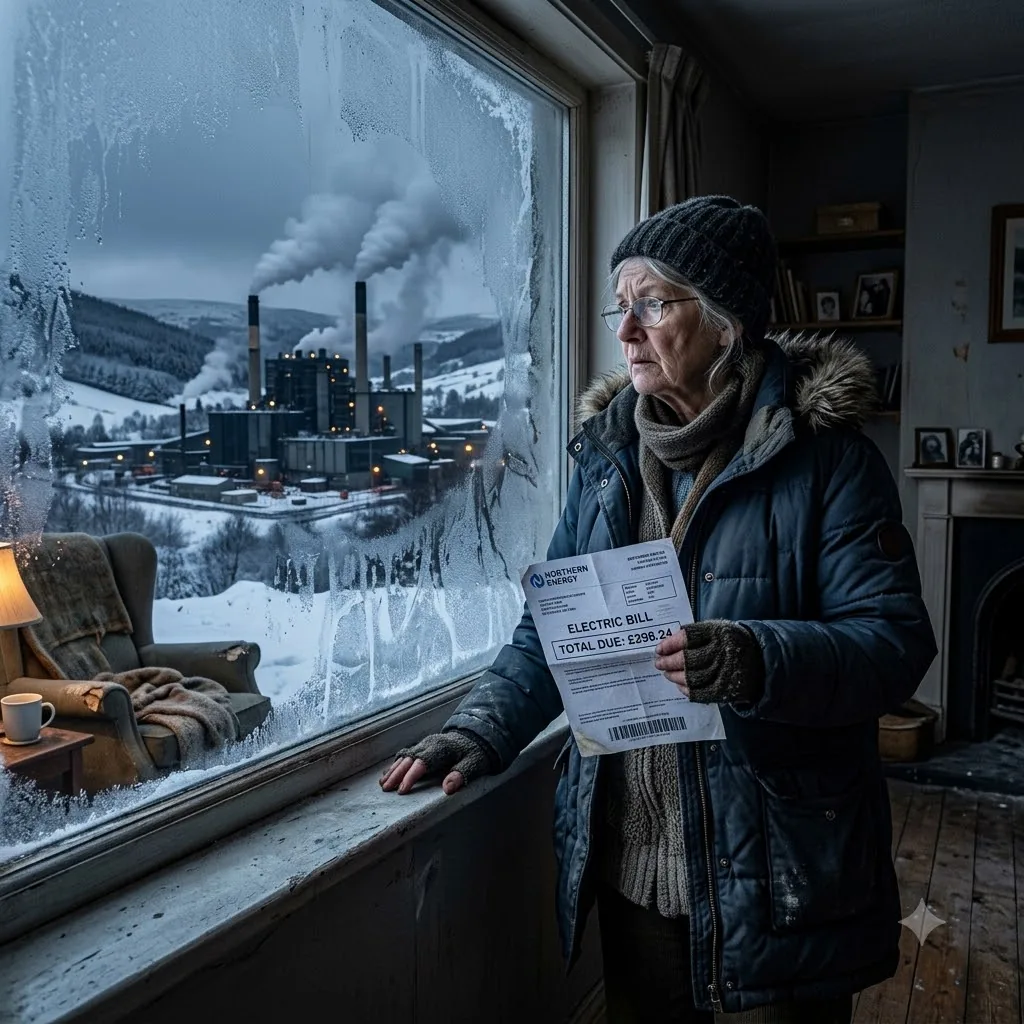
The old coal plant had been a dark, rusted skeleton for as long as Martha had lived on the ridge. Now, it was a blinding fortress. Industrial arc lights mounted on temporary poles bathed the snow-covered acreage in stark white daylight. There was no smoke rising from the two towering concrete chimneys. Instead, the old coal yard was packed end-to-end with gray shipping containers, hundreds of them, stacked three high.
The hum was deafening out here. It vibrated through the soles of her heavy winter boots, a relentless mechanical drone that seemed to vibrate the very oxygen out of the freezing air.
Martha forced her stiff legs forward, keeping her head tucked down against the biting wind. As she trudged along the shoulder, the high-tension utility wires strung along the road caught her eye. They were sagging dramatically under heavy strain. A series of thick, black, rubberized cables had been zip-tied to the wooden poles, splicing directly into the neighborhood’s main transformers. The temporary cables snaked down the steep wooded embankment, plunging straight toward the illuminated fortress of shipping containers in the valley.
The cold seeped through her corduroy trousers, turning her thighs numb. By the time the brick facade of the municipal building came into view, Martha’s teeth were chattering uncontrollably.
The town square, normally deserted on a Tuesday afternoon, was chaotic. Dozens of pickup trucks and sedans were parked at odd angles in the snowbanks. A mass of people in heavy winter gear clogged the front steps of the town hall.
Martha pushed into the crowd, the icy wind momentarily blocked by the wall of bodies. She recognized her neighbors from the Ridge district. Old Mr. Abernathy was leaning heavily on his aluminum cane, his face purple with cold and rage. Sarah Jenkins, the schoolteacher who lived three doors down from Martha, was arguing with a man on the steps. Every single one of them was clutching a brightly colored final notice.
“It’s not a mistake!” a voice shouted from inside the building.
Martha shoved her way through the heavy glass doors. The lobby was sweltering, the radiators hissing loudly, but the heat offered no comfort against the sheer volume of the angry crowd. At the front counter, Mayor Higgins was standing beside Brenda, the town clerk, who looked on the verge of tears behind the reinforced glass partition.
“I’m telling you what the regional authority told us!” Brenda cried into the microphone, her voice carrying over the lobby’s PA speaker. “The smart meters are functioning correctly! They say the power was consumed on your properties!”
“I live in a single-wide trailer!” Mr. Abernathy bellowed, slamming his cane against the base of the counter. “You’re telling me I used fourteen hundred dollars of electricity in January? I use a wood stove!”
Martha squeezed her way to the front, her numb fingers struggling to unfold her pink slip. “Brenda,” Martha rasped, her voice weak but firm. “They cut my line. I have no heat. You have to freeze the account and turn it back on.”
Brenda looked at Martha, her eyes wide with panic. “I can’t, Martha. The town doesn’t control the grid anymore. The regional authority leased the old plant yard to a tech conglomerate out of state. A data center. Server farms. They signed a priority-draw contract.”
“What does that have to do with my electric meter?” Martha demanded.
Mayor Higgins stepped toward the glass, running a hand over his sweating forehead. “The local substations weren’t built for industrial data processing, Martha. The company bypassed the main grid. They jury-rigged temporary feeds through the Ridge district’s transformers to pull the wattage they need.”
Martha thought of the thick black cables zip-tied to the poles, dragging the heavy utility lines down toward the valley. “They’re running their power through our residential meters,” she realized aloud.
“It’s a localized infrastructure stress,” the Mayor pleaded, parroting a phrase he had clearly been fed. “It creates a feedback loop in the smart meters. The authority says it’s a software glitch, but until they investigate, the automated system treats it as valid usage. If you don’t pay the balance, the system auto-disconnects. We can’t override it from here.”
“So fix it!” Sarah Jenkins yelled. “Call them!”
“They aren’t answering!” Mayor Higgins shouted back, finally losing his temper. “The data center has priority! We are locked out of the regional system until Thursday!”
Martha stared at the Mayor. Thursday. It was Tuesday afternoon. The temperature was projected to drop to negative ten degrees tonight. Without her furnace, the water pipes in her walls would burst by midnight. By dawn, she would freeze to death in her own bed.
“You have to go down there,” Martha said. “To the plant. Tell them to unhook the temporary lines.”
“We tried,” Brenda whimpered into the microphone. “The gates are locked. They have private security. They won’t even let the county sheriff onto the property.”
Before anyone else could shout, the fluorescent lights overhead flickered violently. A loud, electrical pop echoed from the street outside.
The deep, bone-rattling hum from the valley shifted. It dropped an octave, vibrating the glass partition so hard it blurred, then revved upward into a shrieking mechanical whine that forced Martha to cover her ears.
The lights in the town hall surged to a blinding brightness for one terrifying second. Then, every bulb in the building shattered simultaneously.
Darkness swallowed the lobby. The hiss of the radiators died. The crowd fell dead silent.
Martha turned slowly. Through the front glass doors, she could see the town square. The traffic lights were dead. The streetlamps were dark. Every business on Main Street had gone completely black.
The only light left in the world was the blinding white glare of the floodlights down in the valley, cutting through the winter dusk like a beacon. The hum ground on, louder than ever, swallowing the town’s lifeblood whole.