Story code: ST-000229
Part 3: The Memory He Could Not Name
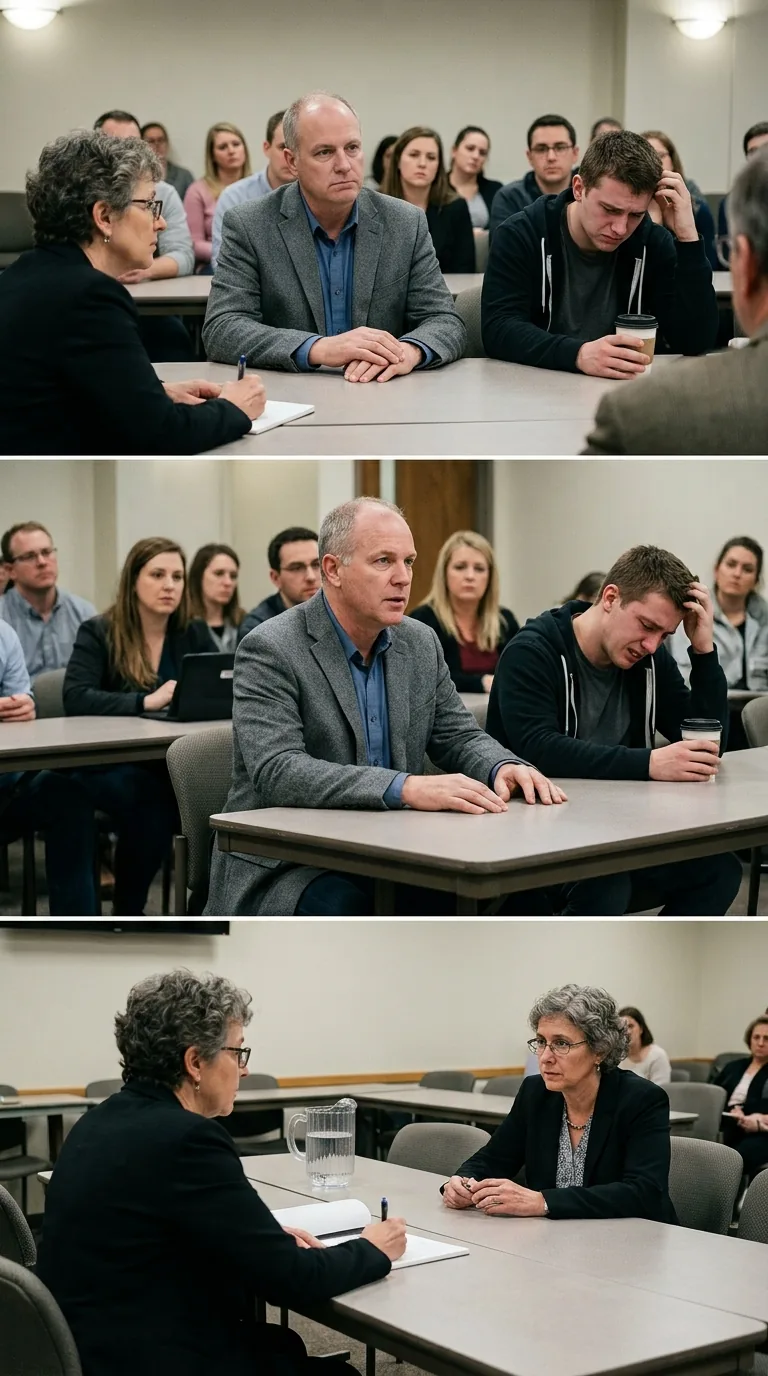
Dr. Park looked at the keychain in my hand, then at Mara, then back at Grant. Nobody in the room moved. Even the technician by the glass door slowed down, one sleeve lifted over the freezer panel, and kept watching without pretending not to.
“You said there was no family dispute,” Dr. Park said.
Grant kept his chin up, but his hand left the podium. “A keepsake is not standing. A story is not standing. She can have whatever object she wants and still not be next of kin.”
The words came out smooth, but his mouth tightened on the last part. I heard that. The room heard it too.
Mara stood beside me, close enough that I could see the thin red line where she had worried the envelope flap open. Her eyes stayed on the chair, not on Grant. When she spoke, she did not raise her voice. “You remember the kitchen drawer,” she said.
Grant turned his head toward her so fast it looked like a jerk. “Don’t do this here.”
She did not stop. “You burned the rice. Nina cut her thumb on the lid. You said the keychain was junk and she kept it anyway.”
A murmur moved through the audience. Not loud. Just enough to change the air.
Grant gave a short laugh that had no humor in it. “Anyone can repeat a family anecdote.”
Mara reached into the open envelope and took out a folded card I had not seen before. It was old paper, the edges softened and darkened from being handled too many times. She held it with both hands. I could see blue ink on one side, the kind that bleeds a little when it gets damp.
She looked at me once, then at Dr. Park. “Read the back.”
Dr. Park held out a hand. Mara crossed the short space between them and placed the card on the table. I stayed where I was, the keychain pressed into my palm so hard the little ring bit my skin.
Dr. Park turned the card over. Her eyes moved across it. The room waited. Then she read out loud, voice flat and careful: “If Nina leaves it in the drawer again, tell her I kept it for her.”
The sentence hit me like a door opening in a place I had not been allowed into for years. I knew it. Not because it was written there. Because I had heard it. The kitchen chair leg scraped the floor in my head as clear as if it were happening now. I knew the steam on the window. I knew Mara’s sleeve brushing my arm when she reached past me. I knew the exact shape of the laugh Grant had tried to swallow when the keychain bounced off the counter.
Grant’s hand slid across the podium edge. “That is not proof of anything.”
Mara shook her head once. “You were there.”
He did not answer fast enough.
That was the first crack. Not a confession. Not a collapse. Just a delay, a beat too long in a room built on quick denials.
Dr. Park set the card down and looked toward the freezer behind the glass. “Bring the preserved sample log up,” she said.
The technician hesitated, then unlocked the side panel and slid a paper tray from the file slot beside the unit. He walked it in with both hands, careful as if the paper might tear the room open. The log showed dates, initials, storage transfers, signatures. I did not need every line. I only needed the one with Mara’s initials beside a note marked personal continuity item.
Grant saw it too. I watched his eyes move across the page and stop.
Dr. Park tapped the note with one finger. “This item was logged as belonging to the continuity record for Nina Vale.”
The audience started to shift in their seats. One man leaned forward. A woman two rows back covered her mouth with her hand. No one spoke over the chair this time.
Grant finally looked straight at me. “You should not have brought this here.”
It was the closest thing to a warning he had said all morning.
Mara answered before I could. “It was always going to come here.”
Dr. Park lifted her head. “Mr. Vale, step away from the podium.”
He did not move.
The technician had stopped beside the freezer, one hand on the door handle, waiting. The blue indicator light kept blinking through the glass like it had all day, ordinary and cold. But now the room had gone from listening to watching, and every face in it had turned toward the same point: the card, the log, the keychain in my hand, and the fact that Grant had just been caught standing on a lie he could not make tidy anymore.
Dr. Park said my name again, clear and public. “Ms. Vale, confirm whether the object and the memory match.”
I closed my fingers around the keychain. The crack in the blue tab pressed against my thumb.
“They do,” I said.
And Grant, for the first time, had nothing to say to the room.