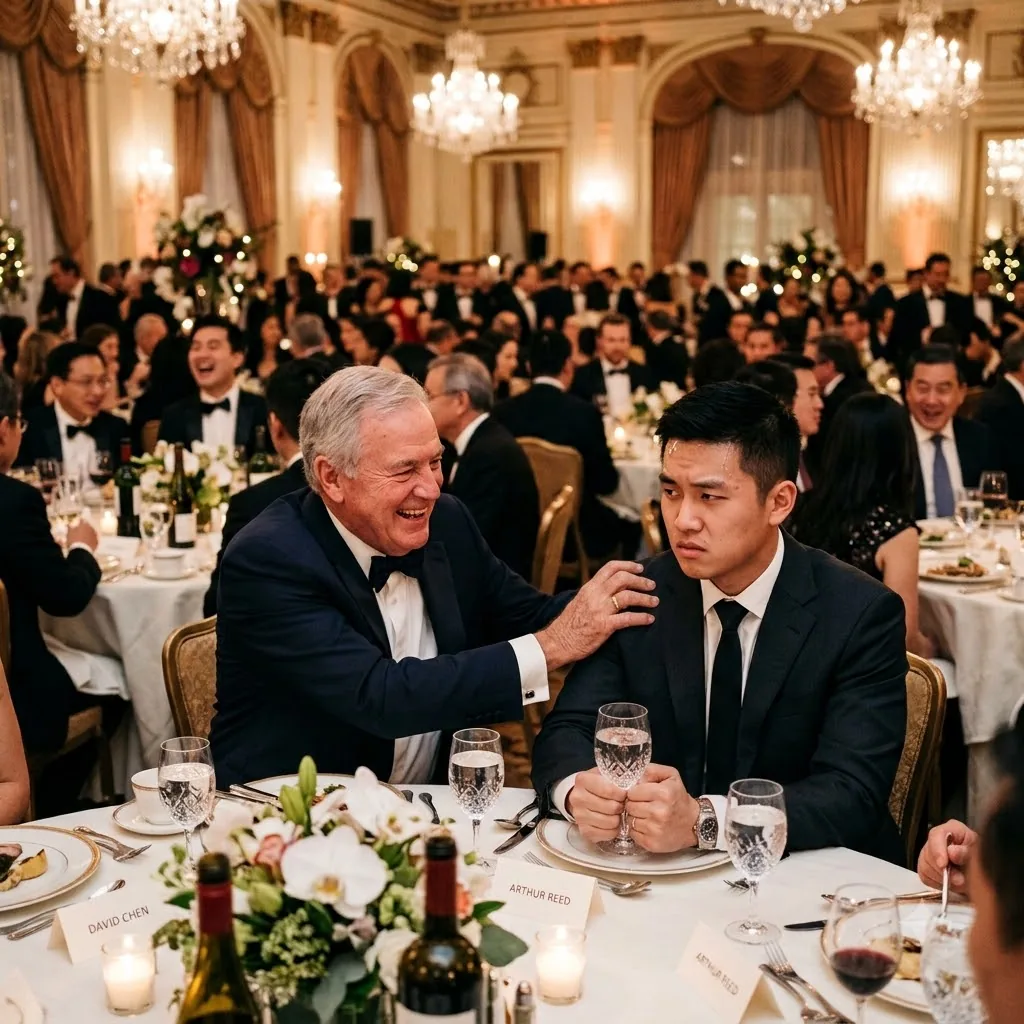
Story code: ST-000950
Part 4: The Cost of Defiance
The mechanical whir of the projector’s cooling fan was the only sound in the council chamber. The sepia-toned illusion of Arthur’s benevolent empire had vanished, replaced by the glaring, undeniable satellite map of his private tennis courts.
Chairwoman Miller adjusted her microphone, her face pale but hardened with resolve. She banged her wooden gavel, the sharp crack snapping the room out of its collective paralysis.
“Given the explicitly fraudulent nature of the Vanguard Trust’s petition,” Miller announced, her voice echoing off the high ceiling, “I am overriding the standard review period. We will vote on the municipal transit expansion and the associated Eastside structural relief fund right now.”
Arthur didn’t shout. He didn’t pound his fists on the podium. He simply stood there, buttoning his tailored suit jacket with deliberate, agonizing slowness. His face smoothed into a mask of cold, terrifying composure.
“All in favor of the expansion,” Miller said.
Three hands went up. Miller, and two progressive council members who had been quietly fighting Vanguard for years.
“Opposed.”
Two hands went up-the older councilmen whose campaign coffers were heavily lined by the Heritage Club.
“Three to two. The motion passes,” Miller declared, striking the gavel again. “The transit project is approved, and the Eastside school funding is secured under municipal oversight.”
It had come down to a single vote. One vote to break a decade of Vanguard’s stranglehold on the city’s development.
Arthur finally turned away from the bench. He didn’t look at the flashing cameras of the local press. He looked directly at David. The grandfatherly warmth was entirely gone from the billionaire’s eyes, replaced by a dark, bottomless calculation. Arthur didn’t say a word. He didn’t need to. He simply turned and walked out the heavy oak doors, his leather shoes clicking rhythmically against the linoleum, leaving his brass executive keys sitting abandoned on the podium.
David let out a long, shuddering breath. The crushing iron band that had been wrapped around his ribs since the fundraiser finally dissolved. He reached into his pocket and checked his phone. There was a new text from his sister, sent over airport Wi-Fi. *Landed in London. Cab to the flat now.*
Maya was safe. The school would get its roof repaired. David had successfully navigated the trap, burning the golden cage before Arthur could lock the door.
Two hours later, David walked through the double glass doors of the Eastside Community Center. The adrenaline crash had left his limbs feeling heavy, but a quiet, profound relief settled in his chest. He wanted to see Mrs. Higgins, the director of the neighborhood food bank. He wanted to tell her that the threat of Vanguard bulldozing their block for a luxury bypass was officially dead.
Instead of the usual bustling chaos of volunteers sorting donations, the main hall was eerily quiet. The loading bay doors were rolled down.
David found Mrs. Higgins sitting alone at a plastic folding table in the center of the gymnasium. She wasn’t organizing inventory. She was staring blankly at a thick stack of printed emails, her hands resting flat on the cheap wood-grain laminate.
“Mrs. Higgins?” David asked gently, his footsteps echoing in the empty gym. “Is the afternoon delivery late?”
The older woman looked up. Her eyes were red-rimmed and exhausted, aging her ten years since David had last seen her. “There is no delivery, David. There won’t be one tomorrow, either.”
David frowned, stepping closer to the table. “What do you mean? Did the distributor mix up the dates?”
She didn’t answer. She simply slid the top piece of paper across the table toward him.
David picked it up. It was an email from the Sterling Group, one of the primary benefactors of the Heritage Club Donor Network. He recognized the sender’s name immediately. It was the man who had sat two seats down from him at the gala, the one who had cheered for David’s supposedly inspirational “immigrant grit.”
*Due to unforeseen shifts in the local economic climate, we are immediately suspending our charitable matching grants…*
David quickly flipped to the next page. It was a termination of funding from the Vance Foundation. The next was a withdrawal from the gala committee.
“Every single matching grant,” Mrs. Higgins whispered, her voice hollow and trembling. “Pulled. In the last two hours. They didn’t just withdraw from the food bank. They canceled the funding for the winter coat drive, the after-school tutoring program, and the community clinic.”
David stared at the stack of papers, his blood running cold. The names on the cancellation notices were the exact same people who had given him a standing ovation last night. They weren’t genuine philanthropists; they were Arthur’s loyal courtiers. And Arthur had just snapped his fingers.
“They said the municipal environment has become ‘hostile to private enterprise’,” Mrs. Higgins read from her own screen, a bitter tear finally spilling over her lashes. “Two hundred thousand dollars, David. Gone before lunch. We operate on razor-thin margins as it is. How are we supposed to feed these families next month? How do I tell the mothers who rely on us?”
The taste of victory turned to ash in David’s mouth. He had defeated Arthur in the council chamber. He had saved the school and protected his sister from being leveraged. But Arthur didn’t just control the Vanguard Trust; he owned the city’s entire ecosystem of wealth.
Since Arthur couldn’t cage David anymore, he had chosen to starve David’s neighborhood instead. It was a surgical, devastating retaliation, executed entirely within the bounds of the law.
David stood in the echoing, half-empty gymnasium, staring at the few remaining pallets of canned goods. He had protected his own family. He had exposed the rot at the center of Vanguard. But as he listened to Mrs. Higgins quietly crying over the ruined budget sheets, the heavy burden of the fallout pressed down on his shoulders. He had won his freedom, but the bitter cost of his defiance would be paid by the very community he had tried to save.