Story code: ST-000976
Part 4: Systemic Friction
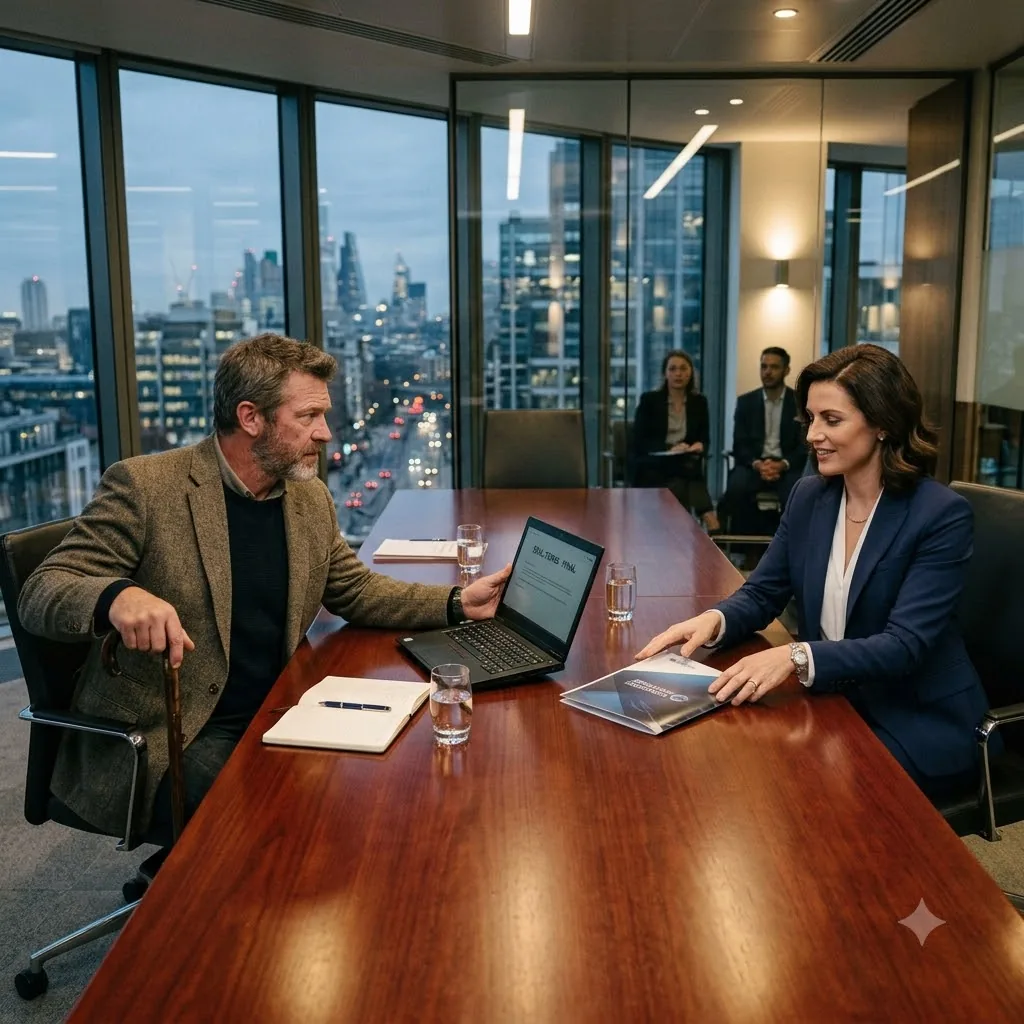
Elias lifted his hand from the heavy-bond paper. He didn’t snatch it away; he just elevated his palm, leaving the hallucinated contract pinned against his closed ThinkPad. Chloe didn’t move to take it. Her eyes remained locked on the words “mutually buoyant,” the glossy veneer of her corporate authority dissolving into the terrified realization that she had almost committed fraud on behalf of a software update.
She reached out with a trembling finger and tapped a red icon on her tablet. Beyond the glass wall, the two security guards stopped. The lead guard looked at his phone, frowned, and gave a short nod toward the conference room before turning away. They retreated down the gray-carpeted hallway, leaving the execution unperformed.
“I’m leaving the laptop and the keycard,” Elias said, his voice quiet in the stifling silence of Conference Room B. “My department is closed. I am laid off. If Vanguard Logistics wants to withhold my severance based on a hallucination from a defective language model, they can explain it to the state labor board. But you should ask yourself if they’re going to pay for your legal defense when that happens.”
Chloe didn’t answer. She sat frozen in her ergonomic mesh chair, staring at the physical evidence of her own obsolescence. She wasn’t a ruthless executive. She was just a flesh-and-blood human interface for a machine that didn’t know what it was doing, hired to take the blame when it broke the law.
Elias picked up his phone, slipping it into his jacket pocket. He turned his back on the external optimization consultant and pushed through the heavy glass door.
The walk through the bullpen was a gauntlet of averted eyes. The remaining employees kept their heads buried in their monitors, typing with desperate, performative urgency. None of them looked at Elias. They were all too afraid that whatever algorithmic scythe had just missed him was still swinging through the room.
By the time Elias pushed through the revolving doors and stepped out into the blinding glare of the parking lot, the adrenaline that had sustained him in the fishbowl began to evaporate. The brutal July heat radiating off the asphalt hit him like a physical blow. The microscopic vibrations in his left bicep-the warning tremors he had held at bay through sheer force of will-suddenly flared. The muscle twitched violently, a rapid, uncontrollable spasm that jerked his arm against his ribs.
He fumbled his keys with his right hand, dropping them once on the scorching pavement before finally unlocking his ten-year-old sedan. He climbed inside, shutting the door against the roar of the nearby interstate.
The interior of the car was an oven. The steering wheel was too hot to touch. Elias didn’t start the engine. He just sat in the stifling, stale air, gripping his left wrist with his right hand, trying to physically clamp down on the misfiring nerves.
He had won the standoff. He hadn’t signed away his rights. He hadn’t let Chloe weaponize his service record or fire him for cause. But as the heat pressed in on him, the hollow reality of the victory settled into his chest. He had walked away with his dignity intact, but he had also walked away without his COBRA authorization forms. Vanguard Logistics was still broken. The machine was still in charge of the payroll system. His severance was trapped in a digital limbo, and without the insurance override, his pharmacy would not release the medication he needed today.
Without the medication, the tremors would spread. Without the medication, he would fail the mandatory physical screening for his upcoming neurological surgery next week-a procedure the VA would only cover if he remained medically stabilized beforehand.
Elias took a ragged breath. The sweat stung his eyes. He reached into his jacket pocket and pulled out his phone. The screen was still warm from the recording he had made in the conference room.
He opened his contacts and dialed the Veterans Affairs regional medical center. He pressed the phone to his ear, listening to the hollow digital ringtone as a bead of sweat rolled down his neck.
The ringing stopped. A synthetic, flawlessly modulated female voice filled the speaker.
“Thank you for calling the Veterans Health Administration,” the automated voice chirped, possessing the exact same soothing, hostage-negotiator cadence Chloe had used thirty minutes ago. “To ensure we direct your call to the proper department, please tell me, in a few brief words, what you need help with today.”
Elias closed his eyes. The tremor in his arm shook the entire door panel of the sedan.
“Pharmacy,” Elias croaked, his throat completely dry. “Medication authorization.”
“I think you said, ‘Pharmacy,'” the machine replied cheerfully. “Is that correct? You can say ‘Yes,’ ‘No,’ or ‘Main Menu.'”
“Yes,” Elias said.
“Great,” the AI responded. “Due to unusually high call volumes, all of our pharmaceutical care representatives are currently assisting other veterans. Your estimated wait time is… forty-seven minutes. Please stay on the line, as your health and service are incredibly important to us.”
Hold music, a tinny, compressed rendition of a patriotic march, began to play.
Elias sat in the suffocating heat of the car, trapped in the silence between the brass notes. He had just fought a desperate, exhausting war against a defective machine in a glass room, only to be cast out into the parking lot, right back into the waiting arms of another algorithm. He kept the phone pressed to his ear, staring out through the heat distortion rippling over the hood of his car, listening to the machine tell him how much his sacrifice mattered while he waited for a human being who might never answer.