Story code: ST-000999
Part 3: The Bargaining Unit
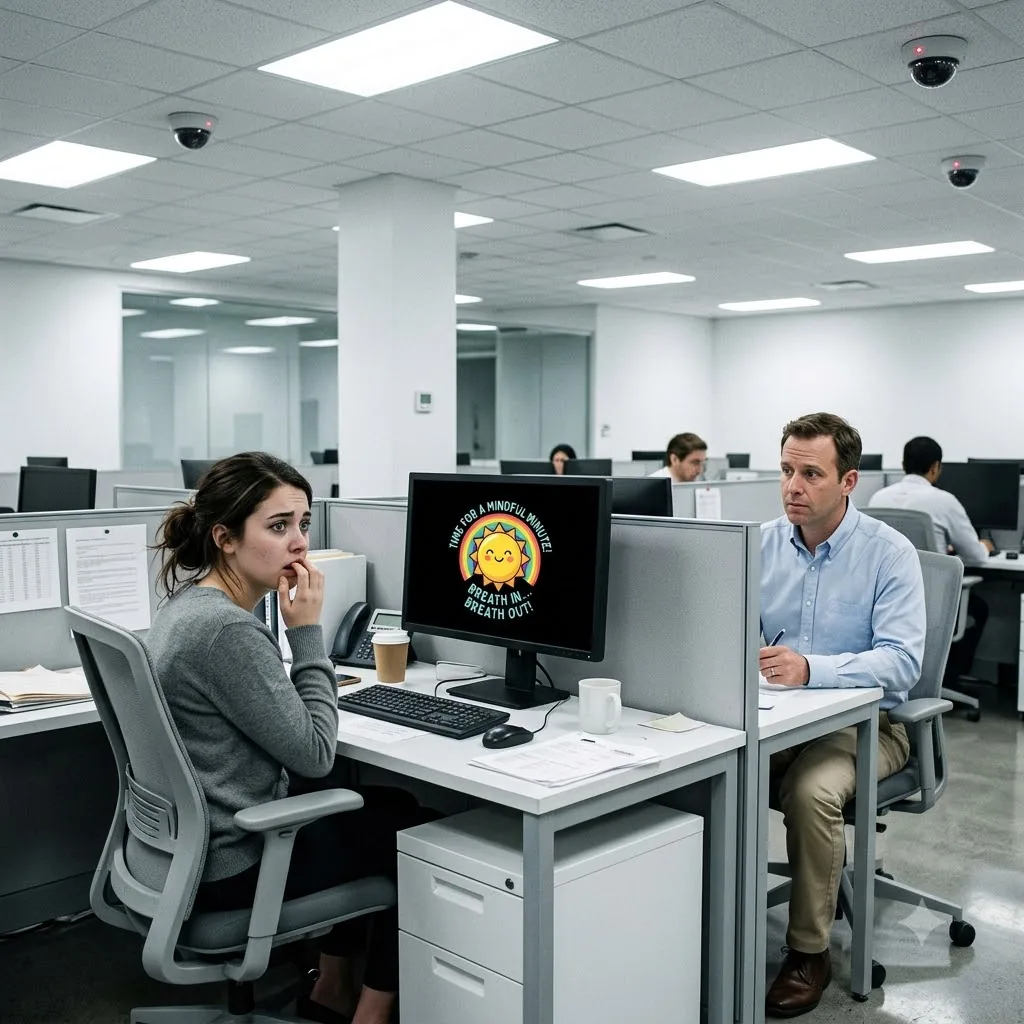
The red error text bled across Marcus’s right monitor. On Chloe’s tablet, his real-time telemetry flooded the interface, stripping away the calm illusion of the loop. The digital needle on her screen slammed from a tranquil seventy-two straight into the red, hovering at a frantic one hundred and forty-three beats per minute. His galvanic skin response spiked off the chart.
Chloe didn’t flinch. She simply tapped a rapid sequence of keys on her tablet, manually overriding the automatic security dispatch before the overhead lights could strobe red and summon the white-polo guards.
“Bring your bag,” she said. The singsong corporate cheer was instantly gone, replaced by a flat, clinical precision. “My office. Now.”
Marcus’s hands shook as he reached under his desk, scooping up his canvas messenger bag. He followed her down the main aisle. The glass-walled HR suite sat elevated at the end of the bullpen, a transparent panopticon overlooking the rows of perfectly aligned, empty desks. His chest heaved, but with every step away from the VibeCheck webcam, a strange, cold clarity began to settle over him. The panic of being caught was fading into the adrenaline of the endgame.
The heavy glass door sealed shut behind them with a soft hiss, entirely cutting off the ambient server hum of the floor. Chloe moved behind her pristine, white-oak desk and sat down. There were no papers, no pens, only a single biometric admin terminal.
“You understand what you’ve done,” Chloe said, steepling her manicured fingers. “Biometric spoofing is a category-one termination offense. I don’t even need to run this through VibeCheck. I can process the manual severance right now. Catching an active digital saboteur is going to reflect incredibly well on my quarterly efficiency bonus.”
Marcus stood in front of the desk, keeping his bag slung over his shoulder. “I didn’t spoof the feed to hide a panic attack. I needed exactly four unmonitored minutes to access the legacy admin quarantine and extract the raw flag logs. I just routed them to your personal terminal.”
Chloe frowned, waking her desktop screen. Her eyes flicked left to read the incoming secure packet. “This is highly unauthorized access.”
“Open the file on Elena Rostova,” Marcus said.
Chloe’s jaw tightened infinitesimally, the first crack in her flawless composure. “Elena was severed three weeks ago. Her joy metrics plummeted. She demonstrated a persistent, uncorrectable pattern of physical fatigue and respiratory irregularity.”
“She was in her first trimester,” Marcus countered, stepping forward and planting his palms on the edge of the oak desk. “The algorithm didn’t detect a bad attitude, Chloe. It detected an elevated basal body temperature. It detected a resting heart rate that increased to support a pregnancy. It penalized her for taking three extra minutes in the restroom for morning sickness.”
“The algorithm measures output,” Chloe said, her voice dropping to a glacial chill. She didn’t look at the screen; she looked dead at him. “It does not contextualize biology. If a unit’s output degrades, the underlying reason is irrelevant to the bottom line.”
“You knew,” Marcus said. He tapped the thick glass of her monitor. “The raw logs show she submitted a formal medical accommodation request to HR two days before her termination. VibeCheck couldn’t read the PDF because she uploaded it to the deprecated legacy server by mistake. But you saw it. You received the manual alert.”
Chloe leaned back in her ergonomic chair, folding her arms over her immaculate beige suit. “And if I had intervened? If I had manually overridden a direct AI termination recommendation to protect a physically compromised worker? My departmental efficiency rating would have dropped by six points. I would have forfeited my performance bonus to harbor a diminishing asset.”
Marcus stared at her, absorbing the absolute, terrifying void behind her perfectly applied makeup. There was no misunderstanding, no machine error to correct. The cruelty wasn’t a glitch; it was the intended architecture. She had willingly fed a pregnant woman to the algorithm for a percentage bump in her quarterly payout.
“You coldly chose a bonus over a woman’s livelihood,” Marcus said quietly.
“I chose the health of the ecosystem,” Chloe corrected, her bright smile returning, sharp and brittle. “And now I am excising you. You have no leverage, Marcus. Forwarding this to a labor attorney will take months of litigation, and you’ll be locked out of the building in five minutes. The company will settle for a fraction of what Elena would have cost us in maternity leave. You accomplished absolutely nothing.”
“I wasn’t looking for a lawsuit,” Marcus said, standing up straight. “I just needed hard proof that HR was actively subverting legal medical accommodations. I needed the final piece to show the rest of the floor exactly what happens when the algorithm decides they aren’t smiling hard enough.”
Marcus unclasped the main flap of his messenger bag.
For the past three months, he hadn’t just been mapping the legacy servers. He had been organizing in the only blind spots the building had left: the acoustic dead zones in the fire stairwells, the unmonitored stalls of the second-floor bathrooms, the brief, ten-second intervals between webcam sweeps.
He reached into the bag and pulled out a thick, heavy stack of green cardstock.
He placed the stack on the pristine white oak and slid it firmly across the desk. The cards fanned out slightly as they hit the edge of Chloe’s keyboard, displaying dozens of cramped, hurried signatures in black and blue ink.
Chloe’s eyes dropped to the cards. The brittle smile froze permanently on her face.
“NLRB Form 3020,” Marcus said, his voice echoing loudly in the soundproofed room. “Signed, physical union authorization cards from eighty-five percent of the floor. VibeCheck can fire a single failing metric, Chloe. It can’t fire a legally recognized bargaining unit.”
Chloe stared at the cards, the green paper a glaring, chaotic stain against the minimalist perfection of her workspace. She reached out with a trembling finger, hovering over the name at the top of the stack. Elias’s signature was right there, dated yesterday.
She looked up at Marcus, the synthetic lavender perfume suddenly smelling stale and suffocating in the stagnant air of the office. Her mouth opened, but for the first time all day, she had absolutely nothing to say.