Story code: ST-001035
Part 3: The Trauma Failsafe
Margaret lowered the phone, her thumb resting lightly on the dial pad. She looked at Sarah with a cold, triumphant smile, her eyes glittering under the harsh amber streetlamp. “Three thousand dollars total. Or you spend the night in lockup, miss your next shift, and lose your nursing license over a criminal trespass charge. I suggest you step aside, Sarah. Your choice.”
Sarah stared at the green glow of the phone screen in the darkness. The numbers tumbled through her head in a rapid, nauseating loop. Three thousand dollars. Arrest. Foreclosure. The complete and utter destruction of the life she had scraped together, all hanging on the whim of a woman in a spotless beige tracksuit who wanted to maintain a sightline to the street.
The panic, which had been boiling rapidly in Sarah’s chest, suddenly hit a ceiling.
It was a distinct, physical sensation, like a heavy steel door slamming shut in her brain. She recognized it instantly. It was the exact neurological failsafe that triggered when the paramedics burst through the double doors covered in someone else’s blood, screaming plummeting pulse rates and dropping oxygen stats. In the trauma bay, panic was a luxury she couldn’t afford. The hysteria vanished. The bone-deep exhaustion burned away into a sharp, crystalline detachment.
Sarah dropped her hands to her sides. She stopped shivering in the chill night air. Her posture straightened, the slump of a fourteen-hour shift disappearing beneath the sudden, rigid stillness of a trauma professional standing over an operating table.
“Call them,” Sarah said. Her voice was entirely flat, empty of all pitch, tremor, or fear.
Margaret’s smile faltered by a fraction of an inch. She blinked, clearly thrown by the sudden drop in volume. “I will. Don’t test me, Sarah.”
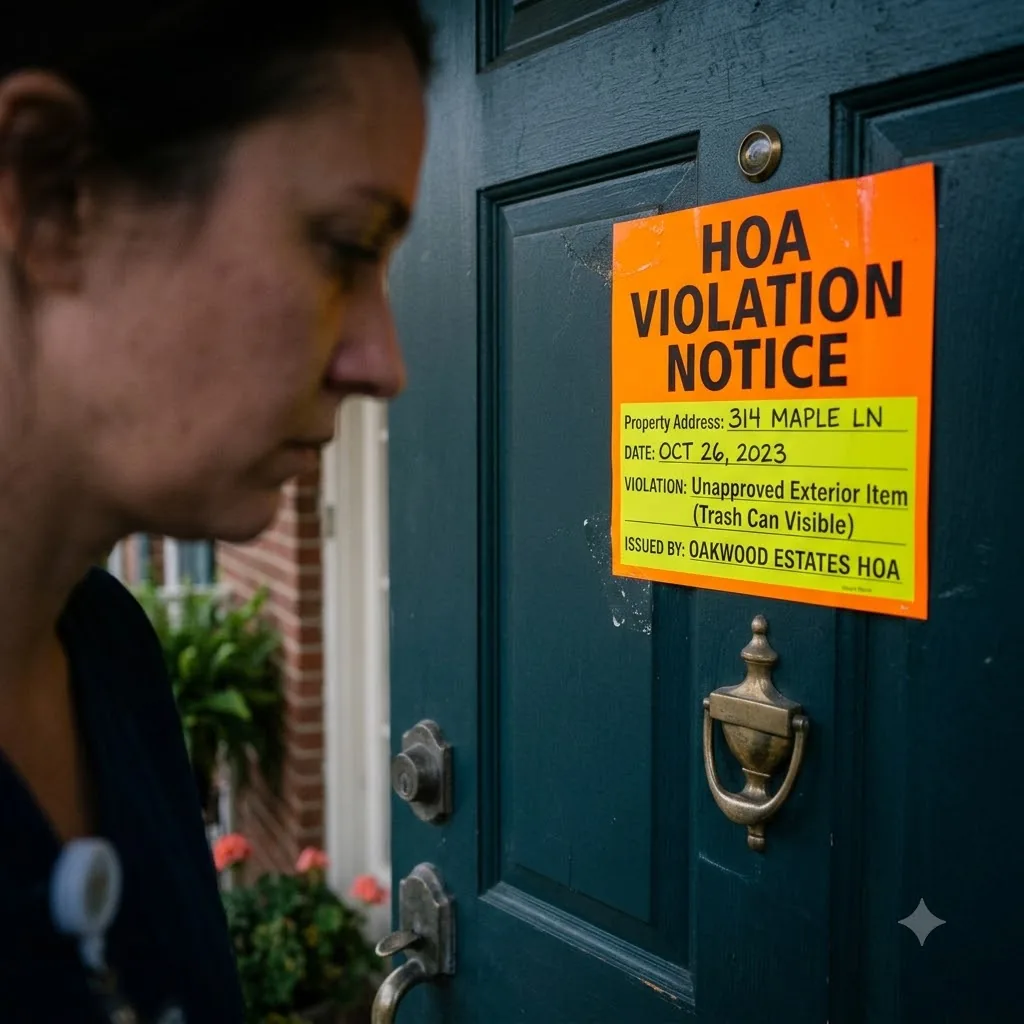
“Call them. But before they get here, I want you to know exactly what I was doing for fourteen hours before I found your little orange sticker on my door.”
Margaret’s eyes darted nervously toward the street, then back to Sarah. The older woman shoved the smartphone into the zippered pocket of her tracksuit and grabbed the pull-cord of the hedge trimmer. “I’m not listening to your excuses. I am clearing this hazard.”
She yanked the cord. The heavy engine roared back to life, spitting a fresh cloud of noxious blue smoke into the damp air. The long, metal teeth blurred into a deadly, vibrating line. Margaret gripped the thick rubber handles, pointing the heavy machinery forward to force Sarah to jump out of the way.
Sarah didn’t jump.
She took a slow, deliberate step forward, her gray scrub top stopping an inch from the heavy metal safety guard. The violent vibration of the idling engine rattled deep in her own ribs.
“Do you know what a high-velocity rifle round does to an eight-year-old boy’s chest cavity?” Sarah asked.
She didn’t yell. She pitched her voice into the exact, cutting frequency she used to issue stat orders over the chaos of a coding patient-a tone so dense and authoritative that it sliced straight through the roaring noise of the two-stroke engine.
Margaret flinched, instinctively easing her finger off the throttle. The blades slowed to a loud, metallic clatter. “Get out of the way!”
“It doesn’t just punch a hole,” Sarah continued, taking another step forward.
Margaret was forced to take a half-step back, her pristine sneakers slipping slightly on the wet grass.
“The kinetic energy creates a temporary cavitation bubble inside the torso,” Sarah said, her voice entirely devoid of emotion. “It expands faster than the speed of sound. It vaporizes the tissue. The lungs don’t just collapse; they turn to jelly.”
“You’re sick! Shut up!” Margaret snapped, her face twisting in revulsion. She revved the engine slightly, a warning blip of deafening noise, but Sarah didn’t even blink.
“When you crack the sternum to attempt a cross-clamp of the aorta, there is nothing left to pump,” Sarah said, her dead eyes locked onto Margaret’s. “The bone fragments feel like wet gravel inside your surgical gloves. You can’t stop the bleeding because there are no intact vessels left to clamp. You are just scooping out handfuls of red sludge while the smell of hot copper and punctured bowels fills the room.”
“I said shut up!” Margaret’s voice hitched, the shrill edge of genuine panic finally bleeding through her sterile, suburban authority. She gripped the trimmer tighter, holding it defensively across her chest like a shield.
“His mother was in the hallway,” Sarah said, her voice dropping into a horrific, clinical whisper that carried perfectly over the idling motor. “She sounded exactly like that engine. A high, mechanical scream. She screamed until her vocal cords tore and she started vomiting blood. I held her up. I wiped the blood off her chin. I pronounced her child dead at 3:15 AM. Then I washed the boy’s brain matter out of my hair, got in my car, and drove home to you.”
Sarah took one more step. The vibrating metal guard of the trimmer pressed directly into the thin fabric of her scrubs, right over her stomach.
“You think you’re terrifying?” Sarah asked, staring into Margaret’s horrified face. “You think a piece of heavy cardstock and a yard tool make you a god? You are a pathetic, empty woman playing dress-up, threatening to steal my home over a rotting plant. You are absolutely nothing.”
The perfect, pristine facade of the HOA president shattered completely.
Margaret’s face flushed a violent, mottled purple. The cold calculation in her eyes vanished, replaced instantly by a feral, unhinged fury. She couldn’t handle the graphic horror invading her manicured lawn. She couldn’t handle the absolute lack of fear in Sarah’s eyes. The cognitive dissonance of being reduced to nothing snapped the last threads of her control.
With a screech of pure, wordless rage, Margaret twisted the throttle all the way back. The engine shrieked. She didn’t step back. Instead, her knuckles turned bone-white as she hoisted the heavy motor upward and swung the screaming, serrated blades directly toward Sarah’s chest.