Story code: ST-001042
Part 2: Dead Weight
Marcus stumbled backward, his boots scraping against the pristine flagstones of Sterling’s porch. He caught his balance just as the heavy oak door clicked shut with an airtight seal. He stood there for a long moment, staring at the brass handle, his lungs working hard to pull in the humid morning air.
A deep, throbbing ache radiated up his forearm. He looked down at his wrist. The skin was already mottling into an angry purple, leaving four distinct, elongated indentations where Sterling’s fingers had clamped down. The grip hadn’t just been strong; it had felt industrial, like the jaws of a hydraulic vice closing over his bones. Marcus rubbed the bruised flesh, a cold knot of dread tightening in his stomach. The faint, icy scent of bergamot and cold mint seemed to cling to his skin, suffocating and sharp.
He turned and made the long walk back across the invisible border that separated Sterling’s manicured fortress from his own dying patch of grass.
By noon, the Texas sun was baking the concrete of Marcus’s driveway, turning the air above it into a wavy, distorted haze. Marcus sat on the tailgate of his rusted fifteen-year-old pickup truck, a clipboard resting on his knees. He had spent the last two hours scrolling through the county’s property records and the HOA’s newly updated bylaws on his phone, desperate for a loophole, an appeal process, anything.
There was nothing. The bylaws, revised three months ago just after Sterling became president, were airtight. Article 4, Section 9 stripped homeowners of the standard thirty-day grace period for aesthetic violations, classifying them instead as “immediate community detriments” that compounded daily. Worse, when Marcus looked up the HOA board members, he recognized the names. Two of them were registered agents for the LLC that had built Sterling’s house. The third was Sterling himself. It wasn’t a neighborhood association. It was a weaponized bureaucracy, and the crosshairs were resting directly on Marcus’s chest.
He tossed the clipboard into the truck bed, the metal clip clattering against the rusted wheel well. He couldn’t fight Sterling on paper. The only way to stop the bleeding-to freeze the fines so he could somehow scrape together a loan or beg a lawyer to take his case on contingency-was to cure the violation. The tarp had to go. The machine had to disappear into the garage.
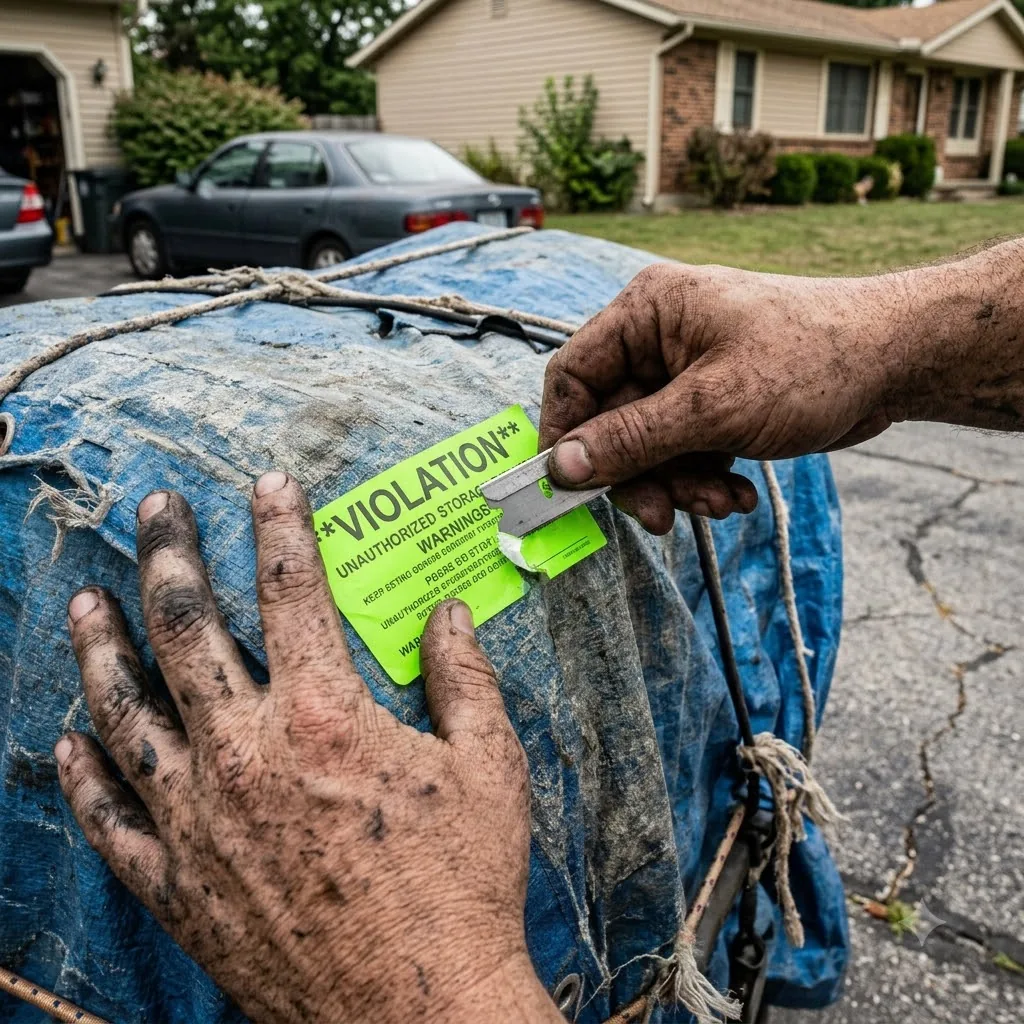
Marcus pulled his heavy leather work gloves out of the cab and walked over to the blue tarp. He grabbed the neon-green citation sticker and ripped it off, taking a layer of the tarp’s woven plastic with it. He threw the heavy canvas back, exposing the skeletal, oil-stained bulk of his grandfather’s Bridgeport milling machine.
It was a beautiful, tragic monster of cast iron and steel. Standing over six feet tall and weighing nearly three thousand pounds, it was a relic of American manufacturing. His grandfather had run a tool-and-die shop with it for forty years. Now, covered in surface rust and sitting on wooden shipping skids in a cracked driveway, it looked exactly like what Sterling claimed it was: junk.
Marcus didn’t have the hydraulic lift. He didn’t have a forklift. He had two heavy-duty ratchet straps, four lengths of galvanized steel pipe to use as rollers, and a desperate, reckless plan.
He spent an hour sweating in the brutal heat, using a crowbar to painfully inch the front edge of the wooden skid high enough to slip the first steel pipe underneath. Every muscle in his back screamed, but the adrenaline fueled by the throbbing bruise on his wrist kept him moving. He hooked the thick yellow webbing of the ratchet strap to the base of the machine, feeding the other end to the trailer hitch of his pickup.
The plan was simple, if dangerous. He would put the truck in four-wheel-drive low, inch forward to drag the machine onto the rollers, and slowly guide it the last twelve feet into the open garage. If he could just get it past the threshold and pull the door down, Sterling’s leverage vanished.
Marcus climbed into the cab. The vinyl seat was scorching. He rolled the window down so he could hear, shifted into four-low, and took a deep breath. He eased his foot off the brake and applied the faintest touch to the gas pedal.
The truck crept forward. The yellow strap pulled taut, groaning under the immense tension. Marcus kept his eyes glued to the side mirror. The massive iron machine shuddered.
*CRACK.*
The sound was like a rifle shot echoing through the quiet, affluent neighborhood. Marcus slammed on the brakes and threw the truck into park, throwing his door open.
The shipping skid hadn’t rolled. The ancient, dry-rotted wood had completely shattered under the diagonal force of the strap. The Bridgeport had pitched violently to the side, sliding off the broken wood and slamming directly onto the concrete driveway. The impact spider-webbed the pavement, carving a deep, jagged gouge into the cement. Worse, the heavy iron base was now resting at a precarious fifteen-degree angle, completely wedged against the lip of the garage foundation. It was immovable. A solid block of dead weight, entirely exposed to the street.
Marcus stared at the disaster, his breathing shallow and rapid. He dropped to his knees, frantically trying to wedge the crowbar under the cast iron, throwing his entire body weight against the steel lever. It didn’t budge a millimeter. The machine was entrenched.
A shadow fell over him.
Marcus froze, turning his head. Arthur Sterling stood exactly on the property line, his immaculate leather shoes toeing the edge of Marcus’s cracked, weed-choked concrete. He wasn’t wearing the linen suit anymore; he was dressed in pristine golf attire, looking entirely unbothered by the suffocating heat.
Sterling held a sleek silver tablet in one hand. He raised it, the camera lens pointing directly at the exposed, listing milling machine and the freshly destroyed concrete beneath it.
*Click.*
“A valiant effort, Marcus,” Sterling said. His voice was smooth, carrying effortlessly across the short distance. “But you’ve only worsened the situation. Unsecured heavy machinery and structural damage to the driveway. That is a Class A hazard under the revised bylaws.”
Marcus scrambled to his feet, gripping the crowbar so hard his knuckles turned white. “You set this up,” he spat, pointing the iron bar at the ground. “You bought the board. You rewrote the rules just to force me out. Why? You already have two lots! Why do you want my house?”
Sterling lowered the tablet. His pale eyes flicked down to the crowbar, entirely unimpressed by the implied threat, before settling back on Marcus’s face.
“I don’t want your house, Marcus,” Sterling said, his tone devoid of any malice, which only made it more terrifying. “I want the ground beneath it. And I am tired of waiting.”
Sterling tapped the screen of his tablet twice.
A loud rumble echoed from the end of the street. Marcus looked past Sterling’s shoulder. Turning the corner onto their quiet suburban cul-de-sac was a massive, yellow Caterpillar excavator, flanked by a flatbed truck carrying sections of temporary chain-link fencing.
“I told you the association would initiate foreclosure on Monday,” Sterling said, turning away. “But the hazard abatement protocols take effect immediately.”