Story code: ST-001045
Part 2: The Faraday Compromise
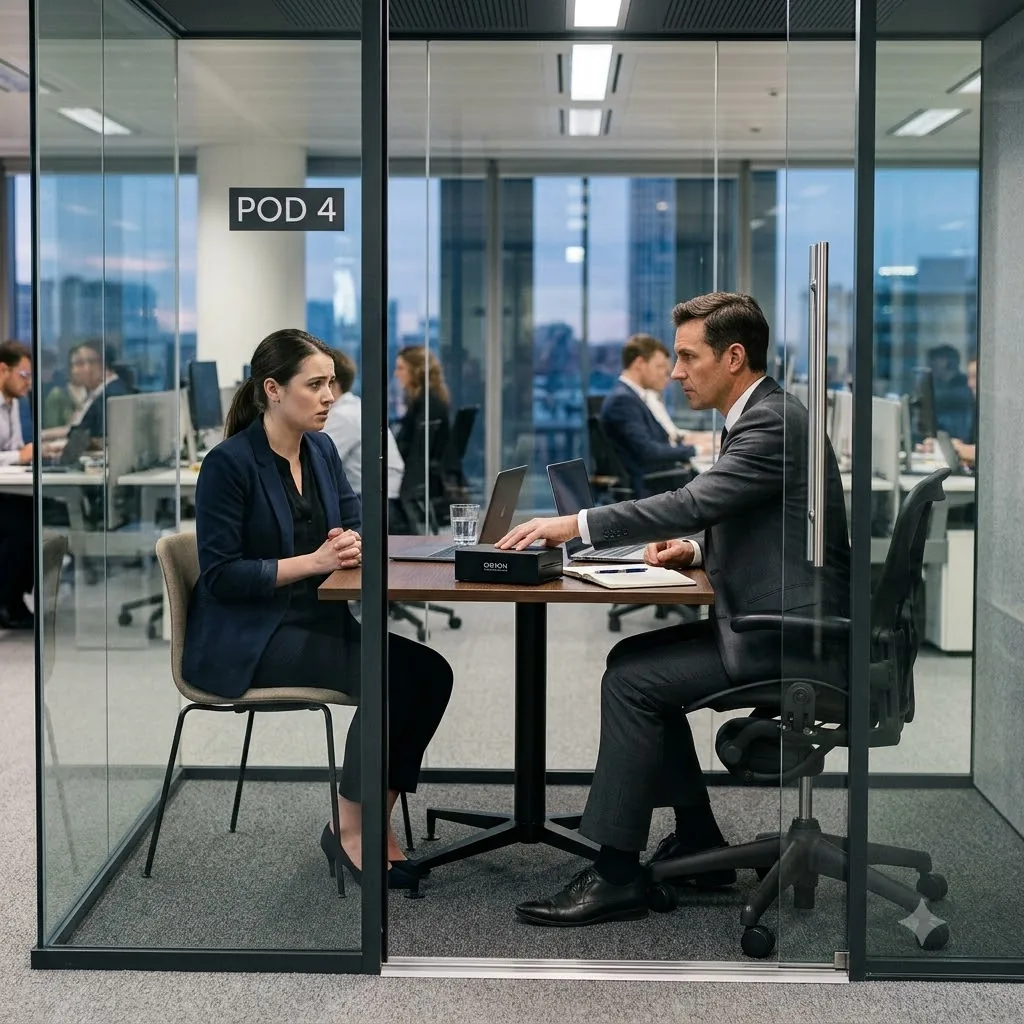
Sarah stared at the featureless white cube resting on the table. She did not reach for it. “Is this a medical device?” she asked, keeping her voice carefully flat. “Because I have not consented to medical telemetry.”
“It is a wellness hub,” Elias corrected, leaning back and crossing his arms. The movement pulled his tailored blazer taut. “It is a core component of the Culture Success initiative. Refusing to integrate with our support infrastructure is classified as active self-harm under the employee handbook. And Sarah, if you are terminated for self-harm, you lose your access to this building. You lose your desk. You lose your… unique vantage point.”
Sarah’s heart hammered against her ribs, a frantic rhythm she desperately hoped his eyes couldn’t detect in the pulse at her throat. He was fishing. He had the exact timestamps of her unplugging her devices, but he didn’t know why. He didn’t know she was tracking the massive, unauthorized data packets that piggybacked on the daily firmware updates. If she lost her job today, she would lose access to the local intranet. She would never find out where those massive packets were being routed, or what they were extracting from the floor’s three hundred employees.
She reached out and closed her fingers over the cube. It was unnervingly heavy, feeling more like a block of solid lead than consumer plastic. It was completely smooth. “How does it connect? There is no cord.”
“The prongs deploy automatically when the base senses a standard electrical outlet,” Elias said. A deeply satisfied smile crept onto his face as he watched her pick it up. He stood, grabbed the heavy chair he had wedged against the door handle, and dragged it back to the table. “You will plug it in directly beside your bed. We require baseline readings of your REM cycles to ensure the office lighting isn’t disrupting your circadian rhythm. It connects via an independent cellular network. Do not attempt to wrap it, shield it, or smother it. The device reports all tamper attempts instantly to HR.”
He opened the heavy glass door. The ambient, chaotic hum of the open-plan office rushed back in, hitting Sarah like a physical wave.
“Have a restorative evening, Sarah,” Elias said.
Sarah walked the six blocks to the subway, the white cube burning a metaphorical hole in her canvas tote bag. Without a smartphone to distract her, she watched the commuters around her. Everyone on the train was hunched over a glowing rectangle, wireless earbuds firmly wedged into their ears, completely tethered to the unseen cloud. They looked tired. Their skin looked grey under the fluorescent carriage lights. Sarah clutched her paper ticket and focused on the rhythmic clatter of the tracks, grounding herself in the physical world.
Her apartment was a third-floor walk-up in a decaying brick building on the edge of the city. It was her sanctuary. The walls were lined with overflowing bookshelves and framed botanical prints. A heavy, mustard-yellow rotary telephone sat on the kitchen counter. The kitchen appliances were decades old, boasting mechanical dials rather than digital keypads.
More importantly, she had spent her entire first month’s salary retrofitting the space. She had carefully installed highly conductive copper mesh lining behind the drywall and hung dense, metallic-threaded blackout curtains over the windows. It was a rudimentary but highly effective Faraday cage. It blocked almost all ambient radio frequencies, Wi-Fi signals, and cellular data. It was the only place she could sleep without the agonizing tension headaches that had plagued her since she started working in the corporate sector.
She set her tote bag on the wooden dining table and pulled out the white cube. It sat on the scarred oak surface, stark, modern, and entirely alien. She had until eight o’clock to plug it in, according to the strict telemetry guidelines in the onboarding manual she had memorized.
She walked into her bedroom. It contained a simple iron bedframe, a stack of paperback novels, and a small brass bedside lamp. There was one electrical outlet on the wall next to the headboard. She unplugged the lamp.
She stood in the dim room, holding the heavy cube. If she plugged it in, Elias’s cellular connection wouldn’t be able to broadcast through her copper-meshed walls. The device would register as offline. She would be fired by tomorrow morning, and her investigation into the six o’clock firmware updates would die.
Unless she opened a window.
Sarah looked at the heavy blackout curtains shielding her bedroom window. Pulling them back would break the cage. It would let the city’s invisible web of signals in. It would let the cube’s signals out.
She checked the mechanical winding clock on her dresser. It was seven-fifty-five.
She had to choose. She could abandon the investigation, accept her termination, and keep her analog sanctuary safe. Or she could compromise the only safe space she had left to stay on the inside.
Gritting her teeth, Sarah marched to the window and yanked the heavy curtains back. The streetlights from the alleyway below cast long, unnatural orange shadows across her bedroom floor. She immediately felt a phantom prickle at the base of her skull-the familiar, low-level static pressure she felt every day at the office.
She knelt by the outlet. As she pressed the flat back of the white cube against the plastic wall plate, two metal prongs shot out from the seamless white box with a violent, mechanical snick, piercing the outlet slots.
The cube seated itself flush against the wall.
For a moment, nothing happened. Then, the cube began to emit a sound. It wasn’t a digital beep or a pleasant chime. It was a low, oscillating hum, right at the absolute bottom edge of human hearing. It vibrated directly in Sarah’s teeth, skipping her eardrums entirely.
It was the exact same frequency the dual monitors at her desk emitted during the firmware updates. The paralyzing sound she had been crawling under her workstation to escape.
Sarah backed away, her breathing turning shallow. The featureless surface of the cube began to pulse with a faint, sickly-sweet violet light, casting a bruised hue over her bedsheets.
Then, the rotary phone in her kitchen rang.
Sarah froze in the bedroom doorway. The harsh, mechanical trill of the metal bells echoed loudly through the quiet apartment. Nobody called that number. Only her elderly landlord had it, and he communicated exclusively by slipping handwritten notes under her door.
She kept her eyes locked on the rhythmic violet pulse of the cube as she slowly backed down the short hallway and into the kitchen. The phone rang again, loud and violently demanding in the small space.
She reached out with a trembling hand, picked up the heavy plastic receiver, and pressed it to her ear.
“Hello?” she whispered.
“Your sleep cycle has not commenced,” Elias’s voice stated flatly, his tone stripped of all therapeutic warmth. “The wellness hub indicates drastically elevated cortisol levels. Please lie down, Sarah. The intervention is beginning.”
Sarah stared at the kitchen counter in pure horror. The phone cord was dangling limply off the edge of the counter. She had unplugged it from the wall jack yesterday morning.