Story code: ST-001051
Part 4: The Pacifier
The siege lasted exactly forty-two minutes. For Leo, kneeling on the scuffed hardwood of the basketball court with his hands laced tightly behind his head, it felt like an eternity of suffocating heat and sheer terror. The red and blue strobe lights of state police cruisers bled through the high, frosted windows of the gymnasium, painting the terrified faces of the trapped teenagers in violent, rhythmic flashes.
Maya had not fired the weapon. When the tactical teams finally breached the chained doors with a deafening crash of heavy battering rams and shattering safety glass, she simply engaged the safety, placed the handgun carefully on the center-court logo, and raised her soot-stained hands. She didn’t look afraid. As the heavily armed officers swarmed her, pinning her to the floor, she looked entirely vindicated.
“We are the policyholders!” Marcus roared as two armored officers forced him face-down onto the hardwood, his sawed-off shotgun sliding harmlessly away toward the bleachers. “You’re arresting the victims! They took everything from us!”
Sarah echoed the chant, struggling against the heavy plastic flex-cuffs biting into her wrists. The gymnasium was a chaotic swirl of shouting police, sobbing students, and the metallic clatter of confiscated weapons. Leo kept his face pressed toward the floor, squeezing his eyes shut, his heart hammering a frantic rhythm against his ribs. An officer hauled him to his feet, patting him down roughly. Leo babbled his innocence, his voice cracking as he held up the thick leather work gloves like a shield. He repeated his name, his FEMA trailer number, his occupation. *I’m an accountant. I didn’t know. She brought bolt cutters. I thought it was an audit.*
They believed him. After three grueling hours of interrogation in the back of a sweltering command tent pitched on the football field, a tired state detective had tossed Leo a bottle of tepid water and told him to go home. The police had found the heavy canvas duffel bag. They had cataloged the massive, yellow-handled bolt cutters and the angle grinder layered over the false bottom. They recognized a panicked, ignorant bystander when they saw one.
As Leo stumbled away from the high school campus, he looked back at the loading dock. The armored transport truck was gone. The entire insurance convoy had slipped away during the chaos, taking the regional drives, the unedited drone footage, and the last shred of corporate accountability with them. The student walkout was over. The teenagers had been evacuated, their cardboard protest signs trampled into the dying grass by heavy police boots. Maya’s armed takeover hadn’t stopped the insurance conglomerate’s escape; it had provided the perfect distraction for it to slip away unnoticed.
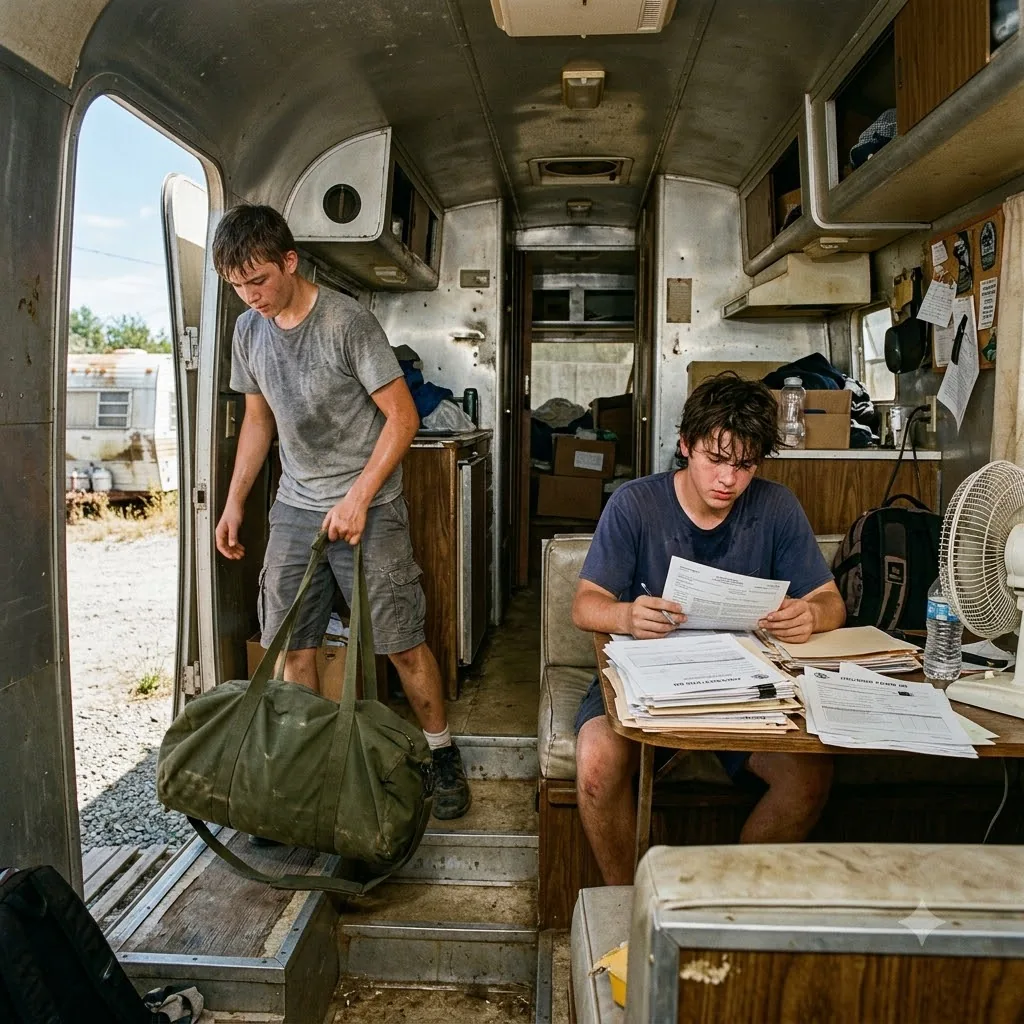
The walk back to the relief camp was a blur of hazy, smoke-choked sunlight. When Leo finally reached his cramped, aluminum-sided unit, the hollow metal door was still slightly ajar, exactly as they had left it.
He stepped inside. The air was a stagnant, baked-fiberglass oven, easily topping a hundred degrees. The silence was absolute, pressing against his eardrums with a physical weight. He stood in the center of the tiny kitchen area, the thin linoleum floor creaking beneath his shoes.
The cheap laminate dining table was still bowed slightly in the center, permanently warped by the immense weight of the canvas duffel bag Maya had dropped there just a few hours ago. And scattered across the floor, exactly where they had fluttered down like dead leaves, were the remaining thirty-nine pages of his meticulously highlighted appeals strategy.
Leo slowly sank onto the sagging, synthetic-leather bench seat. He didn’t bother to wipe the sweat dripping from his chin. He stared down at page twenty-two. It bore a perfect, pale gray imprint of Maya’s boot tread-a permanent stamp of ash obliterating the convoluted regulatory clause he had been so certain would save him.
He reached down and picked up the paper. The blue ink from his ballpoint pen, marking out secondary review loopholes and administrative deadlines, looked entirely pathetic. It was a language spoken only by the people who had just permanently abandoned the valley. The rules, the forms, the certified letters-they were all a polite fiction. They were a bureaucratic pacifier designed to keep desperate people quietly organizing paperwork while their lives were liquidated.
Maya was currently sitting in the back of a state police transport, chained to the floor, facing decades in a federal penitentiary. Her life was definitively over. But as Leo stared at the useless legal jargon in his trembling hands, a cold, suffocating truth settled in his chest.
Maya’s violence, as reckless and terrifying as it was, had forced the world to acknowledge her existence. She had made a noise loud enough to stop a crowd, to draw the authorities, to demand space in a reality that was trying to erase them. She had acted. It was destructive, but it was real.
Leo dropped the paper. It drifted back to the ash-stained floor. He sat alone in the stifling heat of the FEMA box, surrounded by forty pages of automated rejection. The insurance company was gone, his neighborhood was a grid of white ash, and his flawless understanding of the system had achieved absolutely nothing. Maya was locked in a cage, but it was Leo who realized he was the one who didn’t exist.