Story code: ST-001053
Part 3: The Concrete Ledge
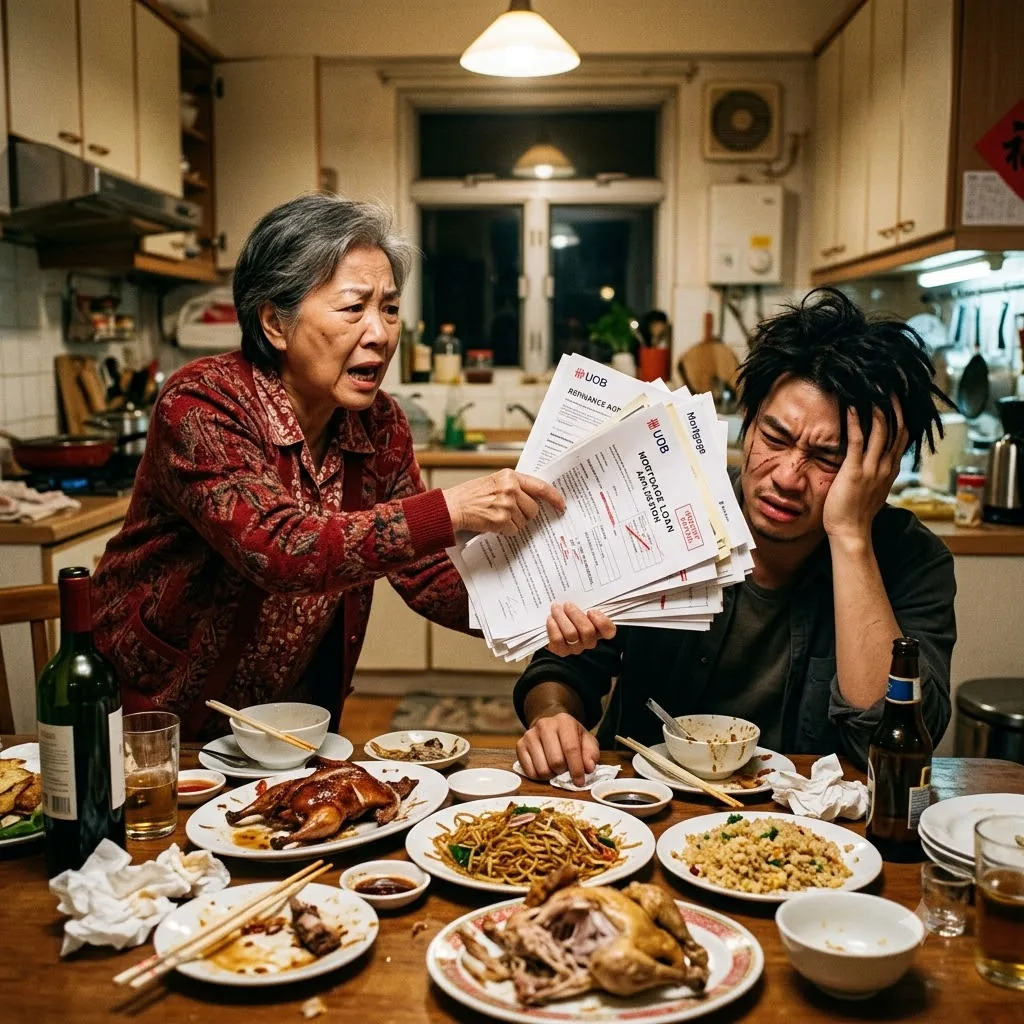
It had been forty-eight hours since Kevin dropped the uninked bank documents onto the hallway coat rack and bolted into the night, leaving the rhythmic, booming chant of his name to echo pointlessly in his wake. Now, the only sound was the wet slap of a paintbrush against plywood.
The basement of the subterranean avant-garde theater smelled of severe mildew, hot dust from the overhead lighting grid, and the sharp tang of spirit gum. Kevin knelt on the scarred concrete floor, violently dragging a brush loaded with cheap gray latex paint across a fake brick wall. He was trying to lose himself in the repetitive motion, trying to drown out the sickening knowledge that at nine o’clock this morning, the bank had officially padlocked his parents’ warehouse. He had not slept. He was still wearing the same dress pants from the banquet, though the knees were now stiff with dried gray paint.
The heavy steel fire door at the top of the stairwell suddenly groaned open, groaning on rusted hinges. A sharp rectangle of afternoon sunlight sliced through the gloom, momentarily blinding Kevin. He squinted as a silhouette stepped onto the metal grate landing.
The footsteps descending the stairs were heavy, deliberate, and entirely out of place. They were the hard, measured clicks of expensive leather business shoes, not the soft scuffs of canvas sneakers worn by the theater’s tech crew.
Kevin’s hand froze. The paintbrush dripped thick, gray globs onto the concrete.
Mr. Chen stepped into the dim basement light. He was still wearing his charcoal suit from the party, but the proud, dominant energy that usually radiated from him was entirely gone. His tie was loosened, his collar unbuttoned. His shoulders bowed inward as he looked around the damp, windowless space, his eyes tracking over the discarded coffee cups, the racks of thrifted costumes, and finally settling on his son kneeling in the dirt.
In his right hand, Mr. Chen clutched the manila refinancing folder. The cardboard was severely crumpled now, the yellow star sticker peeling at the edges.
“Your landlord let me into your apartment,” Mr. Chen said. His voice was not the booming roar from the kitchen. It was thin, raspy, and dangerously quiet. “He said you were three months behind on rent. I found a flyer for this… theater collective on your mattress.”
Kevin swallowed hard. His throat felt full of sand. He slowly lowered the paintbrush to the edge of the paint tray. “Dad, I’m so sorry. I couldn’t… I just couldn’t sign it.”
Mr. Chen stepped closer, his expensive shoes crunching softly on a patch of spilled glitter. “The loan officer refused to answer your mother’s calls this morning. She was hyperventilating in the kitchen. So, I took this folder and I drove directly to St. Jude’s Hospital. I thought, if my son is simply too overwhelmed with saving lives to bring the paperwork, I will humble myself. I will walk into the human resources department, beg for the employment verification myself, and drive it to the bank.”
Kevin’s lungs seized. The damp basement air suddenly felt too thick to breathe. He stared at the yellow star sticker, watching it tremble as his father’s grip tightened on the cardboard.
“The graduate medical education office is very secure,” Mr. Chen continued, his voice wavering, threatening to crack under a terrible, invisible weight. “I had to wait in the lobby for an hour. Finally, a director came out to speak with me. She recognized your name immediately.”
Mr. Chen stopped walking. He was only three feet away now, staring down at Kevin with an expression of pure, unadulterated devastation.
“She told me you were a brilliant student,” Mr. Chen whispered. “She told me the faculty was deeply saddened when you formally withdrew from the residency match six months ago. She told me you never signed a contract. You are not a doctor. You have not been at that hospital since November.”
Kevin looked down at his paint-stained hands. There was nowhere left to run. No more phonetic medical jargon to hide behind. The silence in the basement stretched, heavy and suffocating.
“You sat there at the banquet,” Mr. Chen said, a raw, ragged edge finally breaking into his voice. “You watched your mother cry in the kitchen. You let us bet our entire livelihood on a ghost. Why? Were you trying to punish us for the pressure? Were you just a coward?”
“I wasn’t punishing you!” Kevin shouted, his voice cracking violently as he scrambled to his feet. The sudden movement knocked the paint tray over, sending a pool of gray sliding across the concrete, but neither of them looked at it.
“Then why lie to our faces for six months while our business bled to death?” Mr. Chen demanded, his face contorting with grief and rage.
“Because if I stepped into that hospital for one more shift, I was going to die!” Kevin screamed back, his chest heaving. The sheer force of the confession tore out of his throat, raw and desperate.
Mr. Chen flinched as if he had been physically struck. “What are you talking about?”
“I couldn’t sleep. I couldn’t eat. My hands wouldn’t stop shaking every time I scrubbed in,” Kevin cried, the tears he had been holding back for half a year suddenly spilling hot down his cheeks. “The pressure of the debt, the expectations, the absolute terror of making a mistake-it was crushing me. I couldn’t breathe, Dad. And then one night in November, I went up to the roof of the visitor parking garage.”
Mr. Chen’s eyes widened, the anger draining from his face in an instant, replaced by a pale, absolute horror.
“I stood on the concrete ledge for three hours in the freezing rain,” Kevin sobbed, his voice dropping to a harsh, wet whisper. “I looked down at the pavement, and I realized that stepping off was the only way I could finally rest. It was the only way I could stop the panic. I wanted to jump. I wanted to do it so badly.”
Kevin wiped his face with the back of his paint-covered wrist, smearing a streak of gray across his cheek. “I didn’t jump. But I walked down the stairs, went straight to the dean’s office, and I quit. I had to choose between my career and my life. So I quit to stay alive.”
Mr. Chen stood completely paralyzed in the center of the damp basement. He looked down at the crumpled bank papers in his hands-the undeniable proof of their total financial ruin-and then looked back at his son, whose whole body was shaking in the dim light. The heavy fire door above them rattled gently in the wind, leaving a suffocating silence in its wake.