Story code: ST-001078
Part 2: The Mortality Projection
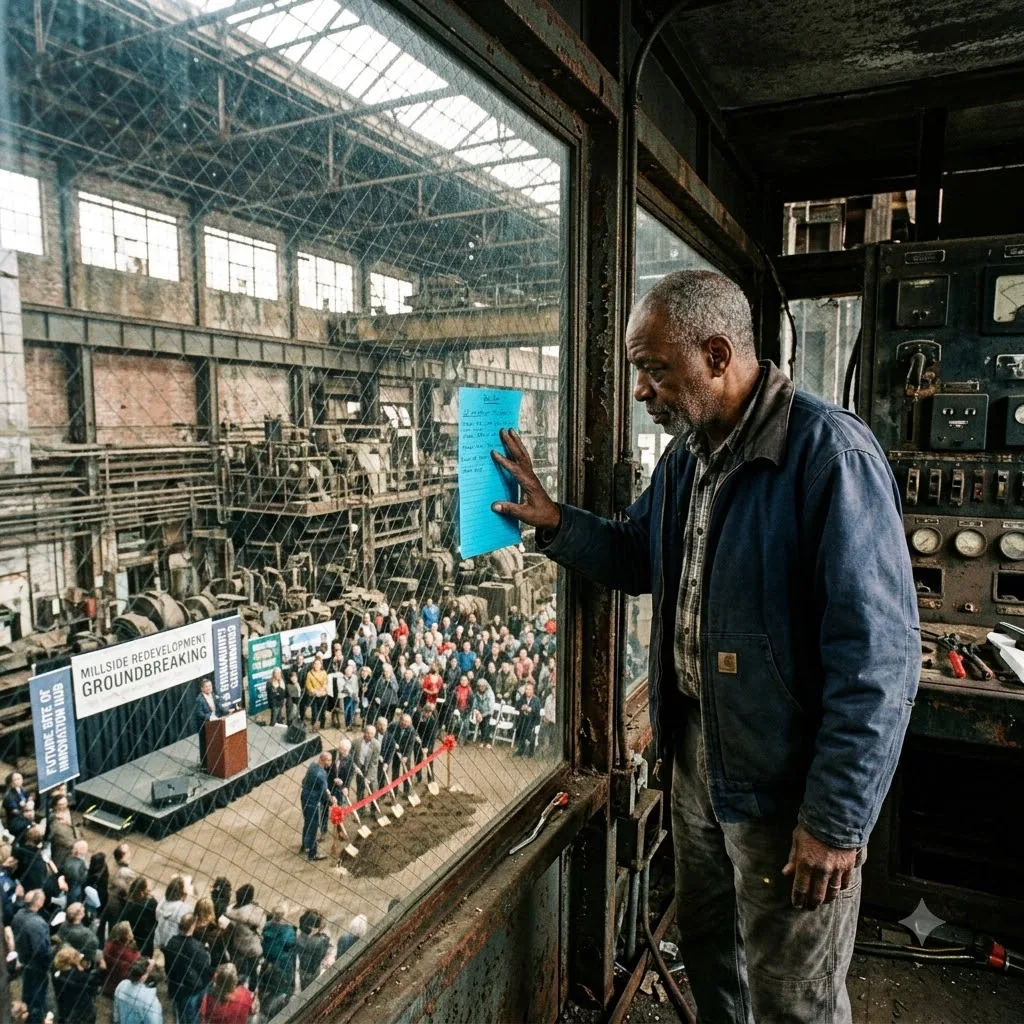
The sharp, ear-splitting shriek of audio feedback ripped through the cavernous steel mill as the microphone struck the concrete. Dozens of wealthy investors and city councilmen winced, instinctively covering their ears. David didn’t flinch. He couldn’t. He remained absolutely paralyzed at the edge of the stage, his eyes wide and fixed on the grime-streaked window forty feet above.
Pressed flat against the reinforced glass was the blue document. Even from this distance, David recognized the heavy azure stock and the unmistakable gold-embossed seal of his offshore holding company. He didn’t need to read the bold black text printed across the top of the page; the title was burned into his memory. *Oakhaven Asset Shielding & Worker Mortality Projections*.
It was the actuarial death warrant he had commissioned three years ago. The report conclusively proved that the mill’s degraded insulation and chemical runoff had lethally compromised the workforce. It detailed the aggressive, incurable cancers incubating in the lungs of the men who had poured steel there for decades. Most damningly, it outlined the exact, highly illegal financial maneuvers David’s shell company had executed to quietly drain the workers’ pension fund. The strategy ensured that when the inevitable wave of terminal diagnoses hit, the holding company would be bankrupt on paper, completely shielded from the catastrophic medical liabilities.
And now, that highly classified document was resting against the glass, held by one of the dead men walking.
The chilling reality of the situation washed over David, turning the blood in his veins to ice. Earlier that morning, he had dismissed Marcus as a stubborn, nostalgic nuisance. A man worried about his retirement checks was rational; he could be bought, bullied, or waited out. But the man in the faded denim coat glaring down at him was not worried about his golden years. Marcus was on the list. David explicitly remembered the man’s name highlighted in the appendix of projected casualties. Marcus was dying.
A suffocating terror seized David’s throat. A dying man in a locked room had absolutely nothing to lose. He couldn’t be threatened with jail time. He couldn’t be bought off with a settlement he wouldn’t live to spend. He was a man with an expiration date, holding the physical proof of his own murder.
*Click-whir.*
The mechanical shutter of a camera shattered David’s frozen stupor. In the second row of the audience, a photojournalist for the city’s largest newspaper was adjusting the focus ring on a massive, white telephoto lens, aiming it directly up at the control booth.
Bile rose in the back of David’s throat. The modern optics on that camera were more than powerful enough to read the text on the blue paper through the glass. If that high-resolution image hit a server, let alone a front page, the groundbreaking ceremony would instantly become a federal crime scene. David wouldn’t just lose the luxury loft project; he would lose his assets, his freedom, and likely spend the rest of his life in a penitentiary.
“No!” David gasped, his voice cracking without the microphone. He scrambled forward, waving his hands frantically at the press pool. “Ladies and gentlemen, please! Lower your cameras! The flashes are agitating him! We are dealing with a severe mental health crisis!”
The investors murmured in confusion. The photojournalist lowered his camera for a fraction of a second, frowning at David, before raising the heavy lens back toward the ceiling.
Up in the booth, Marcus didn’t shout. He didn’t bang his wrench. He simply tapped a grease-stained finger against the gold seal on the paper, maintaining dead-eyed contact with David, and then pointed slowly at his own chest. *I know what you did to me.*
David spun around, his chest heaving under his tailored suit, and desperately signaled his head of security. Vance, a massive man in a dark suit, hurried up the side stairs of the stage.
“Get up there,” David hissed, grabbing Vance by the lapel and pulling him close so the surrounding cameras wouldn’t pick up his trembling voice. “Break that door down. I don’t care about the optics anymore. I need that piece of paper in his hand. If he drops it, we are all going to prison.”
Vance glanced up at the booth, his jaw tight. “Sir, we can’t just breach it. The exterior fire stairs are rusted through; they won’t hold the weight of a tactical team. And he chained the primary steel door from the inside. We’d need an acetylene torch to cut through the hinges.”
“Then get a torch!” David spat, saliva flying from his lips.
“It will take at least twenty minutes to haul the equipment up there,” Vance warned quietly. “And the local news affiliate in the back just went live. If we start cutting through a door with sparks flying while you have the mayor sitting in the front row, it’s going to be broadcast to the entire state.”
David looked back at the crowd. The polite, captivated audience from five minutes ago was gone. They were whispering, pointing, shifting uncomfortably in their velvet chairs. The narrative was unraveling by the second.
A sharp gasp from the front row snapped David’s attention back to the ceiling.
Marcus had pulled the blue document away from the glass. With agonizing, deliberate slowness, the old steelworker rolled the thick azure paper into a tight cylinder. He walked two steps to the left, stopping directly in front of the narrow, open ventilation slit at the bottom of the window frame.
He held the rolled document entirely outside the glass, dangling it over the forty-foot drop.
The drafty air of the cavernous mill fluttered the edges of the paper. Below, the press corps instinctively surged forward, sensing a drop, their cameras raised and waiting to catch whatever the desperate protester was offering.
David’s heart hammered against his ribs with bruising force. He was entirely trapped. If he ordered Vance to storm the stairs, Marcus would simply let go of the paper, sending the damning evidence fluttering softly down into the waiting hands of the press.