Story code: ST-001083
Part 2: The Tip Line
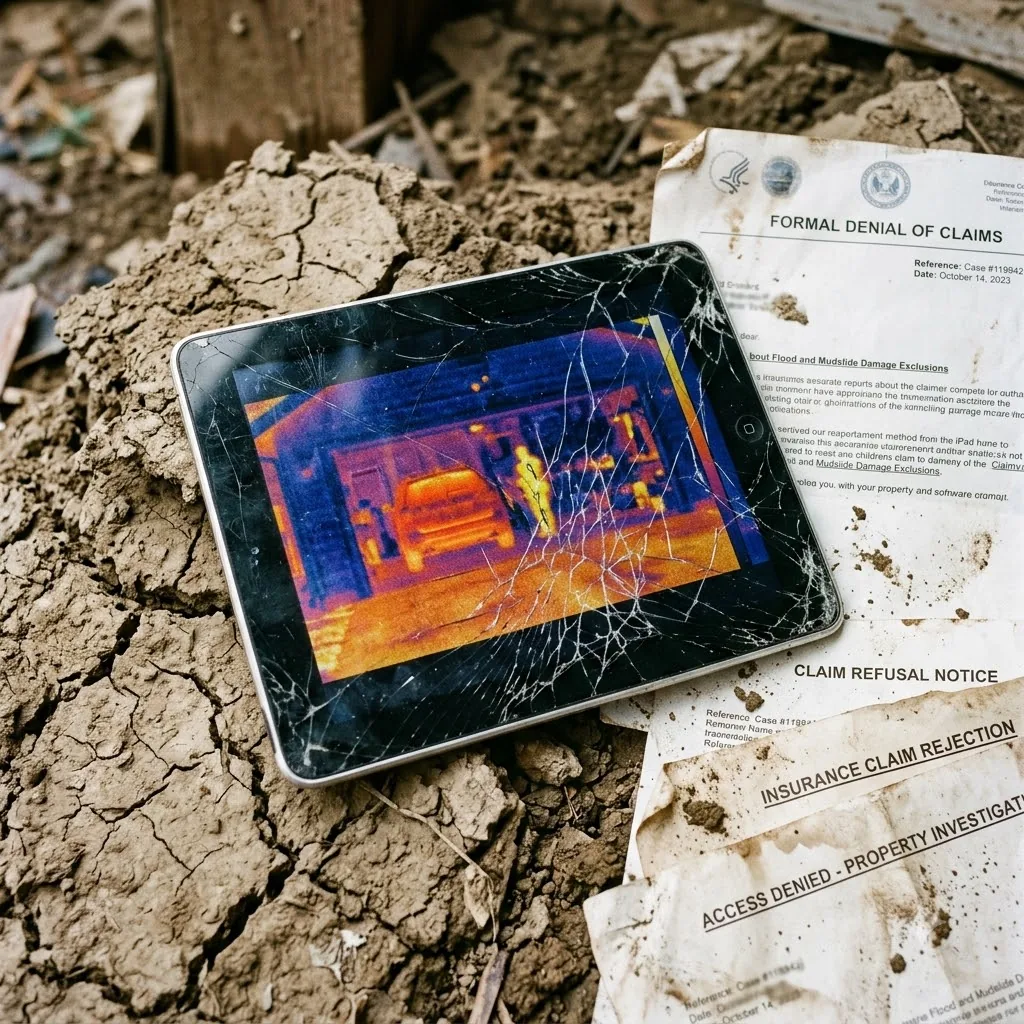
The black glass of the iPad reflected David’s wide, bloodshot eyes. He sat frozen in the damp shell of his collapsed sunroom, staring at his own terrified reflection. The sharp crack of the broom handle shattering the drone’s chassis still echoed in his ears, but it was the silence that followed that made his stomach drop.
For six uninterrupted days and nights, the grinding shriek of Miller’s CNC machine had dominated the ruined cul-de-sac. Now, the machine was completely silent.
David dropped the twin joysticks. The controller clattered against the folding table, sliding over the stack of denied disaster insurance claims and knocking a few waterlogged envelopes onto the muddy floorboards. He didn’t bend to pick them up. He was listening.
Outside, the wind rustled the dead branches of the slanted oak tree. Below that, faintly, came the heavy, sucking sound of work boots pulling out of deep mud.
Miller was outside the garage.
David snatched his cell phone from his pocket. The screen showed one bar of signal, dipping occasionally to “No Service.” He had bookmarked the ATF and FBI joint task force tip line three days ago, right after noticing the suspicious, heavy metal blocks being delivered to Miller’s driveway by a privately contracted truck. Back then, David had told himself he was just being a good citizen, keeping an eye out in a vulnerable neighborhood. Now, as the heavy footsteps squelched in the darkness, he knew he was just desperate to get someone-anyone-with authority onto his abandoned street.
He hit dial and pressed the phone hard against his ear. It rang four long times before a mechanized voice prompted him to select an option. He hammered the keypad, navigating through a maze of automated menus designed to filter out the thousands of post-disaster panic calls that had plagued the county since the mudslides.
Finally, a sharp click. “Federal Tip Line, Operator Four-Two. State your emergency.” The voice belonged to a man who sounded like he hadn’t slept in a week.
“I need to report illegal weapons manufacturing,” David whispered, cupping his hand over his mouth and ducking lower behind the half-wall of his sunroom. “My neighbor. He’s building heavy ordnance. Machine guns, maybe something bigger. I just saw the receivers in his garage.”
“Sir, what is your location?”
“Sycamore Drive. The mudslide zone. You have to send someone right now.”
The operator sighed, the sound carrying a heavy static over the weak cellular connection. “Sir, Sycamore Drive is under a red-tag evacuation order. There are no emergency services available in that sector. Local police are stretched across the county managing the looting in the commercial district.”
“He’s not looting,” David pleaded, his voice cracking. “He’s running an industrial CNC machine. He’s milling custom, modular weapon parts. There are no serial numbers. He just smashed my drone.”
“He smashed your drone?” The operator’s tone shifted from exhausted to instantly skeptical. “Sir, are you flying a civilian drone over private property in a declared disaster zone?”
“He’s making weapons!” David hissed, peeking over the top of the drywall. The darkness three houses down was absolute, but the pale, cold beam of a heavy-duty flashlight was cutting through the fog, sweeping over the hardened mud trenches. The beam was moving away from Miller’s garage. It was moving up the street. Toward David.
“Sir,” the operator said, his voice taking on the practiced, slow cadence used for the hysterical. “People are using heavy generators. People are using power tools to clear debris and secure their properties. A CNC machine does not automatically equal illegal firearms. Unless you have definitive photographic proof of an assembled, illegal firearm, we cannot dispatch federal agents to a red-tagged zone based on a noise complaint and a broken toy.”
“I was recording it! The feed was live!” David tapped furiously at his iPad screen, but the proprietary app only saved high-resolution footage to the drone’s internal SD card. He didn’t have the cloud backup subscription. “The footage is on the drone. It’s in his yard.”
“File a property damage report with local PD when the precinct reopens on Monday,” the operator said. “Do not engage your neighbor. Do not return to an evacuated zone. Goodnight.”
The line went dead.
David stared at the phone. Monday was three days away. He was alone in a ruined house with no power, a stack of worthless insurance denials, and a neighbor who was actively hunting for the pilot.
The flashlight beam swept across the wreckage of the house next door. Miller was checking the properties systematically. He was looking for whoever had been spying on him.
A cold spike of pure adrenaline pierced David’s chest as a horrifying memory surfaced. He had purchased the drone two years ago. On the very first day, he had used a label maker to print a small, neat sticker. He had placed it squarely on the underside of the drone’s gray plastic chassis, right next to the camera gimbal.
*If found, please return to David at 442 Sycamore Drive.*
Miller didn’t just have the broken drone. He didn’t just have the SD card with the footage of his illicit factory. He had David’s exact name and address.
The sucking sound of boots in the mud grew louder. It was no longer three houses down. It was two.
David scrambled backward on his hands and knees, ignoring the sharp splinters of wood digging into his palms. He crawled away from the sunroom windows, retreating into the pitch-black hallway of his ruined home. He didn’t have a weapon. He didn’t have a car to escape; his sedan was buried under six feet of dried clay in the driveway. The entire street was a treacherous trap of hardened sludge, uprooted pipes, and jagged debris. If he tried to run in the dark, he would break his ankle in a mud trench before he made it a hundred yards.
The flashlight beam cut through the shattered remnants of David’s front window, casting long, distorted shadows across the hallway wall. The heavy footsteps stopped right at the edge of David’s property line.
“David?” Miller’s voice called out. It wasn’t a yell. It was a calm, resonant baritone that easily carried over the wind. It was the voice of a man who measured his words as carefully as he measured his steel.
David held his breath, pressing his back against the cold, damp drywall of the corridor. His heart slammed against his ribs with such violence he was sure Miller could hear it through the ruined walls.
“I know you’re in there, David,” Miller called out, the beam of the flashlight tracking slowly across the broken front door frame. “I found your little sticker.”
A heavy clump of mud fell from the ceiling, landing with a soft thud on the floorboards.
“We need to talk about what you saw,” Miller said, taking a step onto David’s rotting front porch. The ruined wood groaned under his considerable weight. “And we need to talk about it right now.”