Story code: ST-001083
Part 3: The Social Contract
The warped wooden frame of David’s front door had been wedged shut ever since the earth shifted beneath the foundation, but it offered no real resistance. There was a sharp, splintering crack, and the door violently swung inward, groaning on bent hinges. The blinding, cold beam of a high-lumen flashlight pierced the pitch-black hallway, sweeping over the cracked drywall and the heavy layer of dried, cracked mud that coated the hardwood floor.
David scrambled backward, his palms scraping painfully against sharp pebbles and broken glass. He bumped hard into an overturned bookcase, sending a shower of waterlogged paperbacks spilling into the dark. He was cornered in his own corridor, his back pressed against the damp plaster. He threw a forearm over his eyes to block the blinding glare of the flashlight.
Heavy, deliberate footsteps crossed the threshold. Miller stepped into the house, bringing with him the sharp, industrial odors of machine oil, ozone, and unwashed sweat. He didn’t rush. He moved with the same terrifying, meticulous rhythm David had observed through the drone’s camera.
“Turn it off,” David stammered, his voice trembling so violently he barely recognized it. “I called the police, Miller. I called the federal tip line. They have my location. They’re on their way right now.”
Miller didn’t answer immediately. He lowered the flashlight, pointing the beam toward the floor so the hallway was bathed in a stark, bouncing glow that cast jagged shadows against the ceiling. In his left hand, hanging by a severed bundle of red and black wires, was the shattered remains of David’s drone. The gray plastic chassis was cracked down the center, one rotor arm completely missing, the camera lens shattered into a web of white glass.
Miller tossed the ruined machine. It hit the floorboards with a hollow, pathetic clatter, sliding to a stop just inches from David’s muddy sneakers.
“They aren’t coming, David,” Miller said. His voice was a calm, resonant baritone, devoid of anger or panic. It was the absolute certainty in his tone that made David’s stomach twist into a cold knot.
“You don’t know that,” David lied, desperately pressing himself tighter against the wall, wishing he could phase through the plaster. “They took the report. I told them what you were doing.”
Miller stepped further into the hallway, his boots crunching over the drone’s broken plastic propellers. “I know they aren’t coming because the county emergency grid for Sycamore Drive was deactivated on Tuesday. I know because I listened to the police scanner while the pharmacy down the hill was stripped to the copper wire. The operator gave you a canned speech about resources, told you this is a red-tag zone, and told you to file a report on Monday. Didn’t he?”
David swallowed hard. The dust in his throat felt like crushed glass. He couldn’t formulate a lie fast enough to counter the devastating accuracy of Miller’s logic.
“You shouldn’t have been flying that toy around my property,” Miller said, wiping a streak of black grease from his knuckles with a dark rag he pulled from his heavy canvas jacket. “It cost you a thousand dollars to find out what I’m doing in my own garage. You could have just walked over and asked.”
“I know what you’re doing,” David blurted out, a panicked surge of adrenaline overriding his better judgment. “You’re milling receivers. You’re building unregistered machine guns. You’re building an armory in a disaster zone! It’s a federal crime!”
David expected a denial. He expected Miller to claim they were just engine parts, or water pump valves, or some innocent machinery needed to clear the mud. Instead, Miller stared down at him, his face an unreadable mask of grim exhaustion.
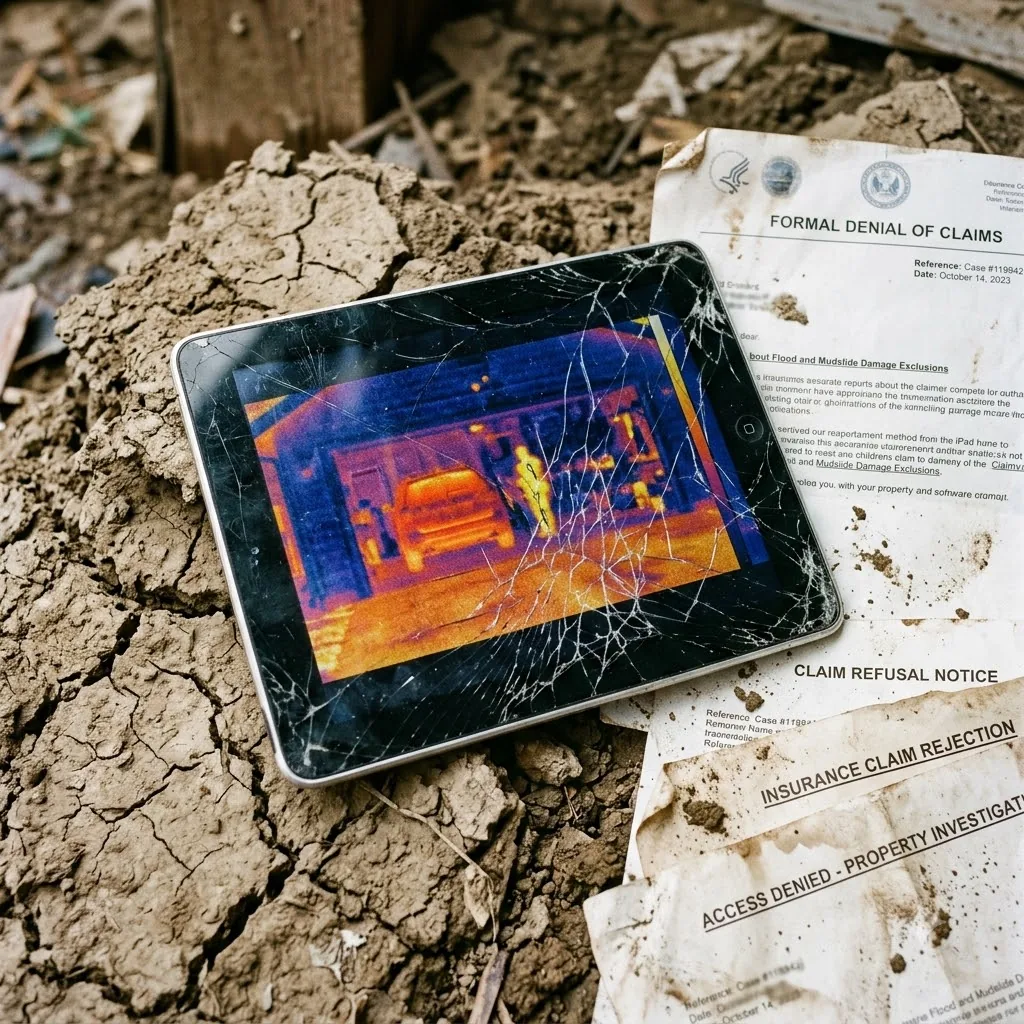
“A federal crime requires a functioning federal apparatus, David,” Miller said quietly. “It requires a jurisdiction. It requires a judge who isn’t currently dealing with the fact that half of district three just slid into the river. You’re sitting in a house that the insurance adjuster already told you is a total loss. I saw the white sedan pull away today. They gave you an act of God speech, denied your claim, and drove back to civilization. We aren’t civilization anymore.”
“They’re doing relief drops,” David pleaded, pointing a shaking finger toward the broken window, as if the FEMA trucks were magically going to appear in the driveway. “They’re coming back. The power will be on next week.”
“The social contract is a luxury,” Miller interrupted, his voice dropping an octave, echoing off the narrow hallway walls. “It’s a piece of paper we all agreed to pretend was real, as long as the grocery stores were stocked and the streetlights turned on. You sat in this rotting house, playing neighborhood watch with a camera, thinking the old rules still applied. They don’t.”
Miller closed the distance between them in two massive strides.
David tried to push himself up, trying to scramble over the fallen bookcase, but Miller was impossibly fast. The larger man reached behind his back, plunging a hand beneath the heavy canvas of his jacket.
He didn’t pull out a tool. He didn’t pull out a broom handle.
Miller’s hand emerged gripping a heavy, matte-black pistol. The metal was pristine, heavily oiled, and completely devoid of any manufacturer etchings or serial numbers. It was a ghost gun, cold and perfectly machined, born in the apocalypse of the garage.
David opened his mouth to scream, but Miller’s left hand shot out, grabbing the collar of David’s ruined shirt. With a violent jerk, Miller hauled David up from the floor, slamming his back against the wall so hard the drywall cracked.
Before David could even raise his hands to defend himself, Miller drove the blunt, heavy steel barrel of the unmarked pistol directly into the soft hollow of David’s throat.
The coldness of the metal was shocking. It dug into David’s windpipe, cutting off his scream, reducing it to a wet, strangled gasp. David’s hands flew up, desperately grabbing at Miller’s thick forearm, but trying to move the man was like trying to push back a concrete pillar.
“When the water runs out in the valley,” Miller whispered, leaning in so close David could feel the heat radiating off him, “the people who survived aren’t going to ask for insurance forms. They’re going to walk up the hill. They’re going to come to the wealthy cul-de-sacs. The state abandoned us. There is only what you can defend.”
Miller dug the barrel half an inch deeper into David’s throat, forcing his chin up toward the ceiling.
“So tell me, David,” Miller said, his eyes dead and unblinking in the harsh glare of the dropped flashlight. “Now that your drone is broken, and your phone call did nothing… how exactly are you planning to defend yourself?”