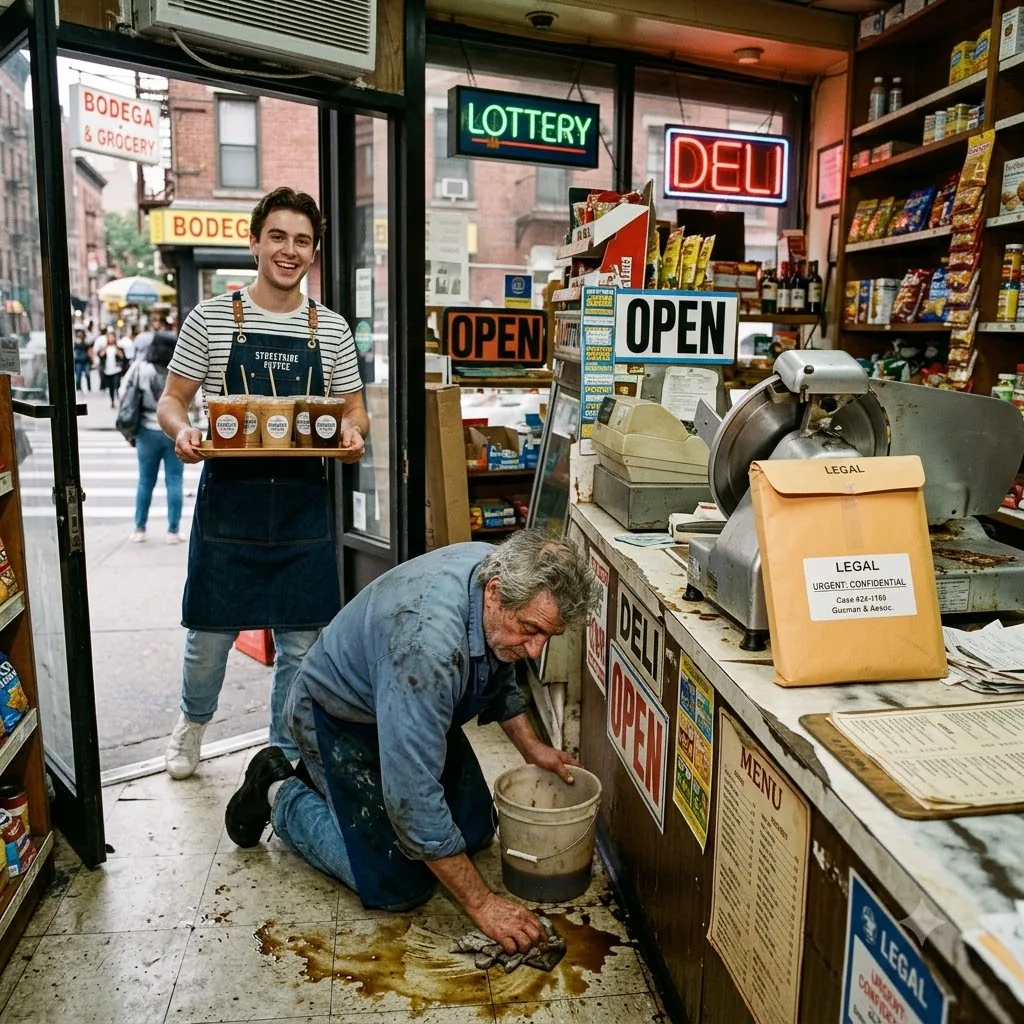
Story code: ST-001087
Part 2: The Shortcut
The hum of the ancient Frigidaire compressor seemed to grow deafening in the sudden silence. Mateo stared at Julian’s pale, manicured fingers pressing into the heavy white paper of the courier envelope. The red seal peeked out from beneath Julian’s palm like a crushed insect.
Julian’s eyes flicked from the bold print of the Apex Commercial Management return address up to Mateo’s face. The manic, neighborly warmth evaporated. The muscles in Julian’s jaw tightened, settling into a hard, calculating line.
“You haven’t opened it,” Julian said. His voice was no longer a pitch; it was a flat, clinical observation.
“Get your hand off my mail,” Mateo said, keeping his voice steady despite the adrenaline spiking in his chest.
Julian slowly lifted his hand, dragging his fingertips across the paper before pulling away entirely. He didn’t step back. Instead, he leaned his weight against the deli counter, his elbows resting on the glass display case that housed the fading rows of Boar’s Head meats.
“Apex Commercial,” Julian murmured, looking around the dim store as if seeing it for the first time. He took in the dust motes dancing in the slanted November light, the scuffed linoleum, the sagging shelves of canned beans. “They manage my side, too. You know that, right? Of course you do. What you probably don’t know is how they operate when they decide a block is ready to pivot.”
Mateo snatched the envelope and shoved it into the front pocket of his hoodie. The stiff corners dug sharply into his hip. “I’m not interested in pivoting. Or synergy. Store is closed, Julian.”
“You think I want to sell egg sandwiches?” Julian asked, letting out a short, humorless laugh. He picked up his silver tablet from the counter. “Mateo, I don’t care about a flow-through concept. I don’t want a partnership. I was trying to give you the dignity of feeling like you were part of the transition.”
Mateo tightened his grip on the rusted putty knife he had forgotten he was still holding. “Transition into what?”
Julian swiped a finger across his tablet screen and turned it around, pushing it across the stainless steel tray of the slicer. “Into a functioning asset.”
Mateo didn’t want to look, but his eyes were drawn to the high-definition rendering on the screen. It was an architectural mockup of a massive, open-concept space. He recognized the arched front windows-they were the windows to his own bodega. But everything else was gone. The cramped aisles, the deli counter, the yellowed lottery sign, the generations of grease and history. It was all replaced by exposed brick, poured concrete floors, and a gleaming, monolithic coffee roaster taking up the exact footprint where Mateo currently stood. The only thing they had kept was the original tin ceiling his grandfather had painted by hand in nineteen eighty-two.
“There is no bodega in this picture,” Mateo said, his voice dropping to a hollow whisper.
“There is no bodega in the future,” Julian replied smoothly. “My investors leased the dry cleaner space knowing it was too small for the roasting equipment. We leased it because Apex promised us the first right of refusal on your square footage the minute your lease hit its renewal window.”
“I have a right to renew,” Mateo snapped, stepping forward, the anger finally piercing through his dread. “It’s in the master lease. They can’t just throw me out.”
“They can’t throw you out,” Julian agreed, tapping the edge of the tablet. “But they can adjust the rent to reflect current market value. And since I am paying eighty dollars a square foot next door, your market value just quadrupled. That envelope in your pocket? It’s not a negotiation, Mateo. It’s an eviction notice wrapped in a legal fiction.”
Mateo’s stomach dropped, a cold, heavy sensation that made his knees feel weak. Four times the rent. He was barely making the payments now by working fourteen-hour days, seven days a week. Four times the rent wasn’t a struggle; it was an execution.
“If you know what’s in it, why were you pitching me on breaking down the wall?” Mateo asked, desperate to find a crack in Julian’s logic.
“Because Apex takes months to process a formal eviction. They will drown you in legal fees, they will send the health department in here to write up that antique slicer, and they will drag it out. I don’t have months,” Julian said, his voice sharpening with genuine irritation. “My contractors are ready next week. If I have to wait for Apex to starve you out, my opening gets pushed to spring. I lose a quarter of revenue.”
Julian reached into the deep pocket of his canvas apron and pulled out a folded document printed on thick, expensive paper. He laid it gently onto the deli counter, right next to a tub of macaroni salad.
“So, I am offering you a shortcut,” Julian said. “A buyout. Directly from my LLC to you. You sign over the remaining rights to your lease, hand me the keys, and walk away clean. No legal battles. No debt to Apex.”
Mateo looked at the paper. “How much?”
“Ten thousand dollars,” Julian said without blinking.
Mateo felt a hot surge of rage flush his neck. “Ten thousand? The fixtures in here are worth more than that. This business fed my family for forty years.”
“The fixtures are garbage, Mateo. And nostalgia doesn’t pay the light bill,” Julian said, his tone turning brutal. “You owe the distributors at least half of that. I saw the beverage delivery guys yelling at you on Tuesday. You take the ten grand, you pay off your debts, and you walk away without a bankruptcy on your record.”
Julian stepped back, adjusting the collar of his pristine Henley. The manic barista persona was entirely gone, leaving behind a ruthless pragmatist.
“If you open that envelope from Apex, the clock starts on their thirty-day notice,” Julian said, pointing to Mateo’s pocket. “Once they formally engage, my offer comes off the table. I’m not getting into a bidding war with my own landlord. You have until tomorrow morning at eight a.m. Take my buyout, or get crushed by Apex.”
Julian picked up his tablet, turned his back on Mateo, and walked toward the door. The mechanical two-tone bell chimed as he pulled the heavy glass door open, letting in a blast of freezing street air before it slammed shut, leaving Mateo alone with the unopened envelope burning against his hip.