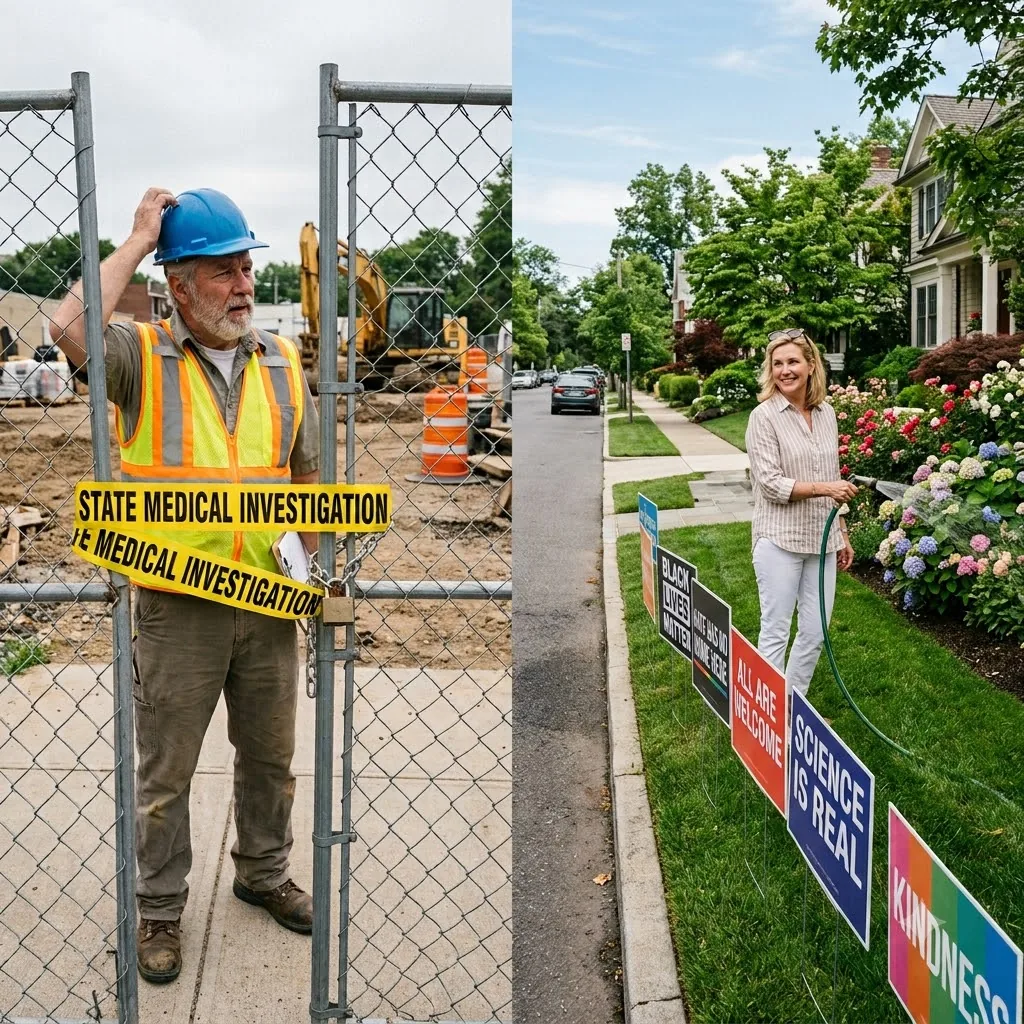
Story code: ST-001125
Part 2: The Accessory
Marcus did not resist as the cold steel bit into his wrists. The taller officer cranked the cuffs one notch too tight, pinning Marcus’s arms awkwardly behind his back. The second officer grabbed the phone from the hood of the truck, tapping the screen to end the active call with Chloe before dropping it into a clear plastic evidence bag.
“On what charge?” Marcus asked, keeping his voice strictly level. He knew better than to shout. He knew better than to give the neighborhood a show.
“Suspicion of evidence tampering and conspiracy to conceal,” the taller officer said, placing a heavy, gloved hand on Marcus’s shoulder and steering him toward the cruiser.
Marcus glanced back one last time. Eleanor had descended her porch steps and was now standing at the very edge of her perfectly manicured lawn. She held her ceramic mug with both hands, a faint wisp of steam rising around her face. She wasn’t glaring. She wasn’t holding a protest sign. She just looked incredibly, terrifyingly serene.
The back of the police cruiser smelled of stale sweat and industrial chemical cleaner. The hard plastic seat offered no traction as the car lurched away from the curb. Through the reinforced wire mesh separating the front seats from the back, Marcus watched his entire livelihood recede in the rearview mirror. His truck, the locked gates, the expensive rented excavation equipment sitting idle-all of it bleeding money by the minute.
The precinct was a labyrinth of scuffed linoleum floors and violently buzzing fluorescent lights. They emptied his pockets, meticulously cataloging his keys, his wallet, and his heavy metal measuring tape. He was placed in a small, windowless interview room and left alone for what felt like hours. The air conditioning rattled loudly in the ceiling grate, dropping the ambient temperature until Marcus’s sweat-dampened work shirt clung like ice to his spine.
Finally, the heavy metal door swung inward. A man in a rumpled gray suit walked in, carrying a thick manila folder and a yellow legal pad. He didn’t bother to introduce himself. He tossed the folder onto the metal table, pulled out a chair, and sat down with a heavy sigh.
“I’m Detective Vance,” the man said. There was a grim irony in the shared last name, though they looked nothing alike. The detective had sharp, exhausted eyes and a jaw covered in graying stubble. “Let’s talk about the foundation schedule for the Elm Street lot.”
“I want my lawyer,” Marcus said immediately, sitting up straight.
The detective chuckled dryly, opening the folder. “Your lawyer is going to tell you to listen to what I have to say first. Because right now, you aren’t officially booked. Right now, we are just having a conversation about why you suddenly moved your concrete pour up by forty-eight hours.”
“We didn’t move it up,” Marcus said, his brow furrowing in confusion. “The weather forecast shifted. If it rains, the trenches flood and the rebar rusts. We pour when it’s dry. That is standard construction protocol.”
“Is it?” The detective slid a glossy photograph across the scratched metal table.
It was a zoomed-in shot of Chloe, taken from a high angle-almost certainly from Eleanor’s second-story bay window. Chloe was leaning against the temporary site trailer, looking pale and clutching her stomach.
“Because it looks to me,” the detective continued softly, “like you rushed a massive foundation pour to help your site manager bury biological evidence of an illegal termination.”
Marcus stared at the photo. The sheer lunacy of the accusation paralyzed his brain for a split second. “You’re insane. That’s an affordable housing project. We are pouring a slab for a low-income four-plex.”
“We have sworn affidavits,” the detective said, tapping the glossy paper. “A deeply concerned citizen noted your manager’s sudden physical changes over the last month. The morning nausea. The severe fatigue. The sudden flat stomach as of Tuesday. And then, conveniently, you order a rush job on thousands of pounds of wet concrete on Wednesday.”
“She had a severe stomach flu,” Marcus said, his voice rising despite his best efforts to control his temper. “And even if she didn’t, that is absolutely none of your business. It certainly doesn’t justify seizing my commercial job site.”
“The law says otherwise,” the detective replied coldly, leaning back in his chair. “A potential fetal remain is considered a human victim under the new state statute. Any location where remains might be concealed is automatically designated a primary crime scene. And anyone who operates the heavy machinery to conceal it is an accessory to a Class A felony.”
The detective slid a second piece of paper across the table. It was a grainy freeze-frame from a street security camera, showing Marcus signing the delivery manifest for the cement mixer.
“Here is your problem, Marcus. The excavation team is rolling up to Elm Street right now. They are going to jackhammer every inch of concrete you laid yesterday. They are going to sift the dirt underneath. If they find so much as a drop of blood down there, you are looking at twenty years in a state penitentiary.”
“There is nothing down there!” Marcus slammed his cuffed hands onto the table, the chain rattling sharply. “This is about the zoning! Eleanor couldn’t stop the permits at the city council, so she weaponized this new medical task force to bankrupt me!”
“I don’t care about neighborhood zoning,” the detective said, his voice dropping to a harsh whisper. “I care about the timeline. Your bank called while you were sitting in holding. Once a property is tagged under the Fetal Homicide Act, all commercial loans tied to it are instantly frozen under the civil asset forfeiture clause.”
Marcus felt the blood drain entirely from his face. The project loan was deeply leveraged against his own house. If the bank froze the funds, he couldn’t pay the crew. He couldn’t pay the equipment rentals. In two weeks, he would be completely bankrupt, regardless of whether they found anything in the dirt or not.
“So here is your one and only lifeline,” the detective said, sliding a typed document toward him. “You sign this affidavit. It states that Chloe requested the rushed pour, that she had exclusive access to the site after hours, and that you had no knowledge of her medical status. You give us Chloe, and I will personally get the district attorney to release the hold on your site by tomorrow morning.”
Marcus stared at the paper. It was a death warrant for Chloe’s freedom, based on absolute fiction engineered by a wealthy neighbor who just wanted her view unobstructed.
“If I don’t sign it?” Marcus asked, his throat bone-dry.
“Then you go to a holding cell right now,” the detective said, checking his watch. “And I give the green light for the backhoes to destroy a hundred thousand dollars’ worth of your fresh foundation.”
Before Marcus could answer, the detective’s hip radio crackled to life. The dispatcher’s voice on the other end was frantic and loud enough to echo in the small room.
“Detective Vance, we have a Code Three situation at the Elm Street site. The suspect, Chloe Miller. She just broke the police line and locked herself inside the site trailer.”