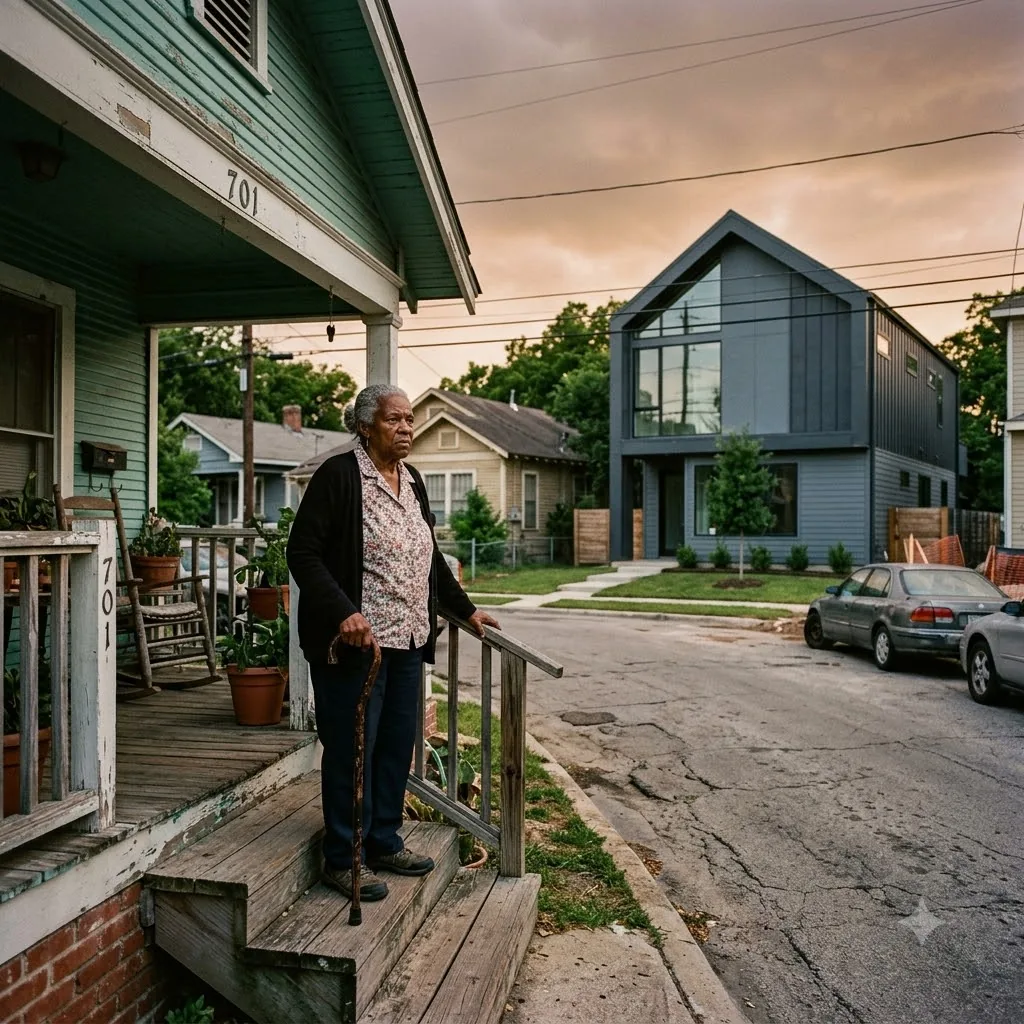
Story code: ST-001127
Part 2: The Algorithmic Eviction
The iron bar connected with the sleek, black front door with a sound like a gunshot. It didn’t splinter. Instead, the reinforced safety glass shattered into thousands of tiny, opaque cubes that rained down onto Loretta’s thick orthopedic shoes. Elias lunged, wrapping his arms around his grandmother’s waist and dragging her backward just as she raised the rusted wagon-wheel spoke to deliver a second, devastating blow. She was shockingly strong, her fury granting her a rigid, unyielding leverage that nearly threw Elias off balance.
“Stop! Grandma, stop!” Elias yelled, his voice cracking. He pulled her down the concrete steps of the porch, putting his own body between her and the ruined entrance of the monolithic smart-home.
An alarm erupted from the eaves of the house. It wasn’t a standard, whooping siren. It was a high-frequency, oscillating shriek that rattled the bones in Elias’s jaw and made his eyes water. The sound was designed to cause physical pain, a digital deterrent pushing them away from the property line.
Despite the agonizing noise, the words of the synchronized text message burned at the forefront of Elias’s mind. He couldn’t shake the exact, clinical phrasing that had lit up fifty screens simultaneously: *CITY OF AUSTIN EMERGENCY ALERT. Municipal Code 4A-Z Triggered. Immediate digital foreclosure initiated on your parcel due to aggregated foundational debt. All connected banking assets frozen to secure demolition tax. Vacate premises by 06:00. Non-compliance will result in kinetic enforcement.*
It hadn’t just been a scare tactic. In the agonizing ten seconds before Elias had sprinted after Loretta, he had frantically opened his banking app. A red padlock icon had covered his screen. His balance was zero. His savings, his checking, the small mutual fund his mother had left him-all of it had vanished behind a cryptographic wall.
“Let me go, Eli!” Loretta snapped, fighting against his grip. She didn’t drop the iron bar. She glared through the broken doorway, her chest heaving.
The shattered doorframe exposed the sterile, brightly lit interior of the smart-home. There was no normal furniture in the foyer. Instead, Elias saw glowing server racks humming behind glass partitions, casting a cold, blue light across the polished concrete floor. Standing at the end of the hallway, clutching a silver tablet to his chest like a shield, was a pale, frantic man in his late twenties. He wore a grey mock-turtleneck and expensive, rimless glasses. This was the ghost neighbor. The neighborhood mailman had gossiped that his name was Vance, a private equity developer who had bought the empty corner lot entirely in cash.
“Are you out of your mind?” Vance’s voice echoed out through the home’s external intercom system, amplified to cut through the shrieking alarm. “I have you on twelve different cameras! Assaulting this property is a federal offense!”
“Turn it off!” Elias shouted back, pointing at the shattered door. The rest of the block party was beginning to move up the driveway behind him. Fifty people, leaving their barbecue and their folding chairs, marching toward the source of the digital hostage situation. “Whatever you just sent to our phones, whatever virus you just used to lock our bank accounts. Undo it right now!”
Elias expected Vance to deny it. He expected the man to feign ignorance, to ask what they were talking about. Instead, Vance’s eyes darted nervously to the crowd gathering on his pristine lawn. He didn’t look confused; he looked like a cornered technician who had expected his automated system to handle the dirty work without human confrontation.
“It’s not a virus!” Vance yelled into the intercom, his voice defensive, almost indignant. “It’s a fully legal, automated smart-contract execution! I bought the underlying, legacy foundational debt of this entire neighborhood from the city’s unregulated secondary market! The algorithm just optimized the collection! You’re all defaulting simultaneously because I called in the margins. It’s just code! It’s just business!”
Elias felt a cold, terrifying weight settle in his stomach. Vance wasn’t just a wealthy neighbor. He was a human router, a forward operating base for a predatory real estate algorithm. The house was a Trojan horse, built to house the servers needed to override the local digital grid.
“You froze our money,” Elias said, his voice dropping an octave, carrying a dark, dangerous edge. “You locked the accounts of seventy-year-old women. You sent an eviction notice masquerading as a city emergency.”
“I didn’t send anything!” Vance stammered, stepping further back into his LED-lit fortress. “The system did! It recognized the loophole in the 1980s property tax codes, bundled it, and bypassed the municipal judges. I can’t stop it now. The notification was just a courtesy protocol. The decentralized network has already seized the digital titles.”
Loretta wrenched her arm free from Elias’s grip. She stepped toward the broken door, raising the iron bar. “Then we smash the network,” she said, her voice deadly calm.
Vance’s eyes widened in genuine terror. He tapped frantically on his tablet. The oscillating alarm suddenly cut out, leaving a ringing silence in the humid night air. But Vance hadn’t surrendered. A heavy, metallic clank echoed from inside the house as automated steel shutters slammed down over the windows and the broken front door, sealing Vance inside a bunker of his own making.
Simultaneously, the streetlights up and down the avenue audibly popped. The power grid for the entire block failed in an instant, plunging the forty-year summer block party into pitch blackness. Only Vance’s monolithic house glowed with its independent battery backup.
Elias pulled his phone from his pocket, desperate to call for help, to call a lawyer, to call anyone. The screen showed zero bars. The phrase ‘NO SERVICE’ flashed where his carrier logo used to be. Vance had jammed the local cell towers. They were entirely cut off.
Through the thick steel shutters, Vance’s amplified voice echoed out into the dark, suffocating street.
“I didn’t call the police,” Vance said, his tone shifting from panicked to terrifyingly clinical. “I called the demolition crews. And they are already idling at the end of the avenue.”