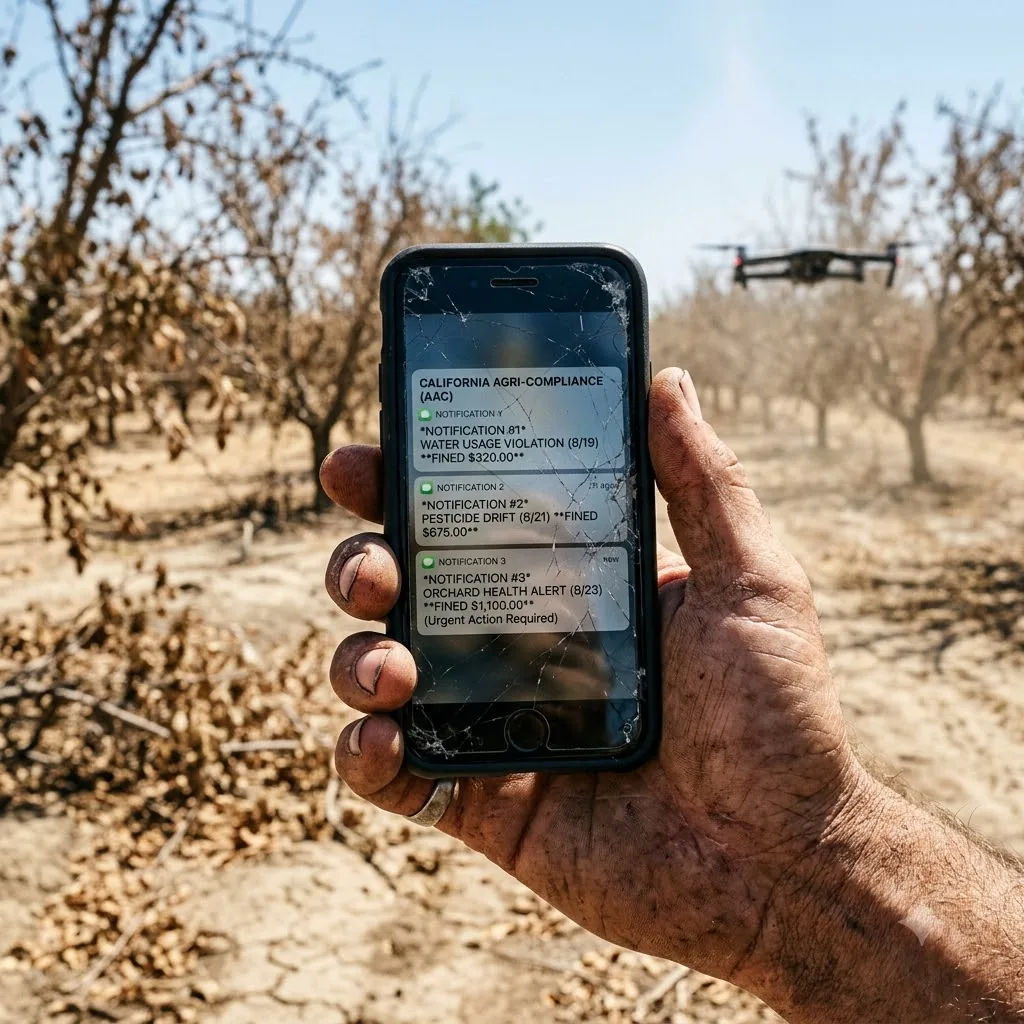
Story code: ST-001138
Part 2: The Compliance Squeeze
Elias threw his hands up, the heavy pipe wrench slipping from his sweat-slicked palms. It hit the baked earth with a dull, heavy thud, kicking up a pathetic puff of the very dust that had just cost him fourteen thousand dollars. The blinding white high-beams of the security vehicle pinned him against the chain-link fence, forcing him to squeeze his eyes shut against the glare. The deafening siren abruptly clipped off, replaced by the digitized crackle of a directional PA system.
“Step away from the primary interface. Acknowledge compliance by taking three steps backward.”
Elias backed up, his boots dragging in the dirt. The passenger door of the armored SUV popped open. A man stepped out, but he didn’t look like traditional law enforcement. He wore a crisp, short-sleeved polo shirt with the AgriCorp logo embroidered in silver thread, tactical cargo pants, and a lanyard holding an oversized, ruggedized smart-tablet. He didn’t draw a weapon. He didn’t need to. The tablet was far more dangerous.
The compliance officer strolled toward Elias with infuriating casualness, his eyes locked entirely on the screen in his hands. A body-mounted camera on his chest blinked a steady, recording green.
“Elias Vance,” the officer said, his voice completely devoid of adrenaline or anger. It was the tone of a man reading a barcode. “Property ID 44-A. You have triggered a Level Three Infrastructure Tampering alert. Which is a shame, because your account was already locked for particulate violations.”
“Your drone cited me for dust,” Elias said, his voice raspy, fighting to keep the tremor of pure rage out of his throat. “Dust from trees that your company intentionally cut the water to. It’s a closed loop. You’re starving me out to take the land.”
“I don’t adjudicate disputes, Mr. Vance. I just process the localized field data,” the officer replied, not even looking up. He tapped the screen three times. “Because you approached a critical telemetry node with a heavy implement, the system has automatically upgraded your risk profile. Your outstanding fine is now thirty-two thousand, five hundred dollars. Due immediately.”
Elias felt the blood drain from his face. “Thirty-two thousand? I don’t have three thousand. You know I don’t. Your servers know every cent in my operating account.”
“Then we are at an impasse,” the officer said, finally looking up. He adjusted his polarized sunglasses. “Under the Agricultural Emergency Act, failure to resolve a critical infrastructure fine results in immediate conservatorship. AgriCorp will assume temporary operational control of the Vance parcel at midnight tonight to mitigate further environmental hazards.”
“Conservatorship,” Elias repeated, the word tasting like ash in his mouth. “You mean foreclosure. You’re stealing the farm tonight.”
“It’s a standard liability shield,” the officer said, stepping past Elias and approaching the humming telemetry box. He pulled a small, silver physical key from his pocket and inserted it into the heavy padlock Elias had been about to smash. “I have to manually reset the tamper sensor you tripped. If you want to appeal the conservatorship, you can file a form at the regional office in Sacramento. But you’ll need to clear the debt first.”
Elias watched in stunned, helpless silence as the officer popped the padlock and swung the metal door of the telemetry box open. The interior was a rat’s nest of modern fiber-optic cables hastily spliced into much older, heavier industrial hardware. Elias’s eyes instantly tracked the wiring. His grandfather had installed the original mechanical valves for this entire valley. Beneath the sleek corporate transponders, the core switching unit was still a decades-old pneumatic relay system.
The officer plugged a short diagnostic cable from his tablet directly into the modern corporate router bolted to the top shelf. The tablet chirped happily. The officer tapped the screen, clearing the alert.
“System reset,” the officer muttered to himself. He unplugged the tablet, closed the metal door, and discarded the old physical padlock into his pocket. From his tactical pouch, he pulled a bulky, modern digital biometric lock. He clamped it through the latch and pressed his thumb to the scanner. A motorized bolt whined, locking the box tight, followed by a blinking blue LED indicating it was synced to the mesh network.
“There we go. Fully digitized,” the officer said, turning back to the SUV. “By the way, because of your upgraded risk profile, the algorithm is shutting down your residential grid power in exactly twenty minutes. Protocol requires us to eliminate fire hazards on abandoned properties.”
“I live there,” Elias said, his fists clenching at his sides. “It’s not abandoned.”
“It will be at midnight,” the officer replied, climbing back into the climate-controlled cab of the SUV. The heavy door slammed shut, sealing away the sound of the engine. The armored vehicle reversed smoothly, executing a perfect three-point turn before accelerating back down the private access road, leaving Elias alone in a cloud of its exhaust.
Elias stood completely still as the dust settled over his boots. He looked at the blinking blue light on the new biometric lock. Thirty-two thousand dollars. Conservatorship at midnight. No power in twenty minutes. The pressure was suffocating, a perfectly engineered corporate vice designed to crush him into quiet submission.
He walked over and picked up his heavy pipe wrench, dusting the dirt from the handle. He stared at the new digital lock. It was impenetrable, communicating securely with a server hundreds of miles away. But as he looked at the thick power conduit running from the station’s main grid down into the ground, a memory surfaced.
The officer had said the lock was fully digitized. That meant it required constant power to maintain its active encryption and magnetic failsafe. The pumping station had a diesel backup generator, but his grandfather used to complain about the ancient transfer switch inside the main facility. It had a mechanical delay. If the main grid power to the valley failed, it took exactly twelve seconds for the heavy diesel generator to spool up and provide current.
Twelve seconds of zero voltage. Twelve seconds where the biometric lock would drop its magnetic hold. Twelve seconds where the old pneumatic relays behind the metal door wouldn’t be guarded by AgriCorp’s firewalls.
Elias pulled his cracked phone from his pocket and checked the time. 7:14 PM. He had less than five hours until the automated system stole his land, and only nineteen minutes until the grid shut off his barn, taking his only industrial arc welder offline. He gripped the wrench tight and started running back toward his dying orchard.