Story code: ST-001140
Part 4: Public Record
The heavy silence in the garage was broken only by the steady, toxic drip of lithium-ion coolant and the faint clatter of a single ice cube sliding off Russ’s boot.
Cold, milky coffee soaked through the thin fabric of his gray work shirt, sticking to his collarbone and running in thin, dark rivulets down his chest. He didn’t blink. He didn’t break eye contact. He just let the sticky liquid settle into his skin.
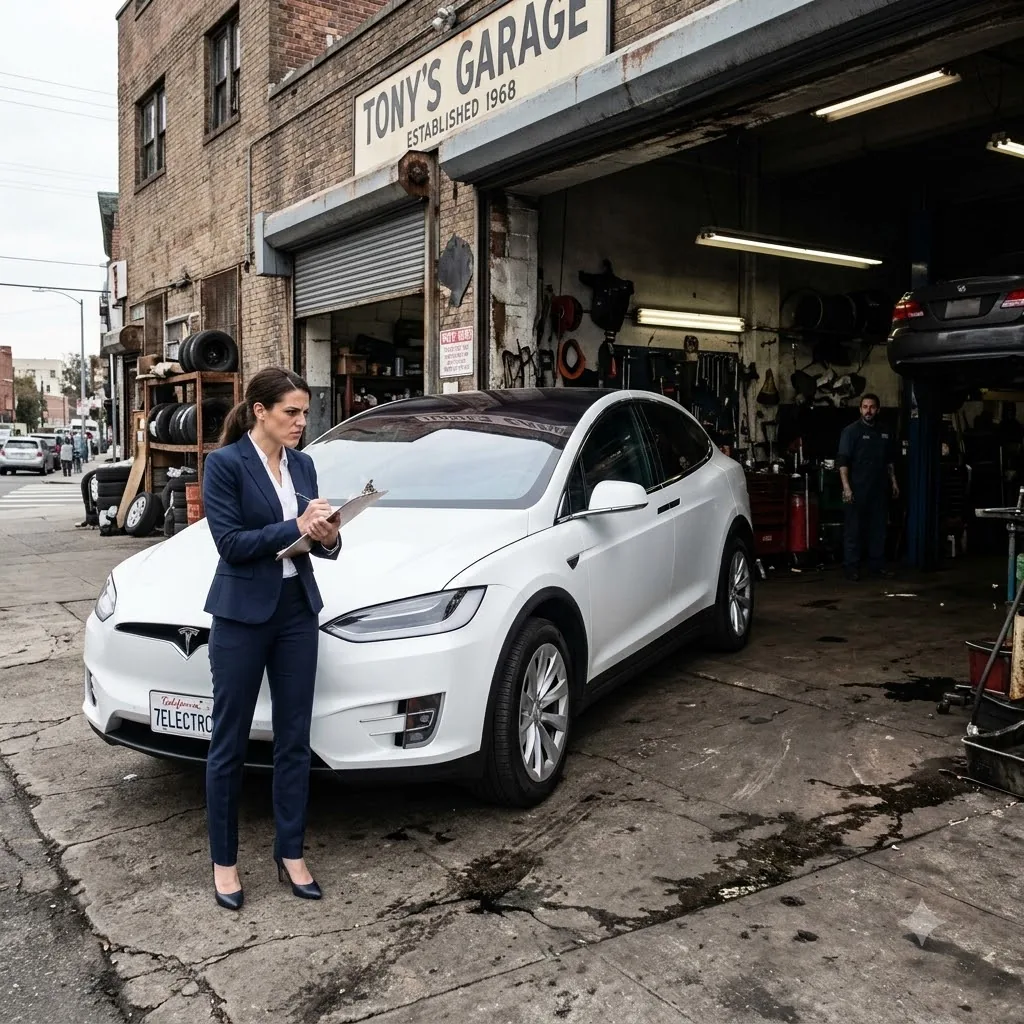
Eleanor stood frozen, her arm still half-raised from the throw. The sudden, violent exertion had completely shattered her immaculate composure. Her chest heaved beneath her tailored charcoal jacket. She looked at her empty hand, then at Russ’s ruined shirt, and finally down at the expanding neon-blue puddle inching toward the storm drain.
Panic, raw and unfiltered, finally broke through her clinical detachment. She had assaulted a mechanic on private property. She had caused a catastrophic environmental hazard. And she had lost complete control.
Without a single word, Eleanor spun around. Her leather heels slipped slightly on the greasy concrete as she scrambled toward the driver’s side of the EV. She yanked the door open, threw herself into the pristine leather interior, and slammed it shut.
Through the tinted glass, Russ watched the dashboard light up. Even from ten feet away, he could see the center console flashing an aggressive, frantic crimson warning about the depleted thermal management system. Eleanor didn’t care. She jammed the gear selector into reverse.
The EV lurched backward. The massive, mismatched police interceptor rim clunked violently against the lip of the concrete bay, the heavy steel jarring the expensive suspension. She didn’t slow down. The front bumper scraped harshly against the asphalt as she wrenched the steering wheel, peeling out of the parking lot. She merged recklessly into traffic, leaving a distinct, wet, neon-blue trail of hazardous waste tracking straight down the center of the public avenue.
Gary let out a long, trembling breath, sliding down the side of the tool chest until he hit the floor. “Oh my god,” he whispered, burying his head in his hands. “She’s going to call the police. She’s going to tell them we destroyed her car and attacked her. We’re done, Russ. We’re completely done.”
Russ finally moved. He turned his head slowly, looking past the empty bay doors and up toward the ceiling rafters.
Mounted in the far corner, directly above the heavy steel chain of the lift, was a small black dome. A single red LED blinked steadily in the dim light.
“Gary,” Russ said, his voice perfectly level. “Did you pay the internet bill this month?”
Gary looked up, his eyes bloodshot and confused. “What? Yes. Last week. Why?”
“Because that camera is hardwired to the cloud,” Russ said, pointing up at the lens. “And it just recorded the lead city planner driving a leaking, catastrophic biohazard onto private property, positioning it over a municipal reservoir drain, and committing felony battery when informed of her federal EPA violation.”
Gary stared at the blinking red light. His mouth opened, but no sound came out.
Russ walked away from the neon puddle. He didn’t go to the utility sink. He didn’t grab a red shop rag to wipe his face. He walked straight into the stifling heat of the small front office and stopped in front of the rusted mechanical time clock. He pulled his worn cardboard timecard from the metal rack and dropped it into the slot.
*Ka-chunk.*
The heavy stamp recorded the time. Four-fifteen in the afternoon.
“What are you doing?” Gary asked, scrambling up from the floor and wiping his sweaty forehead. “You can’t leave. We have to clean this up. We have to call someone.”
“You fired me, Gary,” Russ said calmly, placing the timecard back in its slot. “You did it in front of her. I don’t work here anymore.”
“Russ, please, she forced me-”
“I know,” Russ interrupted, placing a heavy, grease-stained hand on Gary’s shoulder. “I’m not mad. But right now, I am an unemployed civilian who was just assaulted by a high-ranking city official. And as a civilian, I have somewhere to be.”
Russ turned and walked out the side door, stepping into the muggy afternoon heat. He climbed into his beat-up Ford pickup. The vinyl seat was hot, but he barely felt it. The iced coffee was beginning to dry in the stifling cab, the sickly-sweet smell of vanilla syrup mixing with the permanent scent of stale motor oil and rust that clung to his clothes. He rolled down the window and put the truck in gear.
He didn’t drive toward his apartment. He drove straight toward the center of town.
The municipal building was a towering structure of glass and polished steel, a physical monument to the aggressive revitalization phase Eleanor Vance championed. Russ parked his rusted truck between two gleaming luxury sedans in the visitor lot. He cut the engine, grabbed his keys, and walked up the wide concrete steps.
The air conditioning inside the lobby hit him like a physical wall. The pristine, echoing halls were filled with people in sharp suits and expensive dresses, all murmuring quietly as they moved toward the main chamber. The city council zoning meeting began promptly at five o’clock. The public commentary period was the first item on the agenda.
Heads turned as Russ walked down the center aisle. People wrinkled their noses, taking in the dirty work boots, the grease-stained jeans, and the massive, undeniable splash of dark brown coffee and milk plastered across his chest and neck. He looked like an absolute disaster. He looked exactly like the kind of blight Eleanor Vance wanted bulldozed.
Russ didn’t flinch under their stares. He walked straight to the clerk’s podium at the front of the room, picked up the silver pen, and signed his name on the public ledger.
He took a seat in the second row, folding his heavy arms across his chest. The sticky coffee pulled at his skin, a cold, uncomfortable residue that he refused to wash away. He kept his eyes locked on the empty podium at the front of the room, waiting patiently for the lead city planner to walk through the mahogany double doors and realize her demolition timeline was officially over.