Story code: ST-001169
Part 3: The True Meridian
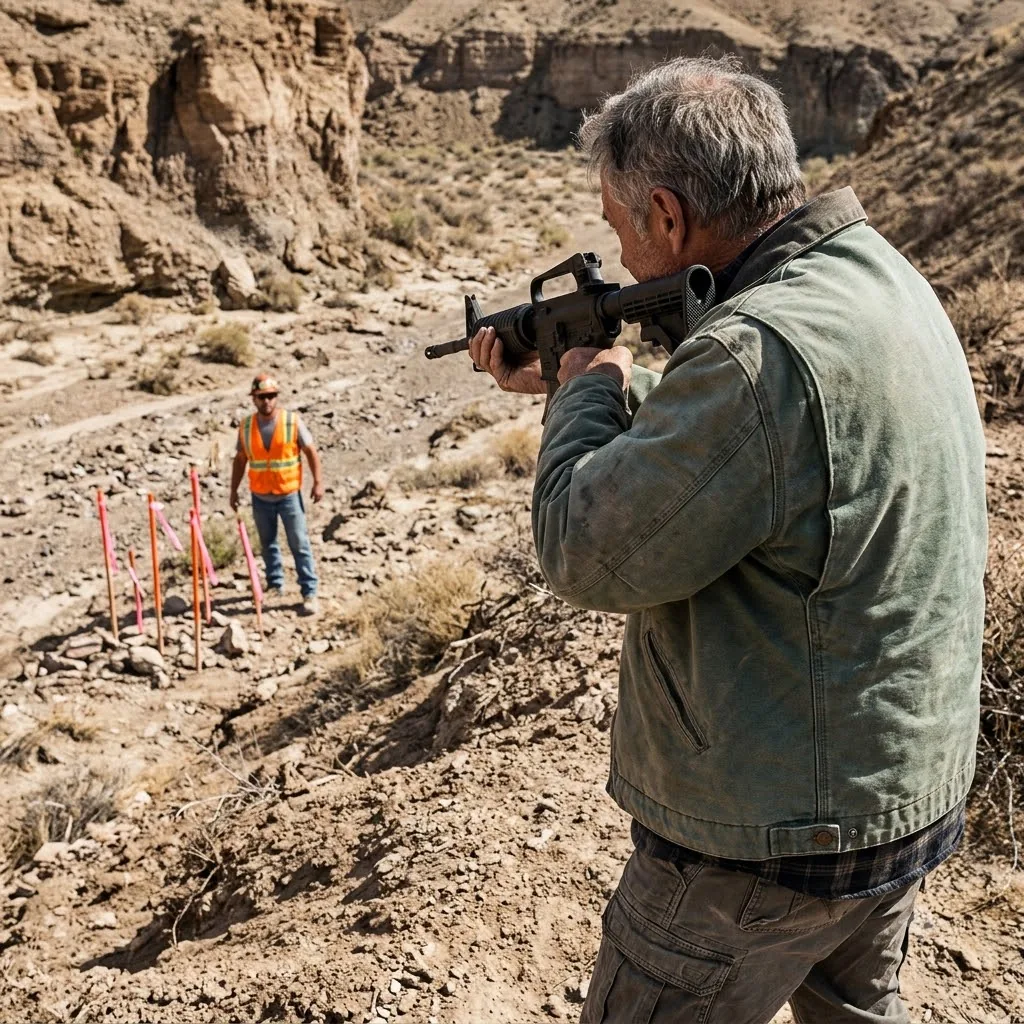
The hollow crack of the uprooted surveyor stake echoed off the canyon walls, mocking the heavy silence that followed. Jim stood paralyzed on the high ridge, the Winchester’s stock digging a bruised pocket into his shoulder. Down in the dry wash, Chayton Blackwater didn’t say a word. He just held the splintered orange wood in one hand and the digital camera in the other, the red recording light blinking like a tiny, unblinking eye.
Jim’s mind spun through a dozen desperate scenarios, each ending in a catastrophic press conference. If he fired, it was murder. If he retreated, it was political suicide. He opened his mouth, searching for a commanding phrase that would assert his authority without sounding like a panicked, trapped man, but his throat was too dry to form the words.
Then, a low, mechanical rumble vibrated through the soles of Jim’s boots.
He tore his gaze away from the camera lens just long enough to look down the arroyo. A plume of pale dust was rising above the scrub brush, moving fast along the rutted access road. Within seconds, the squared-off grill of a county sheriff’s cruiser breached the tree line, its lightbar flashing a silent, authoritative blue and red against the sun-baked rocks.
A massive wave of relief washed over Jim, so intense it made his knees physically weak. He didn’t have to shoot. He didn’t have to back down. The law had arrived to reestablish order and save him from this nightmare.
The cruiser skidded to a halt in the loose gravel between the public road and the disputed boundary line. The driver’s door popped open, and Sheriff Ray Miller stepped out. The tall, weathered lawman adjusted his duty belt, his mirrored sunglasses catching the harsh glare of the afternoon sun. He took one look at Chayton holding the camera and the stake, then tilted his head back to spot Jim standing on the ridge with the rifle.
“Lower the weapon, Jim!” Miller’s voice was a practiced, booming command that carried easily over the idling engine of his cruiser.
Jim hesitated for a fraction of a second, acutely aware of the blinking red light on Chayton’s camera. He needed to look like a cooperative victim, a citizen defending his rights, not a crazed gunman. He slowly lowered the barrel of the Winchester toward the dirt, keeping his posture stiff and righteous.
“It’s about time, Ray,” Jim called out, projecting his voice so the camera’s microphone would pick it up. “I caught him red-handed! He’s trespassing on my deeded land and destroying my property boundaries. I gave him multiple lawful orders to disperse, and he refused.”
Miller didn’t reach for his sidearm, but his hand rested casually near his holster as he crunched through the dry wash. He stopped ten feet from Chayton, who hadn’t moved an inch. Chayton lowered the camera slightly but kept it recording, the lens now capturing both the sheriff and the armed mayor on the ridge.
“Is that right, Chayton?” Miller asked, his tone exhausted, like a man who had spent his entire career dealing with stubborn men in the desert. “You pulling up Jim’s stakes?”
“I’m removing hazards from public land,” Chayton said. His voice was calm, entirely devoid of the adrenaline that was currently shaking Jim’s hands. It was the first time he had spoken since arriving. He didn’t offer a heated argument; he simply reached into his denim jacket with his free hand.
Jim tensed, his thumb hovering over the rifle’s safety. “Watch his hands, Ray!”
Miller didn’t flinch. Chayton pulled out a small, yellow handheld GPS unit, offering it toward the sheriff.
“I don’t need to look at his partisan garbage!” Jim shouted, scrambling down a few feet of loose shale to close the distance, desperate to control the narrative. “I paid Canyon Engineering three thousand dollars to mark that line last week! I have the plat maps filed at the county courthouse. That orange stake is the absolute edge of my western parcel.”
Miller sighed, taking the yellow GPS unit from Chayton. “Jim, secure your rifle in your truck. Now.”
“He’s the one destroying-”
“I said secure the rifle, Mr. Mayor,” Miller barked, the title carrying a sharp, unmistakable edge.
Jim swallowed hard, his pride burning, but he turned and placed the Winchester flat across the tailgate of his pickup truck parked just behind the ridge. When he turned back, Miller was staring down at the screen of Chayton’s GPS, his thumb tapping the directional pad.
“These coordinates are from the Bureau of Land Management server,” Chayton said quietly. “Updated this morning.”
“You can’t trust a civilian’s toy,” Jim snapped, wiping a thick layer of sweat from his forehead. “They recalibrate those things to steal inches. Look at the stakes, Ray. The stakes are the legal line.”
Miller didn’t argue. He walked back to his cruiser, reached through the open window, and pulled out his own county-issued Toughpad tablet. The device was encased in thick black rubber and connected directly to the municipal grid. If there was one piece of technology Jim couldn’t dispute, it was the county assessor’s live database.
Jim watched with rising confidence as Miller synced the tablet, waited for the satellite lock, and walked slowly toward the hole where Chayton had uprooted the first orange stake. The sheriff stared at the screen for a long time, his brow furrowing beneath his wide-brimmed hat.
“See?” Jim said, crossing his arms over his sweat-stained shirt. “Right on the money. Arrest him for destruction of property.”
Miller didn’t pull out his handcuffs. Instead, he looked up from the screen, his eyes obscured by the mirrored sunglasses, and began to walk.
He walked past Chayton. He walked past the second orange stake. He began trudging up the steep, dusty embankment, his heavy boots kicking up shale.
Jim’s confidence faltered. “Ray? What are you doing?”
Miller didn’t answer. He kept climbing until he was standing on the ridge, breathing heavily in the thin, hot air. He didn’t stop there. He walked another twenty feet past Jim, heading straight toward Jim’s parked truck, before finally coming to a halt. He looked down at the tablet, then dragged his heavy boot across the dirt, gouging a thick line in the dust.
“Right here,” Miller said, his voice flat.
“What’s right there?” Jim asked, his stomach suddenly twisting into a cold knot.
“The actual boundary,” Miller said, turning the Toughpad around so Jim could see the glowing blue dot superimposed over the topographic map. “Canyon Engineering based their survey on the old dry wash. But the property lines out here are platted from the true geographic meridian, Jim. Not the creek bed. The creek shifted ten years ago.”
Jim stared at the screen, his brain refusing to process the blue dot. “That… that can’t be right. That would mean…”
“It means your surveyor missed the mark by about fifty feet,” Miller said, his voice dropping low enough that the camera microphone down in the wash couldn’t pick it up, but Jim heard it perfectly.
Miller slowly lowered the tablet, his mirrored shades reflecting Jim’s pale, sweating face. He gestured to the dirt under Jim’s boots, then to the Winchester resting on the tailgate of the truck.
“Your deed ends at that line I just drew, Jim,” Miller said softly. “Which means your stakes are fifty feet deep into federal territory.”
Jim’s breath stopped. He looked past the sheriff, down the long, dusty embankment, past the fluttering orange stakes he had sworn to defend. Chayton was still standing down in the arroyo, holding the camera steady, filming the mayor standing on land he didn’t own.
“You’re standing on BLM land,” Miller said, his tone shifting from exhausted peacekeeper to a lawman observing a felony. “And you just pointed a loaded rifle at an unarmed man who was standing on public property.”