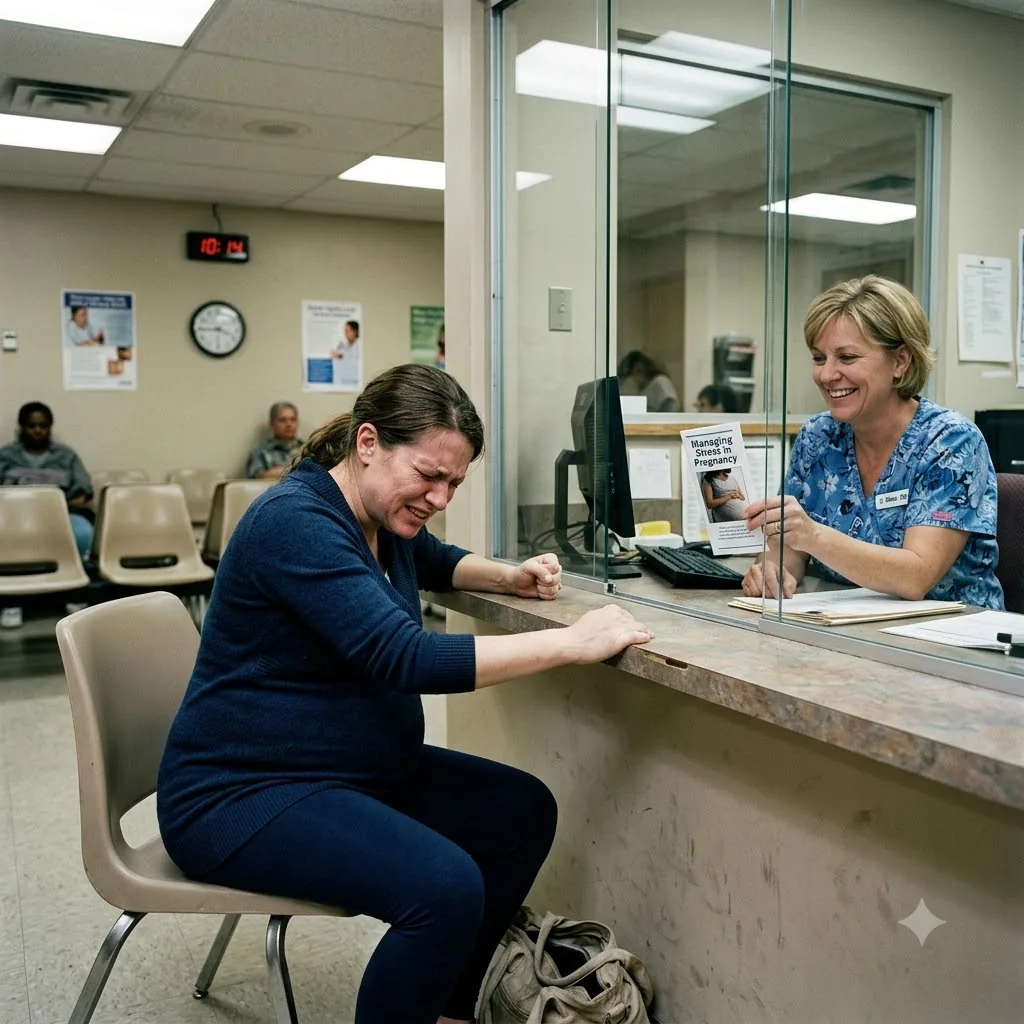
Story code: ST-001184
Part 4: The Fruit Basket
The steady, rhythmic hissing of the ventilator in the neighboring bay anchored Maya to consciousness. She opened her eyes, but her heavy lids resisted, weighed down by a crushing, chemical exhaustion. The ceiling tiles were a dull, speckled beige, vastly different from the blinding white lights of the triage area.
She tried to swallow, but her throat felt coated in sand. She shifted her right arm. A thick IV line was taped to the back of her bruised hand, pumping a warm, sluggish fluid into her veins that made her entire body feel like it was radiating a sickly, artificial heat.
“Maya?”
David’s face appeared above her. His eyes were bloodshot, rimmed in deep purple shadows, and a rough patch of stubble covered his jaw. He looked like he had aged ten years. He gripped her left hand, pressing his forehead against her knuckles. He was crying, his shoulders shaking with silent, ragged sobs.
“The baby,” Maya rasped, the words barely audible over the hum of the ICU monitors.
“He’s in the NICU,” David choked out, his tears wetting her fingers. “He’s breathing on his own. He’s tiny, Maya. Four pounds, one ounce. But he’s fighting. The doctors say he’s going to be okay.”
Maya closed her eyes, a single tear slipping down her temple into her hairline. She reached down with her free hand, her fingers trembling as they brushed the thick, padded bandage strapped across her lower abdomen. The catastrophic, tearing agony in her liver was gone, replaced by the deep, burning ache of a surgical incision. Her belly was flat and empty. She hadn’t heard her son cry. She hadn’t felt his warm skin on her chest. The transition from pregnancy to motherhood had been violently stolen from her in a haze of black static and flashing red monitors.
“Dr. Evans operated,” David whispered, his voice thick with unspent rage. “He said if we had waited another five minutes in that lobby, your liver would have ruptured. You were seizing when they rolled you into the OR. They had to put you under general anesthesia. You’ve been out for a day and a half on a magnesium drip to stop the strokes.”
Maya stared at the beige ceiling. A day and a half. She had a son she had never met, living in a plastic box on another floor.
A sharp, polite knock at the sliding glass door of the ICU room broke the heavy silence.
A woman stepped inside. She was not wearing scrubs. She wore a tailored charcoal blazer, pristine beige slacks, and low, sensible heels that clicked softly against the linoleum. Her hair was pulled back into a sleek, immovable bun. Her badge didn’t mark her as a doctor or a nurse; it read *Patient Experience & Risk Management*.
In her hands, she carried an enormous, absurdly cheerful wicker basket piled high with apples, pears, and oranges, the entire thing shrink-wrapped in stiff yellow cellophane and tied with a massive gold bow.
“Mr. and Mrs. Vance,” the woman said softly, her voice carrying the practiced, soothing cadence of a corporate lawyer. “I’m Susan Albright. I oversee patient relations here at the hospital. May I come in?”
David stiffened, his grip on Maya’s hand tightening until it hurt. He didn’t answer, but Susan took the silence as an invitation. She walked to the edge of the bed and set the massive fruit basket on the rolling plastic tray table. The cellophane crinkled loudly, a harsh, festive sound that felt deeply offensive in the sterile, dimly lit intensive care unit.
“I wanted to come down personally and see how you were recovering, Maya,” Susan said, offering a tight, sympathetic smile that didn’t reach her eyes. “We are all just so relieved that you and your little boy are stable.”
Maya stared at the bright yellow ribbon on the basket. Her tongue felt too thick to speak.
“I also wanted to apologize,” Susan continued, seamlessly shifting into her prepared statement. “You had a very frightening experience in our emergency department. We have reviewed the timeline of your admission, and we recognize there was a… sub-optimal communication flow in triage. Your symptoms presented in a highly unusual manner, but that does not excuse the delay in your care.”
“A delay?” David stood up, his chair scraping violently against the floor. “The nurse turned off the alarm. She called security to drag my dying wife out of the room.”
Susan held up a manicured hand, her expression perfectly composed. “We take these matters very seriously, Mr. Vance. I assure you, the triage protocols are being thoroughly reviewed, and the nurse involved is receiving intensive coaching regarding our anxiety management procedures. We are treating this as a vital learning opportunity.”
*Coaching.*
The word echoed in Maya’s heavy, magnesium-soaked brain. *A learning opportunity.*
Brenda wasn’t fired. She wasn’t standing in front of a medical board explaining why she manually muted a stroke-level blood pressure alarm. She was being coached.
“I have authorized your transition to a private recovery suite as soon as you are discharged from the ICU, completely on the house,” Susan said smoothly, pulling a thick, embossed business card from her blazer pocket and sliding it under the edge of the fruit basket. “If you need anything at all, please call my direct line. The hospital is fully committed to making the rest of your stay as comfortable as possible.”
Susan Albright offered one last, heavily practiced smile, nodded to David, and walked out of the room, her heels clicking away down the corridor.
Maya turned her head slowly, the movement sending a dull throb through her temples. She looked at the tray table. The basket sat there, towering and vibrant, the cellophane catching the fluorescent light from the hallway. Three bruised oranges and a couple of green apples to offset the trauma of being sliced open while seizing. A wicker basket in exchange for the first days of her son’s life.
She looked back at David, who was staring at the doorway, his chest heaving with impotent fury.
“David,” Maya rasped, her voice dry and perfectly hollow. “Throw that in the trash.”