Story code: ST-001186
Part 4: The Executioner
The freezing rain continued to lash against the open doors of the ambulance, pooling on the diamond-plate floorboard and mixing with the sick Leo had just violently expelled. Marcus knelt on the wet asphalt, his collarbone throbbing where the paramedic had struck him, unable to tear his eyes away from the brightly lit interior of the rig. The older police officer stood at the bumper, his posture thoroughly detached, watching the man on the stretcher tremble.
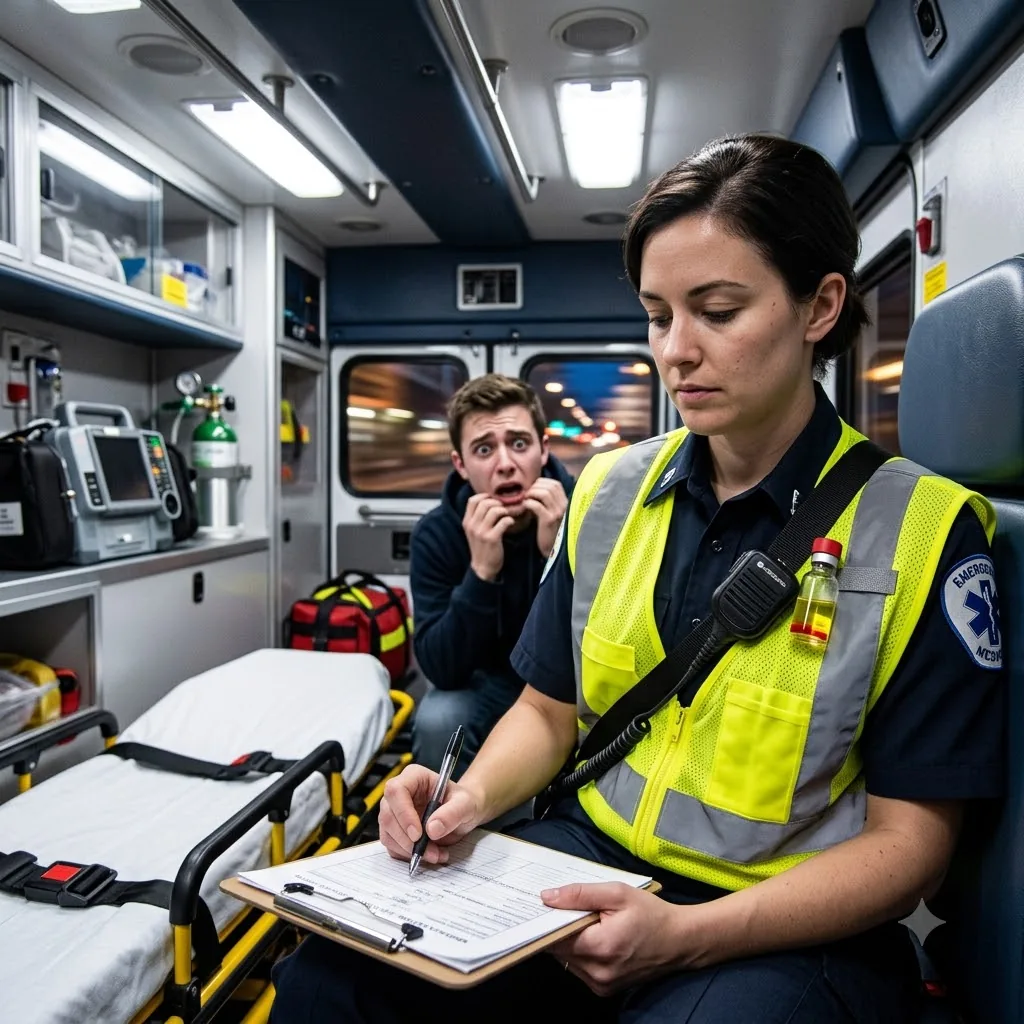
The heavy silence in the back of the ambulance shattered as a secondary wave of precipitated withdrawal hit Leo. It wasn’t just a physical sickness; it was an explosive, chemical terror. The police-issue Naloxone had ruthlessly scrubbed every opioid molecule from his brain receptors, plunging him into an acute agony that made him feel as though his bones were splintering under his skin.
Leo let out a raw, animalistic shriek. He thrashed against the heavy nylon stretcher straps, his wet boots kicking frantically at the aluminum frame. The police officer took a tactical step backward into the rain, safely out of striking distance, while Miller simply stood in the corner, calmly wiping a speck of rainwater off his clipboard.
“Get him secured,” the cop ordered, his voice clipped and hollow over the drumming storm. “Once his vitals are stable, transport him straight to County General. I’ll follow in the cruiser and take custody in the loading bay. He’s an active fugitive now.”
The word *custody* cut through the fog of Leo’s delirium. The sheer misery in his dilated, bloodshot eyes abruptly morphed into pure, blind panic. He wasn’t going to a clinic bed to recover. He was going to a concrete cell, forced to detox on a steel cot because he was fifty dollars short on a corporate ledger.
“No,” Leo gagged, choking on his own saliva as he twisted violently on the thin vinyl mattress. “Not going back. I can’t go back in there.”
With a sickening *crack*, the plastic buckle of the primary chest strap snapped under the sudden, desperate force of his thrashing. Leo surged upward, his breath tearing through his throat in ragged gasps. His hand flailed wildly, searching for a weapon, a shield, anything to keep the authorities away. His bloodied fingers locked onto the neck of a heavy green D-cylinder oxygen tank clamped to the rail above the jump seat.
“Hey!” Miller shouted, finally dropping his clipboard and surging forward. “Drop the tank!”
Leo didn’t drop it. Driven by the primal surge of adrenaline and absolute terror, he wrenched the heavy steel cylinder free from its quick-release mounting bracket. He swung the tank in a clumsy, desperate arc to keep the paramedic away.
The heavy green metal missed Miller entirely but slammed with devastating force into the acrylic front of the ambulance’s main medication lockbox. The thick plastic door shattered in a violent explosion of jagged shards. The impact crushed the internal shelving, pulverizing dozens of small glass vials and plastic syringes. A sharp, medicinal chemical smell flooded the narrow compartment as a mixture of epinephrine, saline, and sedatives rained down onto the floor grating.
But the wild swing took everything Leo had left.
The momentum of the heavy tank pulled him forward. He dropped the cylinder, letting it crash onto the metal floorboard with a deafening ring, and grabbed his own chest. His eyes went impossibly wide, staring at the sterile white ceiling of the rig, completely unseeing. A terrible, wet gasp rattled in his throat.
His heart-which had just survived a massive chemical overdose, a hypoxic flatline, and the violent, agonizing shock of the reversal agent-simply gave out. The sheer physical trauma of the panic and the violent exertion was the final hammer blow.
Leo collapsed backward onto the stretcher. His spine arched once, rigid and trembling, and then he went entirely limp.
On the wall, the cardiac monitor let out a single, uninterrupted shriek. It wasn’t a disconnected wire this time. The sluggish green wave on the screen abruptly flattened into a perfectly straight, unbroken horizon.
Marcus watched from the rain-soaked asphalt, his clothes plastered to his freezing skin. He couldn’t move. He couldn’t breathe.
Miller didn’t rush. The paramedic looked at the shattered lockbox, let out a long, slow breath through his teeth, and then placed two fingers against Leo’s pale, clammy neck. He kept them there for ten agonizing seconds.
“Massive infarction,” Miller said, his voice returning to that maddeningly flat, administrative drone. He didn’t reach for the bag valve mask. He didn’t begin chest compressions. He looked at the cop. “He’s gone. Call the coroner.”
The monitor screamed its endless note.
Marcus slumped against the wet bumper of the police cruiser, the rain washing the blood from his torn cuticles. He stared at his best friend’s lifeless body.
He had fought so hard. He had screamed at the paramedic, clawed at the radio strap, and begged the system to intervene and pull Leo back from the edge. But the system hadn’t wanted to save Leo; it only wanted to repossess him. Sentinel Corrections wanted its fifty dollars. The police wanted their fugitive.
If Marcus had done nothing, Leo would have drifted away in the quiet, dim safety of their bathroom, his mind wrapped in a warm, dark blanket, finally free of the debt and the fear. Instead, Marcus had demanded a rescue. He had forced the doors open and invited the bureaucracy inside.
Because of him, Leo’s final moments weren’t peaceful. They were spent in agonizing, chemical fire, terrified of a cage, fighting a system that viewed his death as nothing more than damaged company property. Marcus rested his head against the cold, wet metal of the cruiser. He had thought he was demanding mercy. Now, listening to the flatline, he realized he had just performed the system’s execution for free.