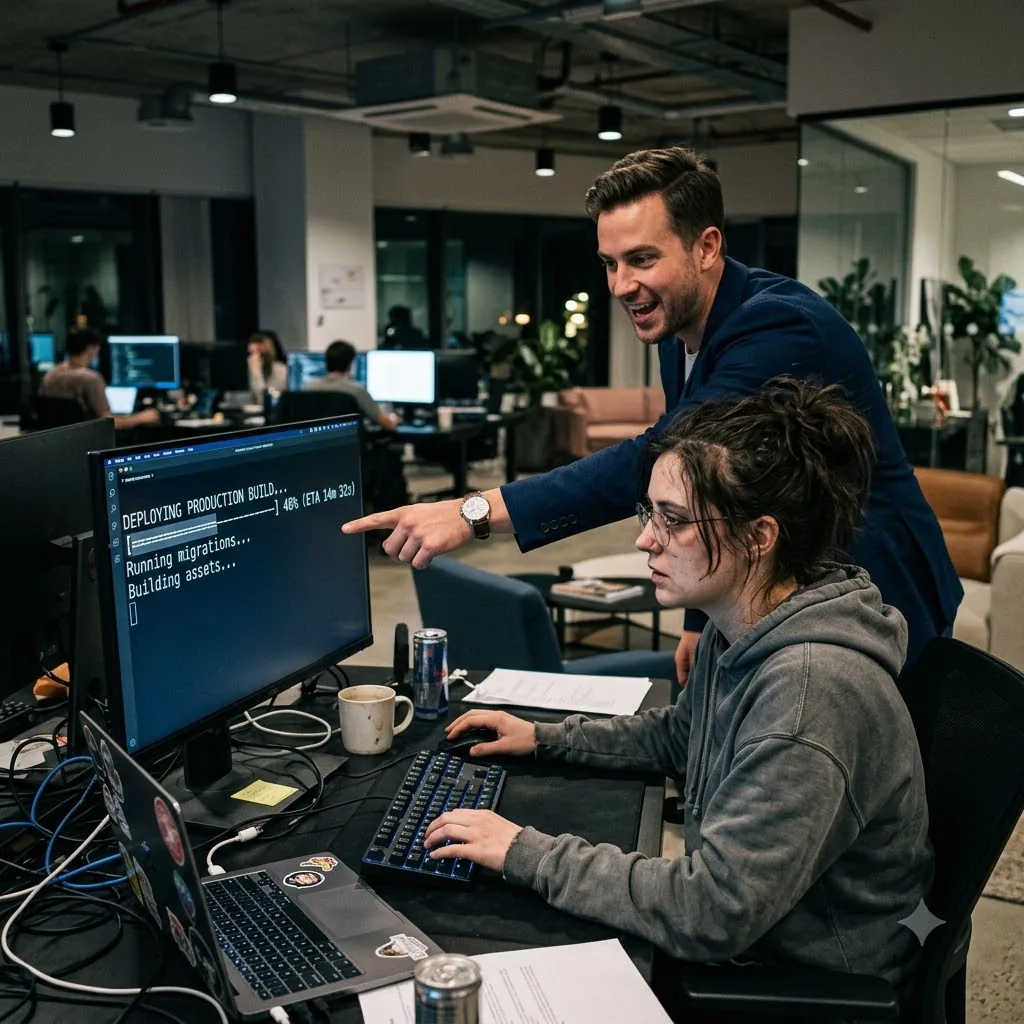
Story code: ST-001193
Part 2: The Failsafe
Maya’s hand clamped down over the mouse a fraction of a second before Julian’s fingers could brush the plastic shell. The sudden, violent movement broke the stagnant, heavy air of the office. Her knuckles turned white from the force of her grip.
“Don’t,” Maya said. Her voice cracked, betraying the severe exhaustion she had been trying to suppress.
Julian froze, his hand hovering over hers. His eyes shifted from the screen to the back of her head, then down to her hand fiercely guarding the peripheral. “Excuse me?”
“The IDE is frozen,” Maya lied, her sleep-deprived brain scrambling to construct a plausible technical excuse. “It’s a memory leak in the compiler. If you minimize it or force a redraw of the user interface right now, the whole environment will crash. I’ll lose the refactoring I just spent three hours building for you.”
Julian slowly withdrew his hand, standing upright. The faint reflection of his designer glasses vanished from the corner of her monitor. “Save it, then. Use the keyboard shortcuts.”
“I can’t. The UI thread is entirely locked.” Maya kept her eyes glued to the sliver of the terminal window peeking out from beneath the dark grey code editor.
Ninety-four percent.
Julian crossed his arms over his chest, the fabric of his expensive blazer rustling. “You’re hiding something, Maya.”
“I’m trying to save three hours of critical work, Julian.”
“Is it a recruiter?” he asked. His voice suddenly dropped its aggressive, visionary edge, replaced by a wounded, passive-aggressive tone. “Are you taking interviews on company time? After everything we’ve built together? Is that why you’re guarding your screen?”
Maya almost let out a ragged, hysterical laugh. A job interview. He thought she was messaging a recruiter on LinkedIn. She didn’t correct him. Let him think she was merely disloyal in the traditional sense. It was infinitely better than him knowing she was executing a script designed to systematically encrypt the local backups of his proprietary routing algorithm, holding the company’s core intellectual property hostage until the staff’s payroll cleared.
“I’m not talking to a recruiter,” Maya said, her eyes burning from the monitor’s glare. “I’m just trying to get the routing module optimized, exactly like you asked.”
Julian leaned back over her right shoulder, crowding her space again. “Then let the UI crash. If it’s frozen, it’s frozen. We have version control for a reason. Force quit the application, Maya.”
She swallowed hard. Her throat felt like dry sandpaper. “Julian, please. Just give the processor a minute to resolve the memory loop.”
“Force quit it.” His voice was no longer a request. It was a direct order from a CEO to a subordinate.
Ninety-six percent.
The processor fan in Maya’s tower whined louder, a high-pitched hum that vibrated up through the desk and into Maya’s wrists. The script was hitting the heaviest part of the backend directory structure.
Julian pulled his smartphone from his pocket. The screen cast a harsh white glare against his face in the dim office. Maya watched him in her peripheral vision. He was opening the system monitoring application.
“Why is the CPU usage on your local machine spiking to ninety-nine percent?” Julian asked, his eyes scanning the metrics on his phone. “And why is your terminal communicating directly with the production database cluster?”
“Local caching,” Maya said instantly, her heart hammering against her ribs. “It’s pulling down a copy of the anonymized user tables to test the routing algorithm against real dataset weights.”
“We don’t pull production data to local machines. That’s a strict security violation.”
“You said you wanted the module lean. You said we needed it tonight. I needed a real data environment.”
Ninety-seven percent.
Julian lowered his phone. The wounded CEO act vanished, replaced by cold, calculating suspicion. He stepped away from her chair, but only to move toward the power strip located beneath her desk.
“Julian, what are you doing?” Maya asked, panic finally bleeding through her carefully maintained composure.
“If this machine is compromised, or you’re violating data compliance, I’m cutting the hardline,” he said, crouching down on the thin carpet. “We’ll pull the system logs tomorrow morning.”
If he pulled the plug, the script would die in transit. The encryption keys wouldn’t scramble. The leverage she desperately needed to force him to pay the staff would vanish, and the incomplete logs would absolutely show the unauthorized python script she had been running. She would be fired, penniless, and potentially facing criminal charges, with absolutely nothing to show for it.
“Don’t touch that power strip,” Maya said, pushing her ergonomic chair back violently. The wheels caught the edge of the plastic floor mat, making a loud, sharp clatter in the empty office.
Julian looked up from under the desk, his hand hovering inches from the thick black power cord that fed her workstation. “Or what, Maya? You’re going to quit? Over a delayed direct deposit?”
Ninety-eight percent.
The terminal output stopped flickering. A new line of text appeared at the bottom right corner of the screen, just barely visible under the edge of the IDE window.
`[AWAITING FINAL CONFIRMATION – Y/N]:_`
The script had paused. It needed human input to cross the point of no return.
Maya stared at the tiny blinking cursor. Her hand moved slowly from the mouse to the keyboard. Her left index finger rested lightly on the ‘Y’ key. Her right pinky hovered over the ‘Enter’ key.
Julian saw the subtle shift in her posture. He tracked her eyes up to the screen, squinting at the tiny sliver of text. He didn’t know exactly what the script did, but he recognized a terminal confirmation prompt when he saw one.
“Take your hands off the keyboard,” Julian said, his voice dropping to a dangerous whisper. He stood up slowly, bringing himself back to his full height, looming over her desk. “Right now, Maya.”
Maya pressed her lips together, calculating the physical distance between his hand and her keyboard, weighing her thirty-six hours of physical exhaustion against the months of unpaid overtime, broken promises, and relentless gaslighting. Her credit card was maxed out. Her rent was due.
“I just need to finish this process,” Maya said, her voice shaking despite her desperate attempt to keep it level.
“I am revoking your system access,” Julian said, tapping furiously on his phone. “I’m locking your administrative role. Step away from the desk.”
She had seconds before her AWS credentials expired globally.
Maya pressed the ‘Y’ key.
Before she could hit Enter, Julian lunged forward, slamming his hand down flat across the center of her keyboard. A chaotic string of letters and symbols exploded across her active code editor as his palm mashed against the keys.
Maya gasped, pulling her hands back to her chest. The screen flickered violently, the IDE stretching and contorting as Julian’s palm triggered a cascade of random keyboard shortcuts.
When Julian lifted his hand, the desktop was entirely clear. The code editor had minimized.
Sitting dead center on Maya’s monitor, fully exposed and maximized, was the terminal window. The raw, unfiltered output of her retaliatory script was plastered across the screen in bright green text against a stark black background.
At the bottom, the confirmation prompt remained, but it was now accompanied by a stark, flashing red warning message triggered by the chaotic keyboard input.
`CRITICAL ERROR: KEEPALIVE SIGNAL INTERRUPTED. INITIATING DESTRUCTIVE FAILSAFE PROTOCOL IN 30 SECONDS.`
Julian stared at the screen, his breathing ragged in the quiet office. He read the file paths listed in the terminal output, his eyes widening as he recognized the core infrastructure directories of his company.
“What did you do?” Julian whispered, his head snapping toward her, the visionary facade completely shattered. “Maya, what is the failsafe protocol?”