Story code: ST-001206
Part 3: The Cost of Authenticity
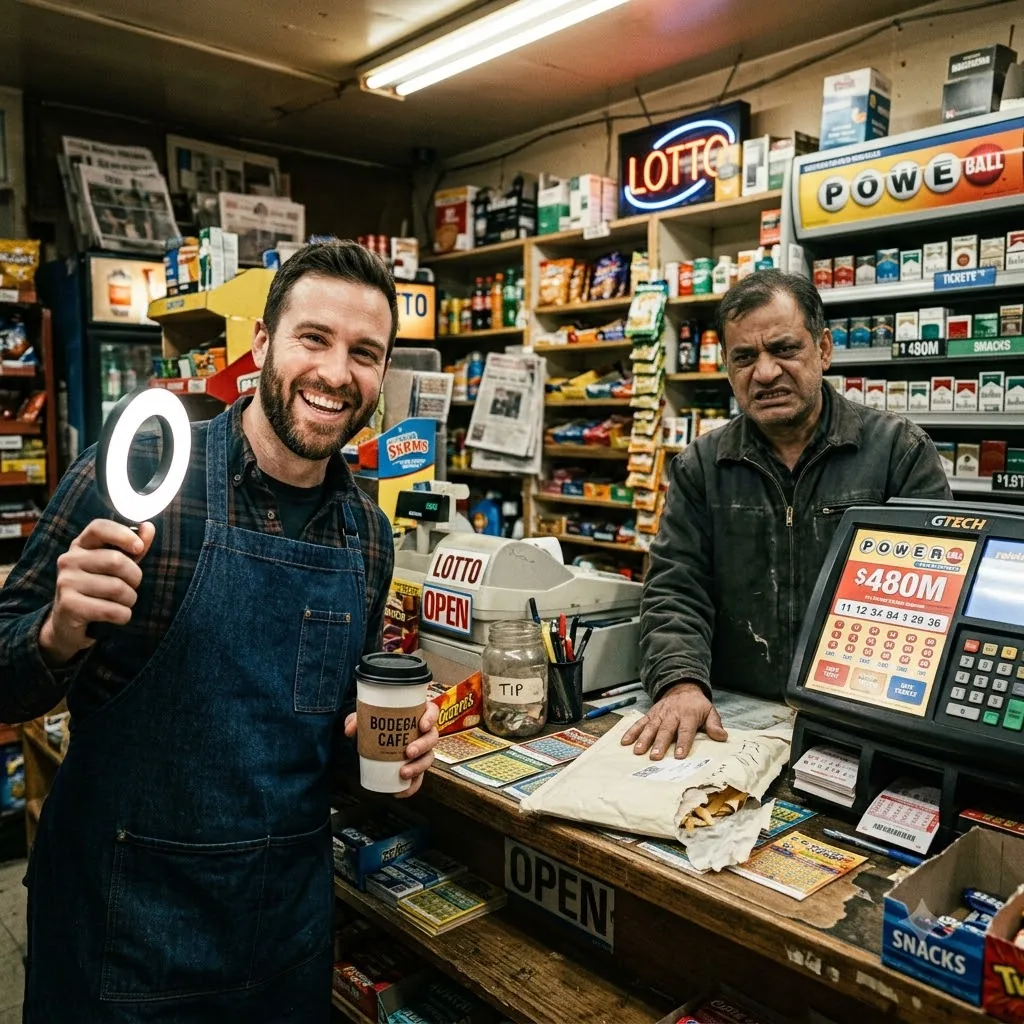
David clamped his left palm down harder, sliding the heavy acrylic lottery dispenser another half-inch across the counter. The wet envelope trapped beneath the plastic held fast. As Julian yanked the grey washcloth upward, the saturated corner of the paper sheared off with a sickening, wet tear. Julian pulled his hand back, gripping nothing but the dirty rag and a blank, soaked triangle of cream-colored paper.
Julian didn’t even notice. “Man, it’s a mess back here,” he chuckled, completely oblivious to the narrow escape as he tossed the soiled rag onto the floor near the trash can. “But that’s the beauty of it. The grit.” He checked his smartwatch, the oversized screen glowing brightly against his wrist. “Listen, beautiful people, I gotta wrap this stream. The Julian Meyer Community Hub soft opening is starting in ten minutes. We’re celebrating the future right down the block. Come down, grab a free cold brew, and let’s talk about keeping this neighborhood authentic.”
He grabbed his gimbal, gave David a condescending pat on the shoulder that felt like a physical blow, and marched out the door. The overhead bells chimed wildly in his wake.
David stood frozen in the stifling heat of the bodega. He slowly lifted the acrylic lottery dispenser. The letter was a ruined, coffee-stained mess, but the bold numbers at the bottom of the page were still perfectly legible. Three thousand dollars. A black arrow. Twelve thousand dollars. An eviction notice dressed up as a lease renewal.
For thirty years, his grandfather had taken the hits. *The stone does not argue with the river.* David looked at his burned knuckles, the skin angry and red from the boiling coffee. He looked at the muddy, brown blur of ink on the legal document. Then, he looked at the floor by the front window.
Sitting in a battered wooden crate were three dozen unsold plantains. They had turned completely black, their skins splitting to reveal fermented, yellow mush. They smelled of heavy, sweet decay. Yesterday, David had planned to throw them out. Today, they smelled exactly like what Julian was doing to the avenue.
David stepped out from behind the counter. He didn’t lock the register. He didn’t flip the sign on the door to CLOSED. He just bent his knees, dug his throbbing fingers under the rough wooden slats of the crate, and lifted.
The crate was heavy, the rotting fruit shifting wetly inside. David kicked the glass door open and stepped out onto the blinding concrete.
The midday sun beat down on his shoulders as he carried the rotting crate down the avenue. The wood dug into his forearms. Juice from the split plantains leaked through the bottom slats, dripping dark, sticky spots onto the pavement. He passed the hardware store that had closed last month, its windows papered over with Julian’s development logos. He passed the laundromat where the owner was currently fighting a sudden, suspicious code violation. The river was washing them all away, one by one.
Half a block down, Julian’s new “Community Hub” occupied the corner lot that used to be a bakery. The facade was all floor-to-ceiling glass and matte black steel. A crowd spilled out onto the pavement-people in minimalist streetwear, local politicians holding fluted glasses of kombucha, and three different videographers circling the perimeter. Inside, ring lights formed a blinding constellation.
David kept walking. The weight of the crate ground into his spine, but his arms felt entirely numb.
He pushed through the heavy glass doors. The air conditioning hit him like a wall of ice, carrying the sterile scent of expensive eucalyptus and fresh paint. It was a sharp, synthetic contrast to the sour, heavy reek of fermentation radiating from his chest.
Julian stood on a low wooden platform in the center of the room, still holding his motorized gimbal, projecting his voice over the low hum of indie-folk music playing from hidden speakers.
“It’s about resilience,” Julian was saying to the captivated audience, panning his phone across the room. “It’s about looking at the legacy businesses, the bodegas, the heartbeat of this city, and saying, ‘We see you. We value you. We are not going to let you fade away.'”
David didn’t say excuse me. He just walked straight into the crowd. The heavy, sweet stench of rotting fruit hit the attendees a second before David did. A woman in a silk trench coat gasped and stepped back, bumping into a videographer. The crowd parted, instinctively repulsed by the smell and the sight of a sweating man in a stained apron carrying a dripping box of garbage.
David walked down the sudden, narrow aisle that formed in the center of the gleaming room. He didn’t stop until he reached the edge of the wooden platform.
Julian paused mid-sentence. His perfect, rehearsed smile faltered, his eyes darting from David’s face down to the leaking crate. “David?” Julian said, his voice dropping its booming, performative cadence. “Hey, man. What… what are you doing here?”
David didn’t answer. He hoisted the wooden crate higher, his burned knuckles screaming in protest, and tipped it forward.
The rotting plantains cascaded onto the pristine polished concrete at Julian’s feet with a series of wet, heavy thuds. Blackened skins burst upon impact, splattering thick, fermented mush against the cuffs of Julian’s distressed denim jeans and his immaculate white sneakers. The smell of decay instantly flooded the sterile room.
The indie-folk music continued to play, but the crowd fell dead silent. Three different camera lenses remained pointed directly at the stage.
“You forgot your prop,” David said, his voice carrying clearly across the quiet room. It didn’t shake. It wasn’t the hollow echo from the bodega. It was loud, flat, and absolute.
Julian took a panicked step backward, nearly tripping over the edge of the platform as he looked down at the ruined fruit. “Cut the feed,” Julian hissed frantically to a videographer to his left. He forced a strained, terrified laugh, looking back at the crowd. “Wow, folks. I think our guy here is having a little bit of a breakdown. We should-”
“Three thousand dollars,” David interrupted, his voice slicing through Julian’s panic.
The room stayed frozen. The videographer didn’t lower his camera.
“That is my rent,” David said, turning slightly so his voice projected to the phones, the politicians, and the silent crowd. “Three thousand dollars a month. That is how my grandfather kept the lights on. That is the resilience you were just broadcasting to your followers.”
David turned back to Julian, closing the distance between them. Julian shrank back, his white sneakers sliding in the slick, yellow rot of the plantains.
“This morning, Julian’s company bought our building,” David announced, staring directly into Julian’s panic-stricken eyes. “And he sent a courier to my counter to give me my new lease.”
Julian raised his hands, his knuckles white around the grip of his gimbal. “David, please, this is a private business matter. This is not the time-”
“Twelve thousand dollars,” David roared. The sheer volume of his voice rattled the glass windows.
The crowd collectively inhaled. A low murmur of shock rippled through the room. Several people lifted their own phones, hitting record.
“Twelve thousand dollars,” David repeated, softer now, but vibrating with a rage that commanded absolute attention. “A four-hundred percent increase. Effective in thirty days. That is not a lease. That is an eviction.”
David pointed a trembling, coffee-burned finger at the puddle of rotting fruit.
“He comes to my store. He calls me the backbone of the city. He tells his thousands of followers that he is preserving our energy.” David’s eyes locked onto the main camera lens blinking red in the corner, then snapped back to Julian. “He is not preserving us. He is pricing us out, bulldozing us into the street, and using our faces to sell you this room.”
Julian opened his mouth, his jaw working uselessly. He looked at the cameras, then at the crowd, desperate to find an angle, a spin, a buzzword that could fix the gaping hole in his narrative. He looked down at the ruined, fermented fruit staining his shoes. He had absolutely nothing to say.