Story code: ST-001232
Part 4: The Price of Survival
The gray static filling Elias’s vision thickened into a suffocating, absolute black. He could no longer feel the scorching concrete beneath his cheek. The last sensation holding him to the physical world was the violent, chaotic trembling of his own ribcage as his organs screamed for fuel.
Above him, a muffled, frantic voice broke through the rushing noise in his ears. The homeowner was no longer shouting about property damage.
“Yes, 911, send an ambulance!” the man’s voice cracked, entirely stripped of its polished boardroom authority. “He’s… he’s diabetic, he needs help right now!”
Elias felt large hands grab his shoulders-not with the aggressive disgust from before, but with a trembling, clumsy urgency. The homeowner hauled him onto his back. The trapped cargo pocket was finally freed, but it didn’t matter anymore. Elias’s jaw was locked tight, his swallowing reflex completely paralyzed. Even if the man figured out how to open the plastic tube of glucose tablets, Elias would only choke on them. He was trapped in the dark, his brain shutting down its non-essential functions one by one.
Time fractured. The blistering heat of the July sun gave way to the deafening wail of sirens bouncing off the massive, affluent houses of the subdivision.
Sharp, authoritative voices replaced the homeowner’s panicked rambling. Gloved hands clamped onto Elias’s arms. A thick rubber tourniquet tightened fiercely around his right bicep. The sharp, clean pinch of a thick-gauge needle pierced his skin, followed instantly by the icy, metallic rush of intravenous dextrose surging directly into his vein.
It was a violent resurrection. Within moments, the absolute blackness splintered. Blinding flashes of red and white light pierced his eyelids. Elias dragged in a deep, agonizing breath, his lungs expanding as if they hadn’t held air in hours. The bone-deep tremors began to subside, leaving his muscles feeling like melted lead.
He blinked his heavy eyes open. The pristine blue sky was sliced by the boxy white ceiling of the ambulance.
“Welcome back, buddy,” a paramedic muttered from above, adjusting the flow of the IV bag hanging from the ceiling. “Your sugar was at twenty-two. You were knocking on the door. Just lay still.”
Elias swallowed thickly, the metallic taste in his mouth replaced by a sickeningly sweet film. He was alive. The glucose was forcing his central nervous system back online. But as the cognitive fog cleared, an entirely different, far more suffocating weight crashed down onto his chest.
The ambulance engine hummed powerfully beneath the stretcher. A blood pressure cuff squeezed his arm with mechanical indifference. Every beep of the monitor, every centimeter of plastic tubing, was a line item on a bill he could never pay. He had spent the last six weeks playing a deadly game of mathematical roulette with his pancreas just to avoid spending four hundred and twenty dollars on a single vial of Humalog. Now, he was strapped into a mobile emergency room that would easily cost him three thousand dollars just to cross the city limits, followed by a hospital admission fee that would swallow his rent, his car, and his life.
He had survived the hypoglycemic crash, but he was financially dead. The debt would bury him faster than the pavement ever could.
“My van…” Elias rasped, his voice sounding like torn sandpaper. “I have… I have to finish the route.”
“You’re not driving anywhere today, man,” the paramedic said firmly, strapping a thick nylon belt tightly across Elias’s thighs. “You’re going to County General. Protocol. Try to relax.”
Relax. The word was a sick joke. Elias turned his heavy head toward the open back doors of the ambulance.
Through the gap between the working paramedics, he could see the driveway. His delivery van sat idling at the curb, its hazard lights blinking uselessly. Beyond it, the sprawling estate loomed against the glaring afternoon sun.
The homeowner was still standing at the edge of the brick porch.
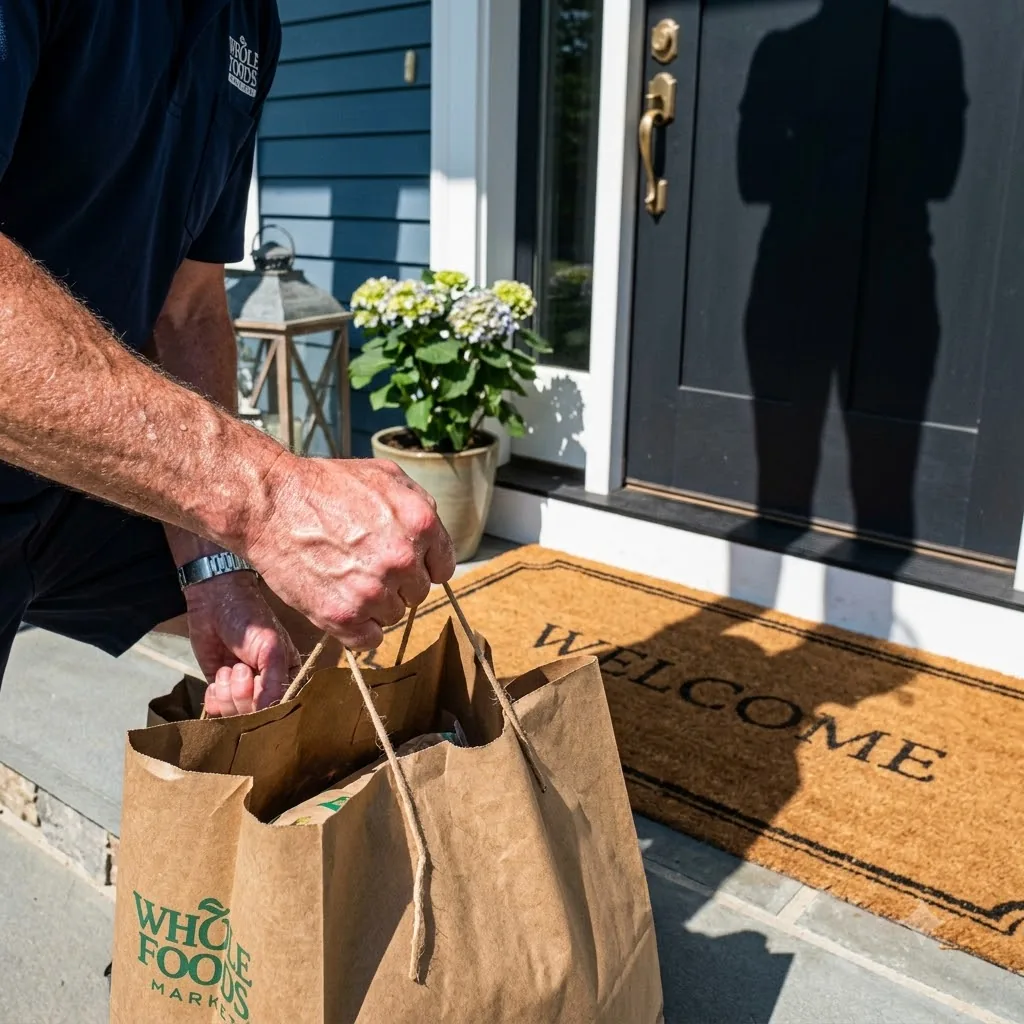
The man had not moved to clean up the spilled groceries. The shattered glass jars and crushed soup cans remained scattered across the immaculate welcome mat. The crisp, white performance polo he wore was ruined, smeared with dark, sweaty handprints and streaks of driveway dirt that cut right across the interlocking silver crest of his private equity firm.
Elias watched the man through the narrowing gap of the ambulance doors. The homeowner was staring blankly at his own manicured hands. The crumpled pharmacy receipt-the long, undeniable ribbon of thermal paper that proved exactly who was responsible for the ransom on Elias’s life-was still clutched tightly in his fingers.
The arrogant bravado was entirely gone. The man’s performative outrage, his loud declarations about protecting his property and his precious margins, had completely evaporated. He looked small, hollowed out, and utterly paralyzed by the terrifying realization of his own complicity. He wasn’t a victim of a drug addict on his lawn. He was the architect of the desperation that had nearly created a corpse on his driveway.
The paramedic reached up and grabbed the heavy metal handles of the ambulance doors.
Elias didn’t look away. He kept his tired, sunken eyes locked on the homeowner as the man slowly raised his head, looking back at the stretcher with an expression of shattered, horrified guilt.
The doors slammed shut with a heavy, final clack, sealing Elias in the dim, expensive confines of the rig, leaving the executive standing alone in the wreckage of his own making.