Story code: ST-001241
Part 2: The Blind
David pressed his thumb against the screen, zooming in on the wet pavement of his own driveway. The resolution was flawless, the focus terrifyingly sharp. He could see the faint scratch on the rear bumper of Sarah’s sedan and the exact way the front left tire compressed against the concrete. The timestamp in the image metadata read 3:14 AM. Less than three hours ago.
Panic, cold and sharp, overrode the dull cramping in his stomach. He backed away from the dispensing robot, his shoulder bumping hard against the wire racks of waiting prescriptions. He hit the call button for Sarah. It rang four times before dropping to voicemail. He dialed again, his breath catching in his throat as the dial tone whined in his ear.
“David?” Her voice was thick with sleep, confused by the early hour.
“Are the doors locked?” he asked, keeping his voice to a harsh, strained whisper. “Did you set the alarm last night?”
“What? Yes. David, it’s six in the morning. What’s going on?”
“Check the garage,” he ordered. The measured, professional tone he used for patient consultations was entirely gone, replaced by a frantic edge. “Just get out of bed and check the interior garage door.”
He listened to the rustle of heavy sheets, the thud of her footsteps on the hardwood, the squeak of the hinges. “It’s locked,” she said, her confusion bleeding into irritation. “The cars are fine. Why are you doing this?”
“Someone sent me a picture of the house. From last night.”
Silence stretched over the line. Then, “Call the police.”
“And tell them what? I got a text of our driveway? They won’t send a squad car for someone standing on a public sidewalk.” He rubbed his forehead, smearing cold sweat across his brow. “Just… don’t go outside today. Keep the alarm on.”
He hung up before she could argue. The heavy steel of the pharmacy’s front security gate began to rattle upward with a deafening screech, signaling 6:00 AM. Maya, his senior technician, ducked under the rising grille, a large iced coffee in one hand and her phone in the other. She didn’t say good morning. She walked straight to her bay, dumped her purse in a locker, and nodded toward the front windows.
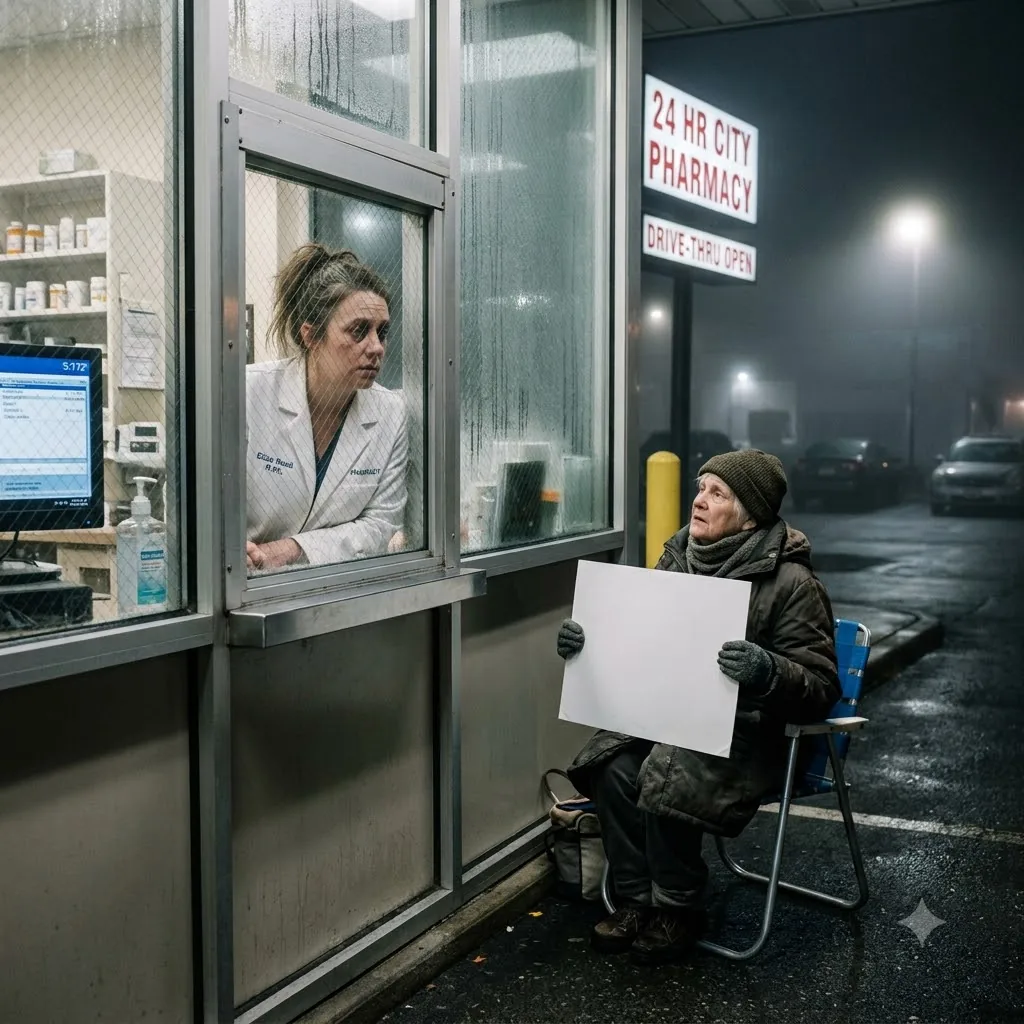
“Statue of Liberty is back,” Maya muttered, pulling on her blue smock. “I swear, if corporate doesn’t get security to trespass her, I’m going to lose my mind. It creeps the customers out.”
“Just ignore her,” David said automatically. It was the district manager’s official directive. *Do not engage. Do not escalate.*
“Hard to ignore a woman holding a giant blank sign like we’re supposed to guess what she wants,” Maya said, logging into the terminal. “Queue is at eighty-two. We’re already behind.”
David moved back to his verification station. The routine usually calmed him. Scan the bottle, count the pills, check the label against the screen, bag it. But his hands were still shaking. He verified a blood pressure medication, a cholesterol statin, a child’s antibiotic. Every time the system flashed a green approval checkmark, he felt a sick twist in his gut.
*The system approved it.* That was his armor. When he filled the prescription for Helen’s son three weeks ago, the state monitoring database had showed no early refills. The software hadn’t flagged the dose. The insurance had paid without requiring a prior authorization. The machine had said yes, so David had put ninety oxycodone pills into an amber vial and handed them through the drive-thru window. He hadn’t asked questions. Questions slowed down the metrics. Questions ruined the wait-time averages.
His phone vibrated in his pocket. The screen lit up through the white fabric of his coat.
He flinched, expecting another photograph of his home. He pulled it out.
DISTRICT 4 ALERT: DRIVE-THRU WAIT TIMES EXCEED 8 MINUTES. CLEAR BOTTLENECK IMMEDIATELY.
He exhaled a shaky breath and shoved the phone back. “Maya, take the window,” he said, gesturing to the drive-thru. “Clear the line.”
For the next hour, the pharmacy was a meat grinder of ringing phones, insurance rejections, and impatient faces. David fell into a frantic rhythm, letting muscle memory take over. But every time the electronic chime of the drive-thru triggered, his eyes darted to the reinforced glass, scanning the drivers. A man in a beat-up truck. A teenager in a heavily tinted sedan. An older woman with an oxygen tank. Any of them could have sent the text.
He glanced toward the front of the store. Beyond the aisles of greeting cards and cosmetics, Helen was still sitting in her folding chair. The sun was fully up now, casting harsh daylight across her blank poster board. Maya was right. The silence of the sign was agonizing. If it said *MURDERER*, he could defend himself. If it said *GREED*, he could blame corporate. But the blank board was a mirror. It forced him to project his own guilt onto its surface.
His phone buzzed twice in rapid succession. Not a corporate shortcode.
It was the unknown number again.
David turned his back to Maya, shielding his phone against his chest. He opened the message thread.
The new message was a screenshot of a document. David recognized the font and the blue corporate header immediately. It was a page from the company’s internal pharmacy operations manual-a proprietary document not available to the public.
A single paragraph was highlighted in bright, digital red.
*Section 4.1.2: Override and Refusal. The automated verification system is a tool for workflow efficiency. It does not replace clinical evaluation. The final decision to dispense any controlled substance rests entirely on the pharmacist’s professional judgment, superseding any automated approval.*
David’s breath hitched. The defense he had repeated to himself a thousand times-the defense he had literally prayed to that morning-was dismantled in a single image. The sender knew he was hiding behind the metrics. The sender had access to the corporate intranet.
Before he could process how that was possible, the third message arrived.
It was another photograph. High-resolution, taken in daylight.
It was Maya. The photo captured her walking from her car to the pharmacy entrance, holding her iced coffee, ducking under the rising security grille. In the background, out of focus but unmistakable, a sliver of the strip mall’s brick pillar was visible.
David stared at the image, his heart hammering violently against his ribs. He analyzed the angle of the shot. It was looking up at Maya from the pavement. It hadn’t been taken from a parked car. It hadn’t been taken by someone walking past.
It had been taken from the folding chair.
David slowly raised his head and looked through the pharmacy cross-aisle, straight through the glass front doors.
Helen was still sitting there. But she wasn’t looking at the empty parking lot anymore. She was looking directly into the pharmacy. Directly at him. And resting neatly on her lap, poking through a perfectly cut hole in the center of the blank poster board, was the dark glass of a telephoto camera lens.