Story code: ST-001250
Part 4: Recurring Revenue
The impact with the freezing asphalt knocked the remaining wind from Wade’s lungs. He rolled onto his side, gasping, his cheek scraping against loose gravel and broken glass. Above him, the heavy pneumatic doors of the Aegis transport slammed shut with a hiss. The massive, matte-grey hauler didn’t even pause. Its electric engine whined, tires crunching over the frost-heaved pavement as it pulled out of the abandoned strip mall parking lot and vanished into the pre-dawn darkness.
Wade lay there for a long time, listening to the silence. The stifling afternoon heat of the courthouse steps was gone, replaced by a bitter, biting 4:00 AM chill that seeped through his torn canvas jacket.
He pushed himself up onto his hands and knees. His wrists were finally free of the plastic zip-ties, but his shoulders screamed in agony with every movement, the joints strained to their absolute limits.
A few yards away, Elaine sat slumped against a concrete parking block. She was trembling, her arms wrapped tightly around her ribs. In the pale, flickering orange light of a dying streetlamp, Wade could see the medical intervention he had bought for four thousand dollars. It was a thick, square patch of synthetic gauze adhered over the jagged cut on her chin. It was stark white, save for a small, black barcode and the Aegis corporate logo printed directly onto the center of the bandage.
Wade sat back on his heels. His right leg felt unnaturally heavy. He reached down, his freezing fingers brushing against the hem of his jeans.
Bolted just above his work boot was a massive, matte-black plastic cuff. It was two inches thick, secured with a seamless, tamper-proof titanium rivet. A tiny LED light on its surface pulsed with a steady, rhythmic green glow.
Wade stared at it. He looked over at Elaine. Her tailored slacks were torn at the knee, and just above her low-heeled shoe, a matching green light pulsed in perfect synchronization with his own.
He reached into his jacket pocket and pulled out his phone. The screen was severely spider-webbed from his violent arrest, but the LCD still glowed. There were no missed calls from his political allies. There were no news alerts about the mass detainment at the courthouse. There was only a single, unread text message from an automated five-digit number.
*Aegis Civil Management: Welcome to the Community Supervision Program.*
*Profile: Harrison, W.*
*Current Balance: $5,382.12 (Includes $4,000 Medical Subrogation, $900 Facility Damage Surcharge).*
*Active Services: GPS Tracking (Tier 1).*
*Daily Hardware Leasing Fee: $35.00. Automatic billing initiated.*
*Warning: Tampering with hardware will result in immediate tactical dispatch and a $1,500 replacement fee.*
Wade slowly lowered the cracked phone. He didn’t feel the burning, righteous anger that had fueled him for the last six months. He didn’t feel the urge to draft a furious post, to rally his Second Amendment supporters, or to march back to the courthouse steps. The anger had been completely hollowed out, replaced by a suffocating, icy dread.
“They didn’t even press charges,” Elaine whispered. Her voice was raspy, wrecked from the screaming and the violence. She didn’t look at him. She was staring blankly at the pulsing green light on her own ankle. “Supervisor Collins just wiped the blood off his face, scanned my retinas, and had the guards drag us out.”
“Why would they press charges?” Wade asked, his voice flat and devoid of emotion. “If they press charges, they have to put us in front of a municipal judge. A judge might dismiss it. A judge might give us community service.”
Elaine slowly raised her head. The bruised circles under her eyes looked like dark caverns in the harsh streetlight. “And they don’t get paid for community service.”
“No,” Wade said, looking down at his cracked screen. “They don’t.”
He thought about Kyle Resnick, the boy who had murdered Elaine’s son. He thought about the yellow override note on Collins’s monitor. *Maintain street-level supervision. Subject generates $1,350 monthly recurring revenue.*
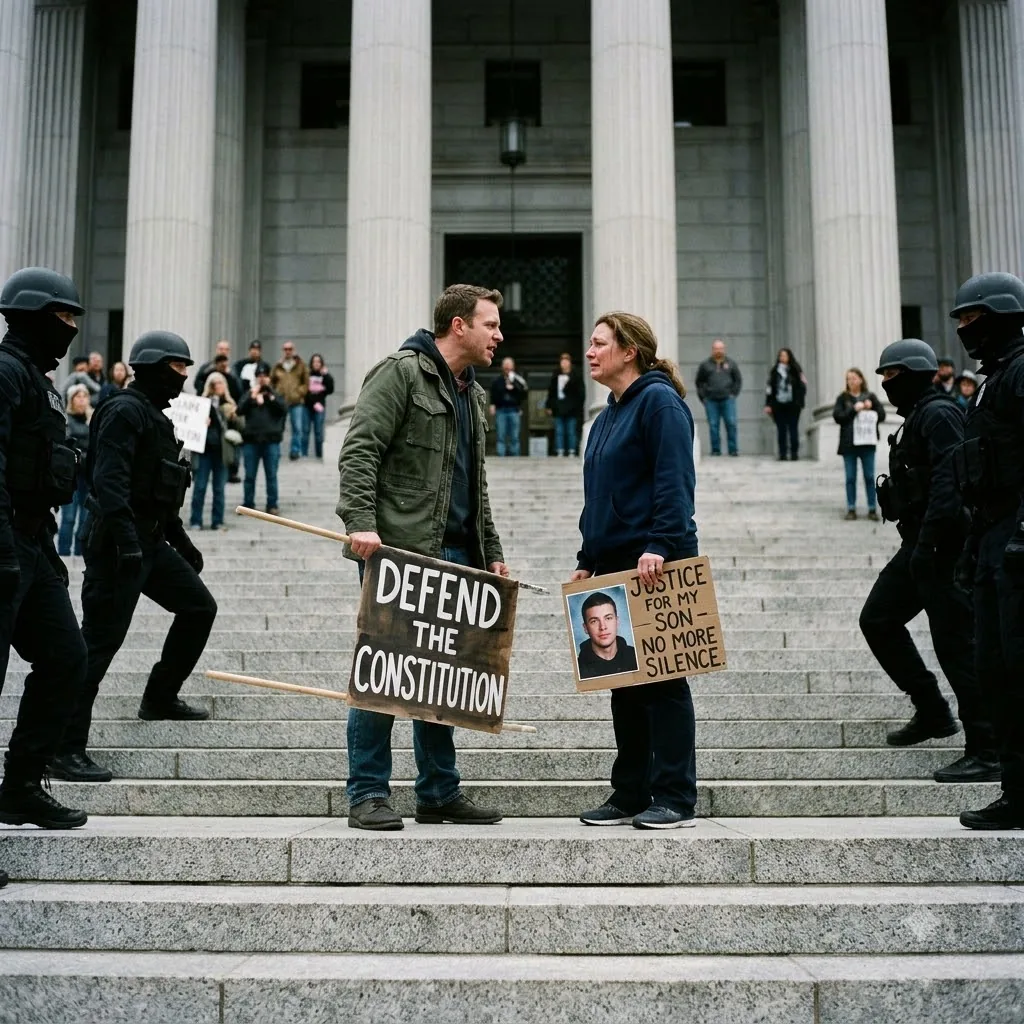
It had never been about justice, or deterrence, or public safety. It had never been about the gun control laws Elaine championed, or the constitutional rights Wade defended. Their entire ideological war-the screaming matches, the fundraising emails, the shattered community, the glossy banners on the courthouse steps-was just a noisy, convenient distraction. It was a smoke screen, keeping them at each other’s throats while the corporate machine quietly slipped its hands into their pockets and chained them to the floor.
They weren’t citizens with opposing viewpoints. They were raw material. They were livestock.
Elaine rested her forehead against her knees. She didn’t cry. There was no energy left for tears. “I paid the city permit fees for that rally,” she said, her voice drifting away into the cold air. “I raised money for six months to stand on those steps.”
“I know,” Wade said softly.
The pulsing green lights on their ankles blinked in the dark, tethering them to the exact same ledger. Wade put his phone back in his pocket, stood up on aching legs, and waited in the freezing parking lot for the sun to rise.