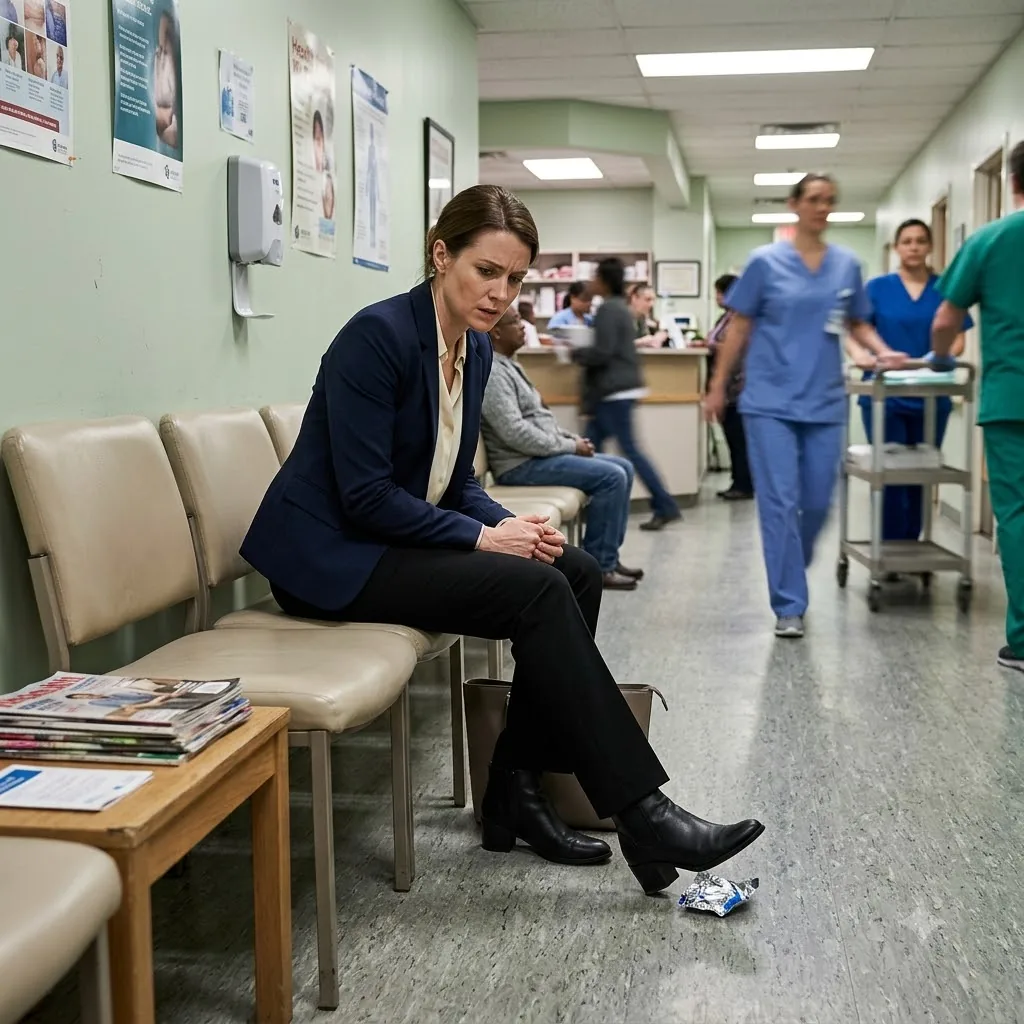
Story code: ST-001251
Part 3: The Tainted Batch
Thorne’s demand hung in the sterile air of his office, heavy and absolute. “Empty your pockets, Chloe.”
Her right hand was still buried in the blazer pocket, her damp palm clamped tightly around the crinkled silver-and-blue foil and a handful of loose change. The sharp, folded edge of the blister pack bit deep into her life line. Four hundred dollars. That was the exact deficit standing between Mark and his Friday immunotherapy infusion. If she took her hand out and revealed the wrapper to the man blocking the only exit, Mark’s trial spot would evaporate. The billing department at Mercy General did not negotiate, and they did not care about apologies.
She forced a laugh, a high and brittle sound that bounced off the framed medical diplomas on Thorne’s wall.
“Dr. Thorne, this is incredibly inappropriate,” Chloe said, her voice vibrating with a feigned, defensive indignation. “You’re upset about Mr. Penhaligon, and I understand that. But listening to an ER resident guess about a piece of foil based purely on the color?”
Thorne did not move from the door. His posture was rigid, his broad shoulders squaring off against her escape. “Take your hand out of your pocket.”
“I have loose change,” she said. She pulled her hand free, opening her trembling fingers to show the quarters and dimes she had blindly scooped up from the waiting room floor. She deliberately left the crumpled foil mashed into the bottom corner of the pocket lining. She dumped the coins onto the edge of his mahogany desk, where they clattered loudly against the polished wood. “See? Change. Now, please, step aside. I need to get back to my territory.”
Thorne remained planted.
Panic flared in Chloe’s chest, hot and blinding. Mark’s pale, exhausted face flashed in her mind’s eye, his shallow breathing echoing in her memory. She could not lose this account. Her corporate training aggressively kicked in-the rigid mandate to pivot, to control the narrative, to handle objections with overwhelming data. If a doctor questioned safety, you drowned them in efficacy.
“You are jumping to conclusions that could permanently damage a vital partnership,” Chloe began, her cadence instantly shifting into the polished, rhythmic hum of her rehearsed sales presentations. “Let’s look at the actual clinical data instead of anecdotal ER panic. In our double-blind studies, the medication demonstrated a ninety-four percent reduction in target symptoms over a six-month period. That is unprecedented in this class of drugs.”
Thorne stared at her, his expression utterly unreadable, his eyes dark under the fluorescent lights.
Chloe stepped forward, her voice growing louder, more frantic as she pointed a shaking finger at the glossy promotional calendar on his wall. “We have a patient retention rate that leads the industry. The absorption profile is steady state, avoiding the peak-and-trough pitfalls of older compounds. You’ve seen the results in your own patients, Dr. Thorne. The safety profile is undeniably robust, backed by three separate longitudinal studies that proved zero correlation with severe neurological events-”
“Stop,” Thorne said quietly.
“The FDA fast-tracked it for a reason!” Chloe pushed on, her heart hammering violently against her ribs, desperate to fill the suffocating silence. “The tolerability is unparalleled. If Penhaligon seized, it was an underlying condition, an off-label drug interaction, anything but our compound. You have to look at the macro-level data, the statistically significant outcomes we’ve published-”
Thorne didn’t yell. He didn’t lunge for her coat to retrieve the evidence. Instead, he stepped away from the door, walked calmly behind his desk, and pulled a small silver key from his scrub pocket. He crouched and unlocked the deep bottom drawer of his filing cabinet.
Chloe’s mouth went bone dry, but the corporate script kept spilling from her lips like water from a burst pipe. “If you put a hard stop on these prescriptions today, you are depriving dozens of patients of a life-changing therapeutic option. The transition protocols alone will cause massive care disruptions across the clinic. We can provide you with the supplemental titration guides, we can fly a medical liaison out here by tomorrow-”
Thorne pulled something heavy from the drawer. He tossed it onto the center of his desk, right over her scattered loose change.
It landed with a dull, crinkling thud.
Chloe’s voice died in her throat.
It was a gallon-sized, clear ziplock bag. Inside was a chaotic, crumpled mound of silver-and-blue foil wrappers. Dozens of them. Some were torn in half, some chewed, some perfectly intact except for the popped blister bubbles in the center. They were exactly like the one currently burning a hole in her right blazer pocket.
“I don’t need your titration guides, Chloe,” Thorne said, his voice dropping to a gravelly, hollow whisper. “And I don’t need the unredacted Phase Three logs anymore. I already know what’s in them.”
Chloe took a trembling step backward. Her eyes were locked on the plastic bag. The overhead lights caught the embossed silver logos on the wrappers, glittering through the plastic like crushed ice.
“Penhaligon is just the first one to collapse in my waiting room,” Thorne continued, placing both hands flat on the desk and leaning forward. “But he’s not the first one in the county. For the last month, Dr. Aris and I have been quietly comparing notes with the medical examiner’s office and two other emergency rooms. We’ve been collecting these from the personal effects of overdose and severe seizure patients across three different districts.”
Chloe shook her head slowly, her breathing shallow and ragged. “No. That’s… that’s impossible. Those could be anything. Generic antacids use similar packaging.”
“They aren’t antacids,” Thorne said. He reached out and tapped the thick plastic of the bag. “We had the residue analyzed by an independent lab in the city. It’s your compound. But what really caught my attention wasn’t the active ingredient. It was the microscopic text printed on the back of every single blister pack in this bag.”
Chloe felt the blood drain from her face. Her right hand twitched involuntarily toward her pocket.
“The lot numbers,” Thorne said, his eyes locking onto hers with a devastating, surgical clarity. “Pharmaceutical companies manufacture millions of these doses, distributed nationwide. But this specific cluster of adverse reactions? They aren’t random. Every single wrapper in this bag shares the same exact alphanumeric sequence. They trace back to a single regional distribution center.”
He took a slow, deliberate step around the desk, closing the distance between them.
“Your lot numbers, Chloe,” Thorne said softly. “Every single seizure, every single overdose we’ve tracked, came from the exact sample boxes you personally placed in our supply closets. You didn’t just sell us a defective drug. You dumped a tainted batch in my county to hit your quarterly quota.”
Chloe backed up until her shoulder blades hit the heavy oak door. The brass handle dug sharply into her spine. The four hundred dollars she desperately needed for Mark’s infusion felt like a sick, twisted joke now. Thorne hadn’t just put the pieces together today; he had been silently building a trap for weeks, waiting for her to make a fatal mistake.
And she had just walked right into it, carrying the final piece of physical evidence in her pocket.
Thorne stood two feet away, looking down at the pocket of her blazer. “So. Are you going to hand over the wrapper you picked up in my waiting room, or do I have the police take it from you when they get here?”