Story code: ST-001243
Part 2: Flesh and Iron
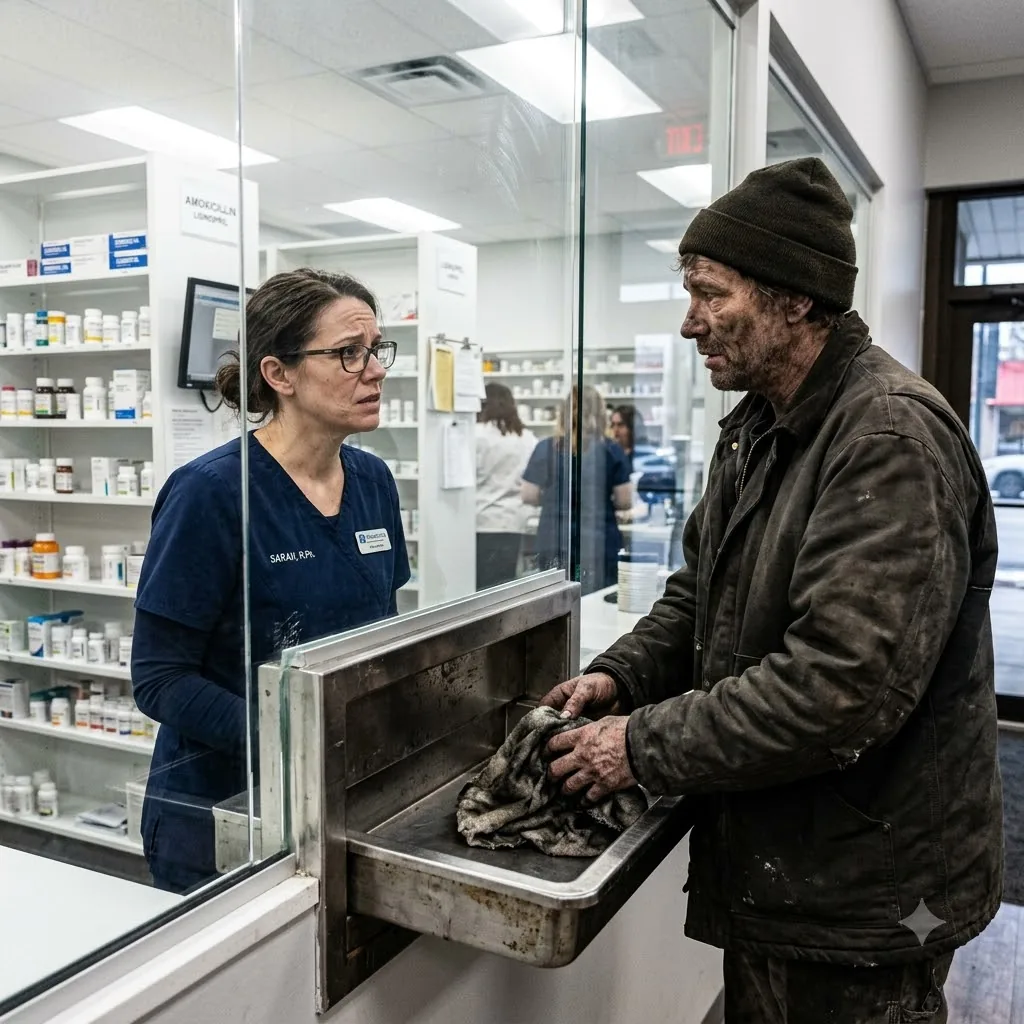
The heavy red canvas fell open layer by layer, peeling back like the petals of a grotesque flower. The heavy scent of copper, old engine oil, and scorched meat pushed through the narrow gap of the transaction tray, hitting David immediately. He stopped breathing. Resting in the center of the rag, cradled in a slurry of melted gas station ice and saturated brown paper towels, were two severed human fingers. The digits were mangled, crushed flat at the joints, and heavily blackened at the torn edges where extreme heat had cauterized the worst of the arterial bleeding.
David’s stomach performed a violent, rolling heave. He stumbled backward, his shoulder blades slamming hard into the rows of neatly alphabetized blood pressure medications behind him. The sterile, fluorescent brightness of the pharmacy suddenly felt suffocating, spinning rapidly around the horrifying visual anchor sitting on the polished steel tray.
Elias did not flinch. His soot-stained face remained locked in a terrifying mask of controlled agony. He leaned closer to the silver microphone. He explained, in a hollow, breathy rattle, that the emergency clinic doctor had managed to tie off the veins and wrap the stump, but their local supply closet was totally empty. They had given him the heavy-duty prescription and told him he had exactly forty-five minutes before the temporary nerve block wore off completely. He was supposed to take the pills, put the severed fingers on ice, and drive out of the fire zone to the regional trauma center to have them reattached.
“It’s wearing off, David,” Elias whispered. The intercom crackled with the sheer proximity of his mouth. “The fire is creeping up my wrist. If the pain hits my chest, my heart is going to give out. The doctor guaranteed it. The shock will stop my heart.”
David’s eyes darted wildly from the gruesome package on the tray to the glowing monitor. The red banner flashed, entirely indifferent to the severed flesh on the counter. DENIED – DISASTER ZONE RISK TIER 4. The algorithm did not see Elias. It did not smell the burnt blood. It only saw a restricted narcotic class and a high-risk perimeter map.
David threw himself forward, his hands shaking violently as he snatched up the pharmacy landline. He dialed the local emergency dispatch directly, bypassing the civilian queue. The receiver emitted a harsh, repeating three-tone error chime. An automated voice informed him that all civilian telecommunication lines in the sector were temporarily suspended to allocate bandwidth for fire and rescue coordination. David slammed the receiver down and hammered his finger against the ‘Emergency Dispense’ button on the screen.
A new pop-up materialized, mocking his desperation. It demanded a secondary Pharmacist-In-Charge biometric fingerprint scan to authorize a Tier 4 override. David was the only staff member in the building. There was no secondary thumb to press against the glass reader.
“Elias, the system wants two pharmacists,” David choked out, the words catching in his dry throat. “I’m alone. The computer physically won’t let me release the inventory tag on that bag. If I hand it to you without a cleared transaction, the RFID sensors at the front doors will trigger a robbery lockdown.”
Elias stared at him through the inch-thick acrylic. The contractor’s skin had turned the dreadful, powdery color of wet cement. Heavy droplets of sweat carved pale tracks through the thick soot on his forehead. He swayed again, his heavy steel-toed boots scraping clumsily against the linoleum. The sheer force of the incoming pain was visibly rewriting his nervous system.
“I’m not dying on the floor because a machine doesn’t know how to read a map,” Elias said, his voice dropping an octave.
With his remaining good hand, Elias reached deep into the heavy, rigid folds of his canvas coat. David’s hand hovered instinctively over the silent alarm button mounted under the counter edge. He prayed Elias wasn’t reaching for a gun. Instead, the contractor pulled out a massive, forged-steel pipe wrench. The tool was easily two feet long, scarred and polished from years of brutal industrial labor.
Elias did not raise the heavy wrench in a striking motion. Instead, he pressed the serrated steel jaws directly against the pristine ballistic glass. The metallic contact produced a sharp, dense clack that echoed loudly in the quiet store.
“David,” Elias said, his breathing now coming in rapid, shallow gasps. “Push the bag through the tray.”
“It won’t fit!” David yelled, genuine panic finally breaking his professional facade. “The gap is barely two inches high! The bottles are too wide. Even if I crush the bag, the security gates will drop the steel shutters over the exits the second you walk through the detectors! You’ll be trapped in here with me!”
Elias closed his eyes. The muscles in his jaw bulged like knotted steel cables. The contractor dragged the heavy teeth of the wrench slowly down the surface of the acrylic barrier. The horrific, high-pitched screech sent a violent shiver down David’s spine.
“Then I guess I have to come back there and take it,” Elias whispered, his eyes snapping open. They were wild, hollow, and utterly disconnected from reason.
Elias took a heavy step backward, adjusting his grip on the massive pipe wrench, raising the heavy iron head up to his shoulder. Above them, a small amber light on the ceiling security camera blinked green. The store’s automated surveillance software had registered the aggressive physical posturing. A calm, synthetic female voice suddenly chimed through the overhead speakers, warning that a disturbance protocol had been initiated and structural lockdown would commence in sixty seconds.
David backed away from the glass, his eyes fixed on the heavy iron tool in Elias’s hand, trapped between the rigid rules of the machine and the lethal desperation of a dying man.