Story code: ST-001292
Part 4: The Weight of the Cross
The cardboard box smelled of dust and damp paper. Elias folded the top flaps down, sealing the entirety of his academic career with a single, screeching strip of cheap packing tape. His office-a shared, windowless bullpen in the basement of the humanities building-was perfectly silent.
His left arm was now a thick, rigid log of white medical bandaging. After the chaos in the Grand Atrium, campus security had unceremoniously escorted him to the curb. He had spent the remaining hours of the night in a crowded county ER waiting room, where an exhausted resident had finally cleaned the infected, blown-out plasma tracks, packed the cratered tissue with antibiotics, and prescribed rest that Elias could not afford.
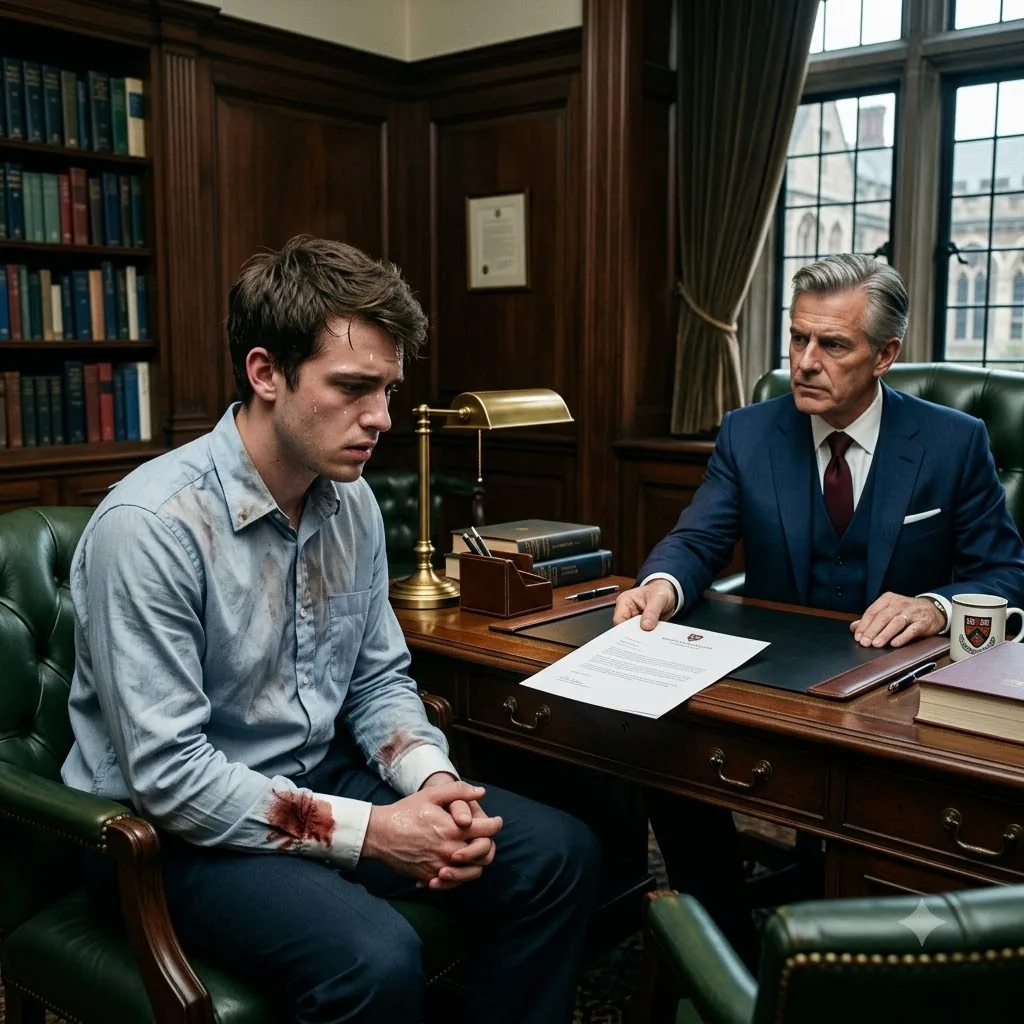
He tucked a battered steel thermos and a stack of ungraded history essays under his right arm. A crisp, heavy-stock white envelope sat conspicuously on his empty desk. He didn’t need to open it to know what it said. Sterling hadn’t even bothered with a face-to-face dismissal. The termination was immediate, citing gross insubordination and biological endangerment. The university’s network had permanently locked him out of his email at 6:00 AM. A second email, sent to the regional academic consortium, ensured he was blacklisted from every institution within a three-hundred-mile radius.
Elias hoisted the box onto his right hip, leaning away from the dull, continuous throbbing of his left arm. The other three adjuncts in the bullpen kept their eyes glued to their glowing monitors. They were terrified. They were all drowning in the same debt, wearing the same thrifted suits, living in the same constant, vibrating fear of the administration. Acknowledging Elias was a risk they simply could not take.
He walked out of the basement and up into the crisp afternoon air.
The walk to the outer parking lots felt infinitely longer than usual. The manicured pathways were lined with imported orchids and perfectly trimmed hedges, purchased with the millions of dollars the board was currently funneling into the Living Waters Aquatic Center. Elias kept his head down, letting the cold wind cut through his thin cotton shirt. He hadn’t bothered to wear a jacket today; the torn, bloody polyester ruin of his only suit coat was currently sitting in a dumpster behind his apartment building.
His 2008 Honda Civic sat alone at the absolute edge of Lot F, its oxidized silver paint peeling on the hood like a severe sunburn. The rear bumper was held on by a lattice of black zip ties, and the front left tire was dangerously bald. Elias unlocked the passenger door with a manual key and shoved the cardboard box onto the cracked leather seat.
He walked around to the driver’s side and slid behind the wheel, the cold, rigid plastic of the steering wheel greeting his right hand. He shut the door, sealing himself inside the quiet, metallic shell.
For a long moment, Elias just sat there, staring at the dust motes dancing in the shafts of sunlight that pierced the dirty windshield.
He did the math in his head. The bright yellow eviction notice taped to his apartment door was an absolute certainty. Friday morning, the sheriff would arrive and change the locks. He had exactly thirty-four dollars and twelve cents in his checking account. His meager credit line was entirely maxed out from the ER copay. He had no job, no prospects, and a physical body that could no longer be farmed for cheap plasma to bridge the gap.
He was entirely, unequivocally ruined.
Elias reached forward and turned the key. The ignition clicked rapidly twice before the starter finally caught, the engine roaring to life with a familiar, rattling hum. He shifted into drive and pulled out of the parking space.
He navigated the winding, tree-lined campus roads, passing the massive limestone buildings that had once represented his entire future. He merged onto the main exit boulevard, stopping at the final red light that separated the university grounds from the sprawling, gray reality of the lower industrial districts.
While he idled at the intersection, Elias looked out through the driver’s side window. Towering over the southern edge of the campus, glowing fiercely even in the fading afternoon light, was the massive neon cross mounted to the side of the newly constructed student recreation center. It was a sterile, blinding white. A beacon of uncompromising purity and mandatory perfection.
Elias stared at the glowing cross. He gripped the steering wheel and waited for the crushing weight of a panic attack to compress his chest. He waited for the absolute despair of homelessness to choke the oxygen from his throat. He waited for the regret to set in.
It didn’t come.
Instead, Elias realized that his lungs were expanding fully for the first time in three years. The suffocating, phantom scent of Provost Sterling’s sharp vetiver cologne was entirely gone. The agonizing, daily terror of hiding his poverty, of wrapping his weeping arm in the dark, of groveling for a three-thousand-dollar lifeline-it had all burned away under the harsh spotlights of the Grand Atrium. He had nothing left to hide, and therefore, they had nothing left to use against him.
The traffic light turned green.
Elias pressed his foot on the accelerator. The old Honda rattled as it crossed the intersection, leaving the pristine iron gates of the university behind. His bank account was empty, his arm was useless, and his apartment would be gone in less than forty-eight hours.
Elias rolled down the window, letting the gritty, exhaust-filled wind of the city rush into the car, and for the first time in his life, he felt completely free.