Story code: ST-001346
Part 2: The Remediation Agreement
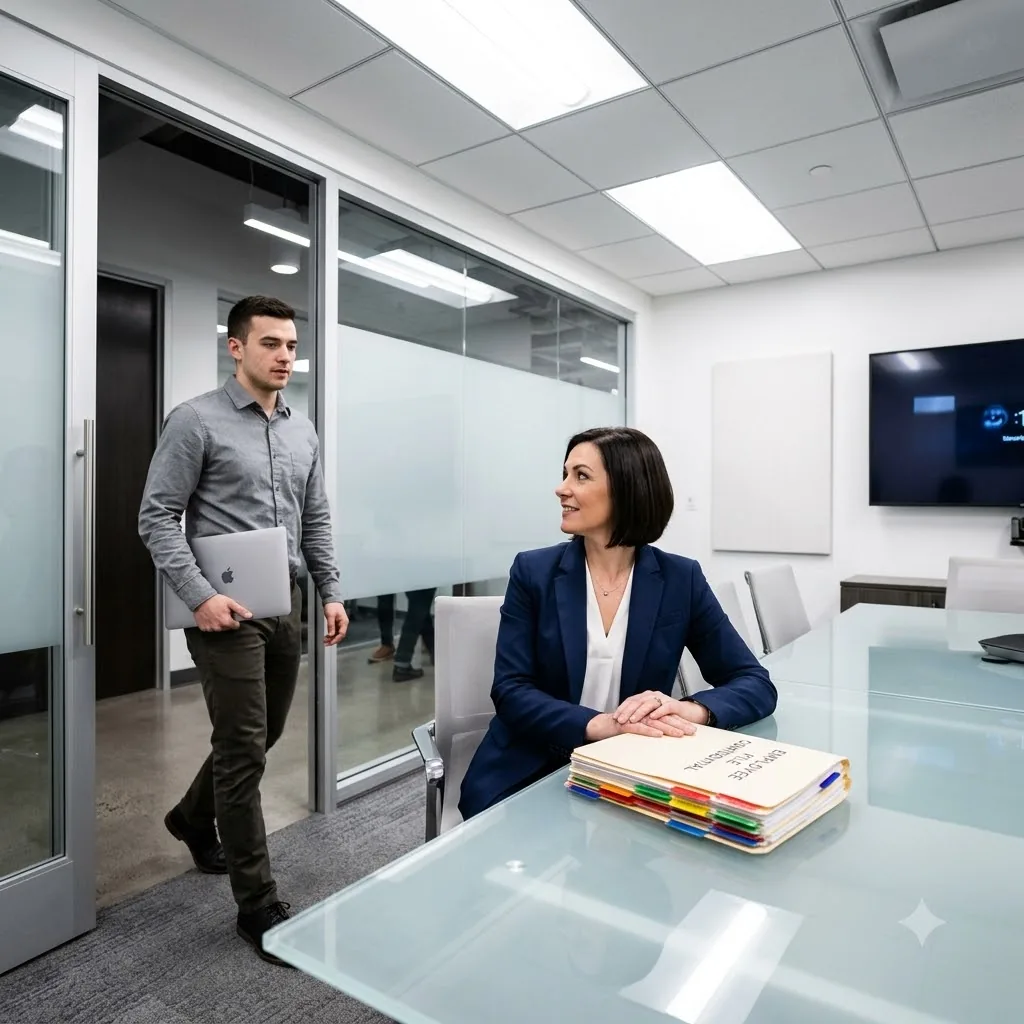
Elias stared at the thick manila folder resting on the frosted glass. The red plastic indicator tabs aligned in a perfectly symmetrical row, exactly a quarter-inch apart. The precision of the physical file heavily contrasted with the complete lack of logic in Brenda’s statement.
“Tier-one security alert,” Elias repeated, testing the syllables. The phrase belonged to the IT infrastructure division, usually reserved for external malware incursions or distributed denial-of-service attacks. It did not apply to a mid-level data analyst cross-referencing public correctional facility contracts with internal billing ledgers. “I believe there is a categorization error. My queries were conducted using my standard employee credentials. The telecom ledgers are hosted on the shared financial drive. There was no security barrier to breach.”
Marcus leaned in, casting a heavy shadow over Elias’s meticulously organized notebook. “The sub-ledger you accessed is restricted, Elias. It is proprietary intellectual property. You bypassed three separate directory protocols to aggregate that data.”
Elias pressed his fingertips against the edge of the glass table, grounding himself against the cold surface. The humming from the fluorescent tubes felt like a swarm of bees trapped inside his left ear canal. He had to tap his right foot against the carpeted floor in a steady, three-beat rhythm to maintain his focus.
“The directory protocols were not bypassed,” Elias explained, prioritizing accuracy over the rising hostility in the room. “They were simply misconfigured. The inmate telecom routing algorithms were directing an additional twenty-two cents per minute into an unindexed ghost account. It is a compounding arithmetic error. I aggregated the data to show you the scale of the glitch. If we do not patch the routing algorithm, the state auditors will eventually detect the mathematical imbalance.”
Brenda and Marcus exchanged a look. It was a micro-expression-a tightening of Marcus’s jaw, a slight lowering of Brenda’s chin-that Elias could not perfectly translate, though he recognized it as non-verbal communication. It felt distinctly coordinated.
“We are well aware of the state auditors, Elias,” Brenda said, her voice remaining locked in that sterile, mechanical cadence. “Which is exactly why your unauthorized intrusion is such a severe liability. You have generated an unsecured, unvetted paper trail regarding a highly sensitive corporate revenue stream.”
“It is not a revenue stream,” Elias corrected, adjusting his wire-rimmed glasses. He pointed to the top page of his notebook, tapping his blue-inked calculation. “It is an overcharge. The inmates are being billed for minutes they are not utilizing. The ghost account is accumulating funds that do not belong to the corporation. It is a mathematical anomaly.”
“It is a proprietary financial structure,” Marcus said. The compliance director’s voice dropped an octave, vibrating in Elias’s chest like a physical threat. “And you have compromised it by downloading the raw data onto your local machine.”
The fluorescent lights flickered, emitting a sharp pop that made Elias flinch. He squeezed his eyes shut for a fraction of a second, his brain struggling to parse Marcus’s terminology. *Proprietary financial structure.* The words tumbled through Elias’s analytical filters, failing to align with any ethical or mathematical framework he understood.
They didn’t see it as a glitch. They saw it as a feature.
A cold, hollow sensation opened in Elias’s stomach, replacing his immediate anxiety with a deep, paralyzing dread. The twenty-two-cent routing error was not an accident. The company had deliberately designed the telecom algorithm to steal from the incarcerated population, hiding the illicit gains in an unindexed ghost account. And he had just handed the architects of the theft a detailed map of his investigation.
“I understand,” Elias said quietly, his voice tight. “The overcharge is intentional.”
Brenda did not confirm or deny the statement. She simply unclasped a silver pen from her clipboard and withdrew a single sheet of heavily watermarked paper from the front pocket of her leather briefcase. She placed it next to the red-tabbed folder.
“We value your analytical skills, Elias,” Brenda said, seamlessly shifting back into her performative corporate warmth. The sudden transition was profoundly jarring. “We want to keep you on the team. We want to get that medical waiver processed so you can have your noise-canceling headphones by Thursday. But we need to close this security incident first.”
She tapped the silver pen against the signature line of the watermarked document.
“This is a standard Non-Disclosure and Remediation Agreement,” Brenda explained. “It simply states that you acknowledge the sensitive nature of the proprietary algorithms, that you will delete all local copies of your audit, and that you understand any external discussion of this proprietary structure violates your employment contract.”
Elias looked at the document. He did not look at the signature line. His eyes automatically scanned the dense paragraphs of legal text, his brain breaking down the syntax and clauses with the same ruthless efficiency he applied to telecom ledgers.
“Sign the remediation agreement, Elias,” Marcus urged, his tone shifting to a patronizing faux-paternalism. “We wipe your machine, we approve the headset, and this all goes away. It’s just corporate housekeeping.”
Elias read the third paragraph. The humming overhead faded entirely into the background as the words on the page snapped into sharp, terrifying focus.
It was not a non-disclosure agreement.
The text explicitly classified his weekend audit as an ‘unauthorized malicious infiltration of secured corporate infrastructure.’ It stated that he had acted independently to manipulate internal billing ledgers. It was a legally binding confession to corporate cyber-sabotage.
If the state auditors ever found the ghost account, this document would serve as absolute proof that Elias had engineered the theft. They were not just sweeping his audit under the rug; they were framing him as the solitary architect of the entire criminal enterprise.
“This document,” Elias whispered, his vocal cords constricting. “Paragraph three asserts that I intentionally altered the routing codes.”
“It is standard boilerplate language for a data breach,” Brenda lied smoothly, not breaking eye contact. “Just sign it, Elias. Or we will be forced to involve the federal authorities regarding your cyber-intrusion.”
Marcus leaned heavily on the glass table, trapping Elias’s notebook beneath his massive forearm.
“You have five minutes to sign, Elias,” Marcus stated. “Or you leave this building in handcuffs.”