Story code: ST-001346
Part 4: The Immutable Ledger
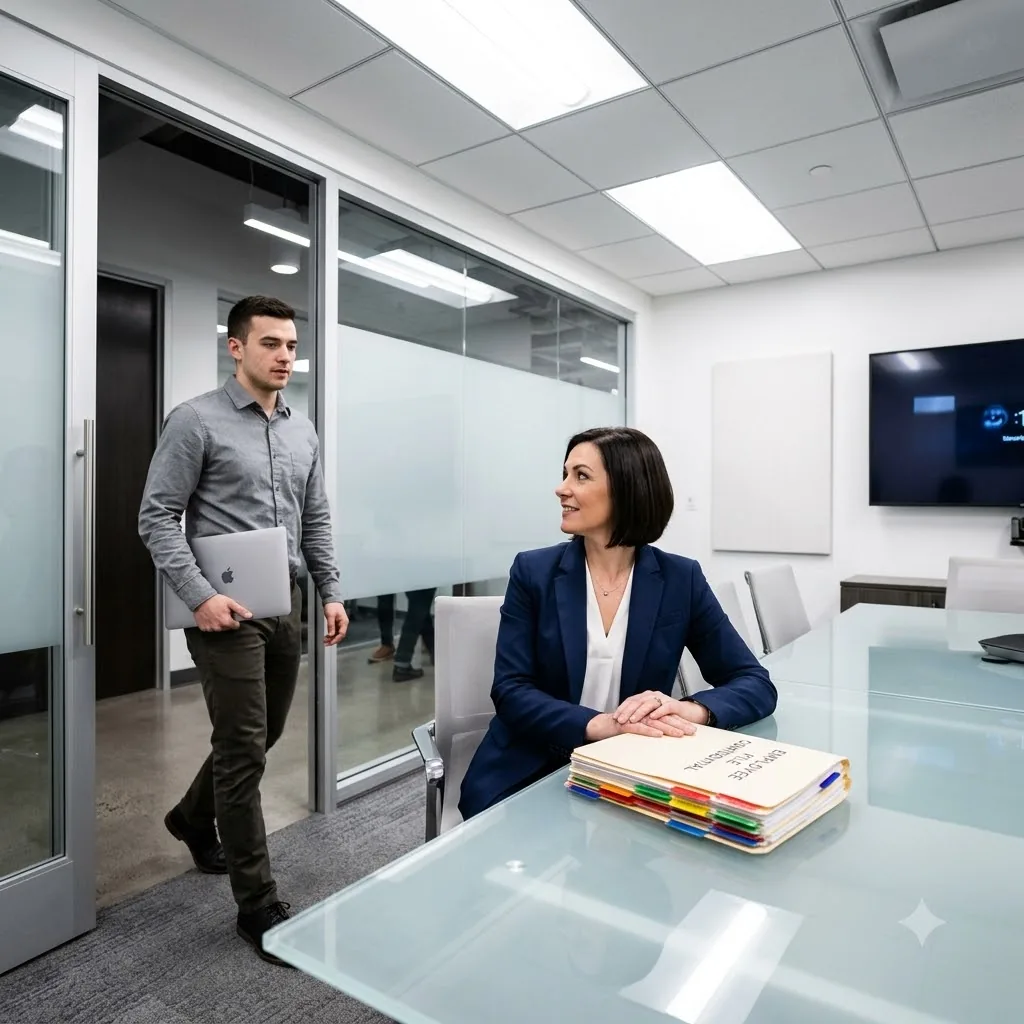
Brenda’s spit was still drying on the frosted glass when Marcus intervened. The compliance director moved with heavy, blunt force, stepping between Elias and the table. He did not yell. His quietness was somehow more oppressive than Brenda’s shrieking.
“Meeting’s over,” Marcus said, his voice a low rumble. “Give me your badge, your company phone, and step away from the table.”
Elias processed the directive. Resistance was mathematically unsound; Marcus outweighed him by at least eighty pounds and possessed a clear propensity for physical intimidation. Elias carefully reached to his belt, unclipped his retractable ID badge, and placed it next to the unsigned Remediation Agreement. He placed his company-issued phone beside it, aligning their edges parallel to the file folder.
He reached for his color-coded notebook.
Marcus’s thick hand clamped down over it. “Company property.”
“That is my personal notebook,” Elias stated, a sharp spike of genuine distress piercing his controlled exterior. The loss of his meticulous handwriting, his prime number sequences, and his routing maps felt like a physical amputation. “I purchased it myself. The ink is my own.”
“It contains proprietary data,” Marcus countered, his grip unyielding. “Walk away, Elias. Now. Before I call building security and have you dragged out.”
Elias looked at the notebook, then at Brenda, who had slumped back into her chair, her chest heaving as she smoothed her silk blouse. The corporate mask was back on, though it fit poorly over her flushed skin. The logic puzzle was over. They had raw power, and he had none.
Elias turned and walked out of Conference Room B. Marcus shadowed him, remaining exactly two paces behind, a silent enforcer ensuring Elias did not deviate toward his cubicle. There would be no gathering of personal effects. No retrieving his ergonomic keyboard or the specific brand of green tea he kept in his desk drawer. He was being purged from the system.
The walk through the sixth-floor bullpen was a sensory nightmare. The collective hum of the fluorescent lights seemed to mock him, but it was the silence of his coworkers that pressed in the hardest. Keyboards stopped clicking. Phones were placed on mute. Dozens of eyes tracked his forced march toward the elevator bank. Elias kept his gaze fixed on the geometric pattern of the carpet tiles, counting the squares to stave off a panic attack. Forty-two squares to the glass doors. Fifty-six to the elevator.
When the heavy glass doors of the lobby sealed shut behind him, the lock engaged with a definitive, electronic click. His network access was officially dead.
Elias stood on the concrete sidewalk, the heavy afternoon heat pressing down on his shoulders. The transition from the sterile, climate-controlled office to the chaotic outdoor environment was jarring. Cars roared past on the adjacent avenue, their engines creating an unpredictable, chaotic wall of noise. He desperately needed the noise-canceling headphones sitting in his online shopping cart.
He walked to his ten-year-old sedan in the far corner of the parking lot, his legs feeling strangely hollow. He unlocked the door but did not get in. He leaned against the sun-baked roof, the hot metal burning through his cotton shirt, and let the financial terror wash over him.
The math of his new reality was brutally unforgiving. His bi-weekly direct deposit was gone. Rent was due in exactly twelve days. His savings account held enough capital to cover baseline physiological needs-shelter, food, utilities-for precisely 2.4 months, provided he immediately canceled all non-essential subscriptions and reverted to a diet of dry goods. The headphones were now an impossible luxury. The ADA accommodation was void. He was an unemployed whistleblower who had just antagonized a twenty-million-dollar fraud ring.
His chest tightened. The sensory overload of the parking lot, combined with the catastrophic collapse of his routine, threatened to completely overwhelm his processing capacity. He needed to anchor himself. He needed a screen, a number, a predictable sequence.
Elias pulled his personal smartphone from his pocket. He unlocked it, intending to check his banking app to verify the exact decimal point of his remaining savings.
As the home screen loaded, a small, green checkmark icon in the notification tray caught his attention.
It was his personal cloud storage application. The notification read: *Sync Complete – 9:14 AM.*
Elias stared at the timestamp. The air in his lungs suddenly went perfectly still.
His meeting with Brenda and Marcus in Conference Room B had been scheduled for 9:15 AM.
The previous night, Elias had set up an automated cron job on his workstation. Because the inmate telecom ledgers were so massive, he had written a script to package his audit trail, the raw state API request logs, and the unredacted routing algorithms, syncing them to his encrypted personal drive. He had initiated the backup to ensure he had the data ready to present on his own device if the conference room projector failed.
Marcus had seized his notebook. The IT department had undoubtedly scorched his workstation the second the meeting began, wiping the local machine and revoking his server credentials. They believed they had successfully contained the blast radius. They believed the only copy of their theft was trapped under Marcus’s hand.
But the sync had finished sixty seconds before Elias walked through the glass doors of the conference room.
Standing in the blistering heat of the parking lot, the roar of the traffic fading into a manageable drone, Elias opened the encrypted folder on his phone. There, resting securely in an off-site server beyond the company’s jurisdiction, was the ghost account. The compounding twenty-two cent overcharges. The timeline that proved the executives had built the algorithm. It was all there, immutably preserved in perfectly balanced columns.
Elias closed his eyes and leaned against his car. He had no job, no reference, and no noise-canceling headphones. The terror of his financial free-fall was absolutely real. But as he gripped his phone, the raw data provided its own kind of armor. The corporation had stripped him of everything, but they had missed the numbers. And the numbers were all he needed.