Story code: ST-001357
Part 2: The Missing Context
The tinny, compressed audio of the tablet’s small speaker shattered the oppressive silence of the hallway. The video, clearly shot vertically from a low angle by a student’s shaking phone, was nauseatingly unstable, but the subjects in the center of the frame were unmistakable.
On the bright screen, Martha saw her own face, distorted by rage and a terrible digital artifacting that made her eyes look entirely black in the poor lighting. She was standing mere inches from the broad chest of Officer Davies, the school resource officer.
“Get away from him!” the digital version of Martha shrieked, her voice cracking in a hysterical pitch she didn’t even recognize as her own. “You’re a sadistic thug, Davies! If you ever lay a hand on one of my students again, I swear to God I will end you! I will destroy your life!”
In the video, Officer Davies simply took a half-step back, raising his large, calloused hands in a gesture of absolute, practiced calm. “Mrs. Gable, I need you to step back and lower your voice,” he said smoothly, looking directly toward the camera lens with the steady, measured gaze of a seasoned professional de-escalating a dangerous threat.
“Don’t you dare tell me to lower my voice after what you just did, you violent piece of trash!” Martha screamed back, her finger jabbing aggressively toward his chest.
The twelve-second clip looped automatically. Henderson didn’t stop it. The digital shrieking played a second time, then a third, echoing off the cinderblock walls of the empty corridor, bouncing against the row of silent lockers.
Martha reached out, her hand trembling violently, and pushed the tablet down so the speaker was muffled against Henderson’s suit jacket. “Phil,” she said, her voice dropping to a desperate, breathless whisper. “Phil, you know that’s not the whole story. You know exactly what happened yesterday afternoon in the cafeteria.”
Henderson took a deliberate step back, breaking physical contact with her hand. “What I know, Martha, is that the superintendent woke me up at four in the morning to tell me our high school is the number one trending topic on social media. I know that the statewide police union has already issued a public statement condemning the hostile, anti-law-enforcement work environment at Harding High.”
“He had his knee on Marcus’s neck!” Martha pleaded, the memory flashing hot and bright behind her eyes. Marcus, a ninety-pound sophomore with severe sensory processing issues, had panicked when a fire alarm malfunctioned. He hadn’t been fighting anyone; he had been covering his ears, rocking back and forth on the linoleum floor. Officer Davies had treated the terrified boy like a hardened criminal resisting arrest, pinning him face-down, grinding his heavy knee into the back of Marcus’s thin neck while the boy choked and thrashed.
Martha had sprinted across the cafeteria and shoved the two-hundred-and-fifty-pound officer off the child. But the viral video didn’t show any of that. The recording started exactly one second after Davies stood up and dusted himself off, framing only Martha’s explosive, terrified, adrenaline-fueled reaction to a child being assaulted.
“The video doesn’t show Marcus,” Martha said, her chest heaving as she struggled to pull air into her lungs. “Davies was hurting him.”
“Marcus’s parents haven’t filed a complaint,” Henderson said, his voice entirely flat, completely devoid of the fourteen years of camaraderie and shared lunches they had built. “Officer Davies has. He’s claiming verbal assault and terroristic threats. The phrase ‘I will end you’ is legally actionable, Martha.”
“It was a figure of speech! I meant his career!”
“It’s a viral sensation,” Henderson countered, finally pressing the side button to lock the tablet screen, plunging them back into the dim lighting of the hall. “The context doesn’t exist anymore. The internet has already decided who the villain is here. And right now, my job is to protect the district from massive civil liability.” He extended his empty hand, palm up. “I need your school ID and your keys.”
Martha stared at his palm, her mind spinning. “My car keys are in my desk. Along with my wallet and my house keys.”
“I’ll have a custodian box up your personal effects and courier them to your home address this afternoon. You cannot enter Room 114. You cannot have access to the district network. You are officially suspended without pay pending the board’s formal review.”
“Phil, please. Let me just get my things.”
“Keys. Now.”
Her hand shook as she reached into her tote bag, unclipped her school lanyard, and dropped it into his waiting hand. The heavy brass keys clinked loudly in the quiet space.
Against her thigh, her phone vibrated in one final, long, agonizing pulse. The metal grew searingly hot for three seconds, burning through the wool of her slacks, and then, mercifully, went completely cold. The battery, drained by the thousands of hate messages pouring in from strangers across the globe in a constant, relentless stream, had finally died. She was entirely cut off.
“I’m going to have to escort you out the front doors,” Henderson said.
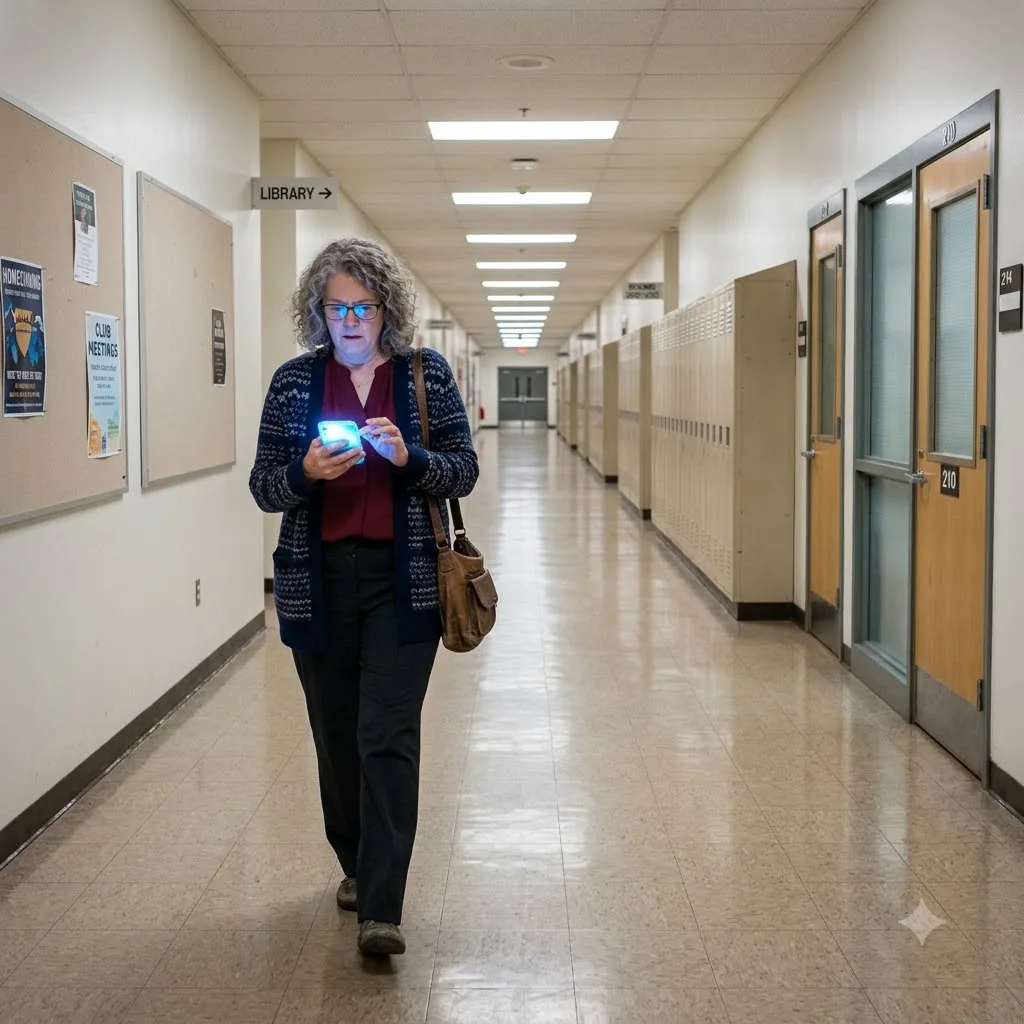
He didn’t walk beside her. He walked two paces behind her, a physical manifestation of her new pariah status. As they moved back down the long, unnaturally quiet corridor, Martha noticed that the classroom doors were no longer completely shut. Small, rectangular faces pressed against the narrow glass panes. Some students held up their phones, silently recording her march back toward the main entrance. Colleagues she had known for over a decade-David, Helen, Sarah from the math department-kept their doors firmly shut, continuing to look away, refusing even to glance out. The suffocating isolation pressed down on her shoulders.
She felt a wave of profound nausea. Without her wallet, she couldn’t call a cab. Without her phone, she couldn’t call her husband. She would have to walk the three miles home.
They reached the main foyer. Through the expansive glass double doors, Martha expected to see the empty visitor parking lot under the gray morning sky. Instead, her breath hitched violently in her throat.
Three large local news vans were parked haphazardly along the curved drop-off lane, their satellite masts fully extended. A massive cluster of reporters, cameramen, and local residents milled around the concrete steps, holding up signs. And standing at the center of the media circus, wearing a perfectly pressed uniform and a fresh, bright white medical sling over his arm, was Officer Davies. He was dabbing at his eyes with a tissue, speaking softly into a cluster of microphones.
Henderson pushed the heavy metal bar of the front door, breaking the seal of the school. “You need to leave district property immediately, Martha,” he said, his voice hard and uncompromising. “Do not speak to the press.”
He shoved the door wide open, forcing her out onto the concrete steps and straight into the blinding glare of a dozen camera flashes.