Story code: ST-001361
Part 2: The Anomaly
Vance’s fingertips brushed the stiff, sharp edge of the manila envelope tucked inside his breast pocket. The subtle friction of his jacket sleeve rustling against his shirt sounded impossibly loud in the quiet of the car.
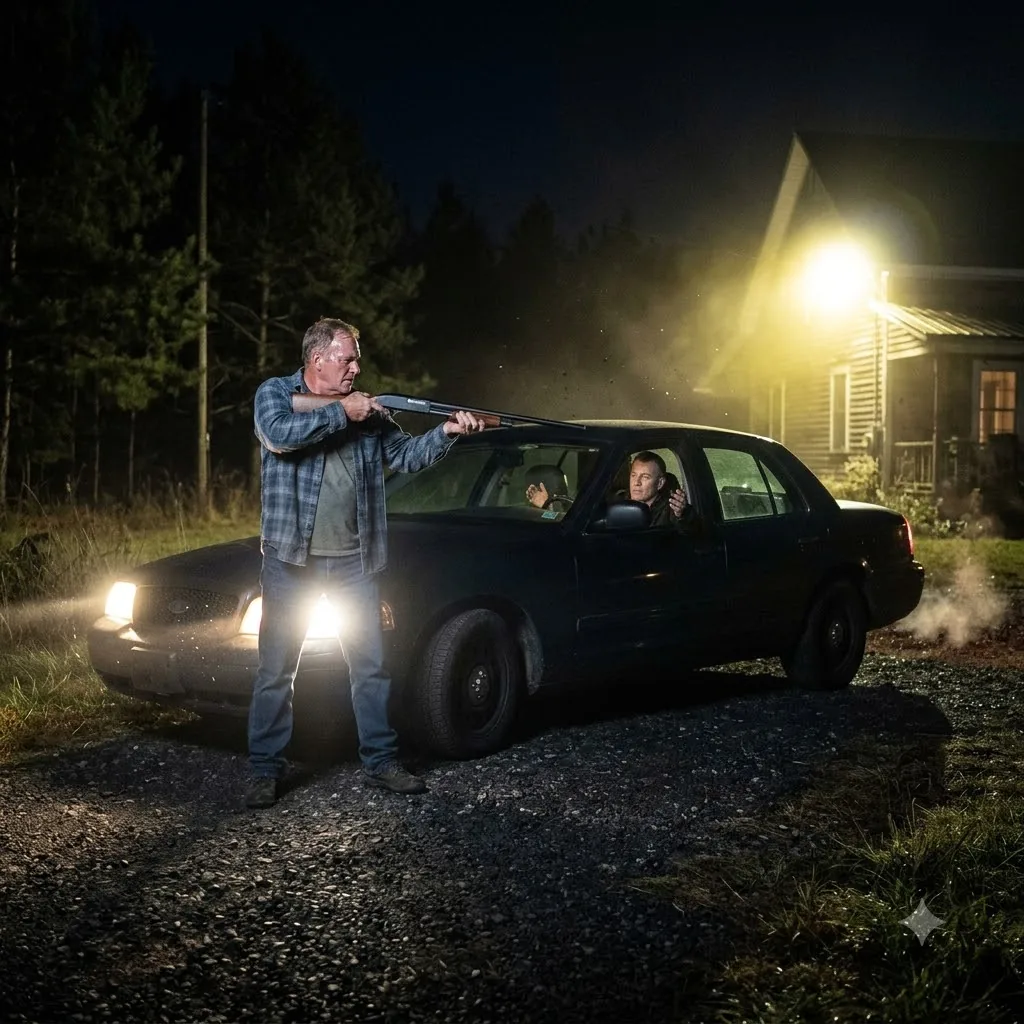
“Four seconds,” the homeowner said, his voice tightening with a sudden, dangerous edge. The shotgun barrel lifted a fraction of an inch, shifting its dark focus from the heavy engine block directly to the center of Vance’s chest. The man’s knuckles were white against the dark walnut stock, his body leaning slightly forward to absorb the impending recoil.
Vance gripped the thick envelope and pulled it free in one smooth, measured motion, keeping his elbow pinned firmly to his side so the movement wouldn’t look like a draw. He held the envelope up to the two-inch gap in the window. The brutal halogen light caught the yellow paper, turning it into a bright, flat square against the shadows.
“It’s just paper,” Vance said, keeping his voice steady and low. “Just paper.”
He turned his wrist and pushed the thick envelope through the narrow gap. It bent slightly against the glass, then slipped out, falling into the dry dust of the driveway with a soft, muted slap.
The homeowner’s eyes flicked to the dirt for a microsecond, then snapped back to the windshield.
“Three seconds,” the man said.
Vance froze. The physical evidence was right there, lying in the dirt five feet from the bottom step of the wooden porch. He had fully expected the homeowner to pause, to at least acknowledge the documents that proved Vance wasn’t a random burglar. Instead, the man treated the envelope like a cheap distraction, a tactical trick to get him to lower the twelve-gauge.
“I am not leaving,” Vance said, staring through the glare. “And you are not going to shoot an unarmed man over a piece of mail.”
“I’m shooting an aggressive trespasser who made a sudden, concealed movement in the dark,” the homeowner corrected, his tone dropping an octave, utterly devoid of his previous bluster. The practiced, wide-stanced posture locked in tighter. “Two.”
The realization hit Vance with the force of a physical blow to the ribs. The old man didn’t just want him gone. He wanted an excuse. The countdown wasn’t a warning; it was a psychological mechanism to justify pulling the trigger. The homeowner was building his ‘stand your ground’ defense in real-time, checking the legal boxes out loud to the empty night so his story would be bulletproof when the sheriff arrived. He was going to claim Vance reached for a weapon.
Vance had to disrupt the script, and he had less than a second to do it.
He slammed his palm against the gear shift, knocking the heavy sedan into park. The transmission clunked loudly. Before the man could register the sound, Vance grabbed the door handle, yanked it, and kicked the heavy car door open with his left boot.
“One!” the homeowner yelled, his shoulder tensing.
Vance threw his hands in the air, stepping out of the vehicle and into the blinding, unforgiving cone of the porch light. The heat of the halogen bulb hit his face instantly, baking the sweat on his forehead. The shotgun tracked him flawlessly, the twin muzzles hovering inches from his face in his mind’s eye, though they were still thirty feet away.
“My hands are empty!” Vance shouted, keeping his fingers splayed wide and stepping completely away from the concealment of the car door. The night air was thick and stagnant. The chirping of the crickets had been completely silenced by the metallic slam of the car door. “I am out of the vehicle. I am completely unarmed. You shoot me now, it is not self-defense. It’s murder, and there is no way you can spin it to a jury.”
The homeowner stood perfectly still on the porch. The barrel of the shotgun did not dip, but the deafening roar of a blast did not come. The silence stretched out, heavy and suffocating. A massive moth fluttered erratically through the beam of light, casting giant, twitching shadows across the peeling white paint of the house’s siding.
“Pick it up,” the homeowner finally commanded, his voice little more than a harsh rasp.
Vance kept his hands raised level with his ears. “You want me to reach for the ground while you have a gun pointed at my head?”
“Pick up the damn envelope and open it. Keep it in the light where I can see your hands. No sudden jerks.”
Vance slowly lowered his arms. He didn’t bend his knees; instead, he hinged awkwardly at the waist, keeping his face turned upward toward the man on the porch to maintain eye contact. He pinched the corner of the manila envelope and straightened up smoothly. The dry dust on the paper left a gritty residue on the pad of his thumb.
“Open it,” the man repeated, the gun stock still welded to his cheek.
Vance slid his index finger under the flap, tearing the adhesive strip with a loud rip. He reached inside and pulled out a single 8×10 photograph printed on heavy glossy stock. He let the empty envelope fall away into the darkness at his feet.
“Turn it around,” the homeowner instructed.
Vance flipped the photograph so it faced the porch. It was an aerial thermal imaging scan of the property, taken by a commercial drone three nights ago. The farmhouse was a bright orange square in the center of the frame. But fifty yards behind the house, at the edge of the tree line where the property supposedly ended in a muddy swamp, there was a massive, glowing red rectangular anomaly buried beneath the earth. A massive heat signature that had no business being there, perfectly geometric and undeniably artificial.
“The county assessment office doesn’t use thermal imaging,” Vance said, his voice carrying clearly across the thirty feet of dirt. “But my employers do. They know what’s buried out by the tree line. They know it’s venting heat. And they know it wasn’t there six months ago.”
The homeowner stared at the glossy photo. The harsh light bounced off the surface, but the bright red rectangle was unmistakable even from a distance.
Vance watched the man’s eyes shift from the photograph to Vance’s face. He expected the man’s shoulders to slump. He expected the realization that his secret was out to drain the fight out of him. That was how the psychology of these encounters usually worked. Once the leverage was exposed, the posturing ended, and the bartering began.
Instead, the homeowner’s jaw tightened until the muscles bulged. The barrel of the shotgun, which had drifted a fraction of an inch off center, locked back onto Vance’s chest with renewed rigidity.
“You should have stayed in the car,” the older man whispered. The words barely carried over the humming of the idling engine, but the absolute lack of emotion in them made the sweat on Vance’s spine turn ice cold.
The homeowner wasn’t afraid of being exposed to the county over a zoning violation or a tax dispute. The man hadn’t been defending his property from a random trespasser at all. He had been guarding the anomaly. And by proving he knew exactly what was buried in the swamp, Vance hadn’t forced a negotiation-he had just upgraded himself from a nuisance to a direct, existential threat.
The man shifted his thumb, and the distinct, metallic click of the shotgun’s safety disengaging echoed across the dirt driveway.