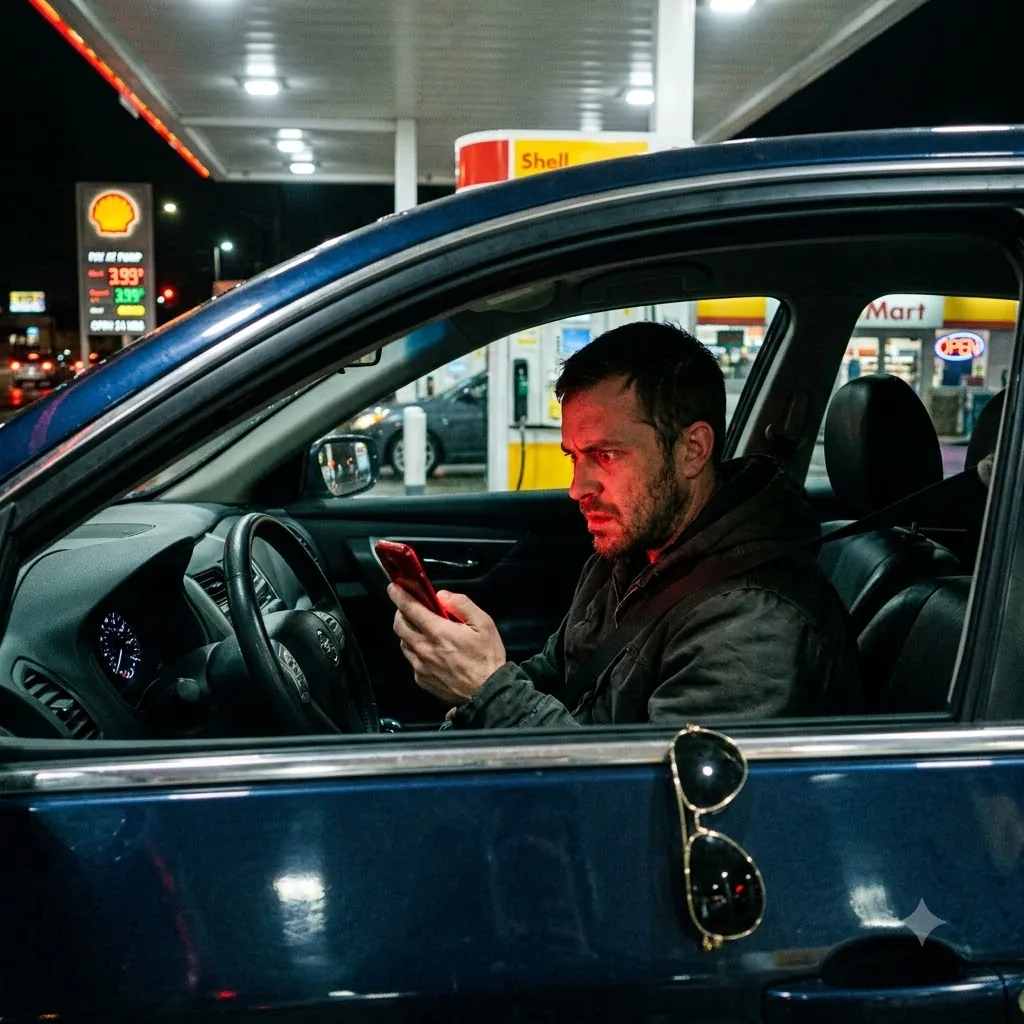
Story code: ST-001364
Part 3: The Contradiction
The freezing wind hit Marcus like a physical wall, stealing the breath from his lungs as he sprinted down the icy pavement. His boots slipped on the sleet-slicked concrete, his legs pumping with the desperate, frantic energy of a trapped animal. Behind him, the heavy brass doors of The Mariner banged open.
“Hey! Stop right there!” the security guard bellowed.
Marcus didn’t stop. He made it to the corner, the salt and slush soaking through his jeans, his thumb still clamped over the gold hinge of the Tom Ford sunglasses. The faint, high-pitched wail of police sirens drifted over the harbor, echoing through the canyon of glass and steel financial buildings.
He skidded to a halt by a towering snowbank. He looked down at the expensive frames in his hand. His chest heaved, pulling in jagged lungfuls of frozen air.
If he kept running, he was a thief. If the police caught him three blocks away, hiding in an alley with a thousand-dollar pair of designer sunglasses in his pocket, there would be no explanation, no defense, no chance. The human algorithm of the criminal justice system would process him just as swiftly and brutally as the ride-share app had. He would be a Black man in a worn denim jacket caught fleeing a high-end restaurant with stolen property. He wouldn’t just miss his midnight rent payment; he would be locked in a holding cell while his landlord’s automated system initiated his family’s eviction.
He couldn’t outrun a digital accusation. He could only break it.
Marcus closed his eyes, his breathing slowing. The frantic heat of panic began to drain away, replaced by a deep, hollow calm. It was the absolute clarity of a man who had already lost everything.
He turned around.
The security guard was fifty yards down the sidewalk, jogging heavily, one hand keying a shoulder radio. When he saw Marcus stop and turn back, the guard slowed to a cautious walk, his posture tensing for a fight.
Marcus didn’t raise his fists. Instead, he lifted the sunglasses by the temples, holding them out delicately between his thumb and forefinger, perfectly visible in the amber glow of the streetlights. He walked at a steady, measured pace directly toward the guard.
“I am returning her property,” Marcus said. His voice was entirely stripped of the begging, frantic desperation he had carried into the restaurant the first time.
The guard frowned, stepping sideways to block the path. “The police are two minutes out, buddy. Don’t make this harder.”
“I’m going to put these on her table,” Marcus said, his eyes locking onto the guard’s. “I am not running. I am not fighting. I am giving them back.”
Marcus didn’t wait for permission. He stepped around the bewildered guard and pushed his way back through the heavy brass revolving doors.
The lavender-scented heat of The Mariner washed over him again, but this time, he didn’t feel suffocated. The dining room was still buzzing with the adrenaline of his previous exit. Waiters were clustered near the hostess stand, whispering furiously. At the curved leather booth in the back, the woman in the cashmere sweater was leaning against one of her male companions, clutching a fresh cloth napkin, playing the role of a traumatized victim who had just narrowly escaped a madman.
When Marcus stepped onto the main dining room floor, the whispers died instantly. The silence ripped across the restaurant like a shockwave.
Silver-watch man saw him first. He stood up, knocking his chair back with a loud clatter against the mahogany floor. “He’s back! Get security in here!”
Marcus ignored him. He ignored the maître d’ rushing forward. He ignored the eyes of fifty wealthy patrons burning into his frayed jacket. He walked with slow, deliberate steps, navigating the sea of white tablecloths until he stood at the edge of the booth.
The woman shrank back, her dark eyes widening in genuine shock. She had expected him to vanish into the gutter. She had counted on it.
Marcus didn’t raise his voice, but in the dead silence of the dining room, his words carried effortlessly to every surrounding table. He reached out and placed the Tom Ford sunglasses gently onto the center of the pristine white tablecloth. The heavy gold frames made a soft, final click against the ceramic base of a candle.
“Here are your sunglasses,” Marcus said smoothly, his tone as professional and flat as if he were confirming a GPS route. “You left them wedged in my backseat, Cynthia.”
The silver-watch man frowned, glancing between them. “Cynthia? Her name is Eleanor.”
Marcus kept his eyes locked on the woman. “Her passenger profile says Cynthia. And at four twenty-two this afternoon, ‘Cynthia’ reported me to the platform for severe driver intoxication. You lied to the algorithm to secure a fourteen-dollar refund because I took a mandatory detour on I-95.”
“Shut up,” Eleanor hissed, glancing nervously at the tables around them. The wealthy patrons were no longer looking at Marcus with fear; they were looking at Eleanor with intense, scrutinizing curiosity.
“Your fourteen-dollar refund permanently deactivated my account,” Marcus continued, projecting his voice. He wasn’t talking to her anymore; he was dismantling her in front of her audience. “It froze my entire ledger. I have a family. My rent is due at midnight, and my money is trapped in the system because you threw a tantrum. You didn’t just try to get me fired, ma’am. You took my family’s rent money.”
“That’s enough,” silver-watch man said, though he didn’t move forward to intervene. He looked down at Eleanor, his brow furrowed. “Eleanor, what is he talking about? Did you report this guy?”
“He was dangerous!” Eleanor snapped, her face flushing a deep, mottled red. The pristine, untouchable aura she had worn earlier was entirely gone. The judgment of her peers was suffocating her, and she lashed out violently to save face. “He is a scammer! He didn’t know where he was going! He was deliberately creeping along, trying to rack up the time on the meter!”
Marcus didn’t interrupt. He just let her talk.
“He’s a menace!” she yelled, her voice pitching up into an uncontrolled shriek. “He was driving ten miles an hour on the interstate! He was going way too slow to even merge into traffic! He was crawling!”
The echo of her outburst bounced off the mahogany walls, followed by a heavy, suffocating silence.
Marcus stood perfectly still. He looked at the silver-watch man, then at the maître d’, and finally back to Eleanor.
“Ten miles an hour?” Marcus asked calmly. “Crawling?”
“Yes!” she spat, pointing a manicured finger at his chest. “Too slow to even merge!”
“Five minutes ago, you told this entire restaurant I was swerving wildly all over the interstate,” Marcus said, his voice low but razor-sharp. “Now I was creeping along at ten miles an hour?”
Eleanor opened her mouth, but no sound came out.
“Furthermore,” Marcus said, leaning forward just an inch, “who reports a driver for going ten miles an hour too slow to merge… and categorizes it as severe alcohol intoxication?”
The color drained entirely from Eleanor’s face. She looked at her friends. The man with the silver watch slowly pulled his hand away from the back of her chair, his expression hardening into cold disgust. The maître d’ took a distinct half-step backward, suddenly very interested in the ceiling.
Outside, the flashing blue and red lights of a police cruiser washed over the frost-covered front windows of The Mariner, casting long, shifting shadows across the dining room floor. Eleanor stared at the sunglasses sitting on the tablecloth, her mouth opening and closing in the silence, utterly unable to construct a single word of defense.